After there has been a bushfire in the forests around here, and in fact in many parts of Australia, there are a number of fungi that are triggered to send up fruiting bodies. One of these is Laccocephalum mylittae (formerly Polyporus mylittae), known in early colonial times as Blackfellow’s bread. This is because it was eaten by the Aboriginal people and it has a sclerotium with a texture rather like grains of cereal pressed together. When sliced it is dense like pumpernickel. This fungus may well have been consumed as a food for tens of millenia. It is widespread across the country.
The fungus spends most of its existance feeding on fallen or buried logs. From this woody matter it transports material to a large underground sclerotium which slowly grows in size. It is reported to grow to as large as 600 mm diameter, but the ones I have seen have been about the size of a football. The sclerotium is heavy, with an estimated relative density of 1.1. This growth may go on for 30 years or more, until there is a fire to trigger off the cycle. The sclerotium rapidly sends forth a fruiting body which is apparent at the surface of the ground within a couple of days of the fire. These are commonly seen along side fallen logs. In my part of the world it occurs in Karri forest. The mushroom is fairly non-descript at first, eventually becoming more defined as it consumes the sclerotium over a period of about a month.
Here is a young mushroom with the sclerotium attached. The mushroom is white, whereas the sclerotium has a dark brown skin covering it.
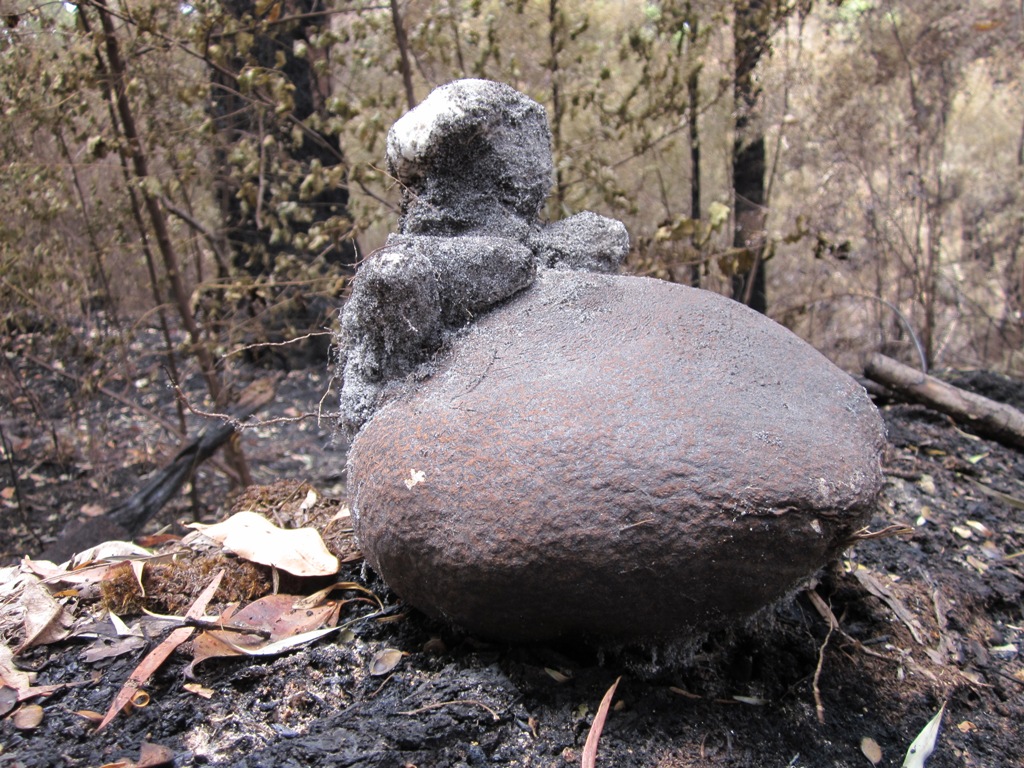
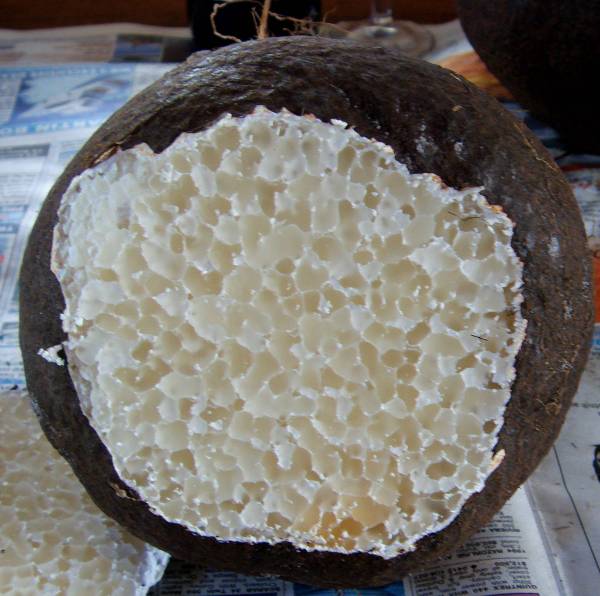
One can easily imagine that the Aboriginal people would have swept through areas they had burned a couple of days earlier to harvest the scelorotiums, which can be quite numerous. Being dense, they provide a significant food source and they do not appear to decay rapidly. They can be crumbled up and dried out into something resembling a cereal grain. Whether the Aboriginal people did this is probably unknown. The picture below shows the scerotium cut open to reveal the inner texture.

It is entirely possible that this fungus could be cultivated like any other wood rotter. I have a specimen that I will attempt to clone if I have the time and inclination. It might make an interesting addition to our native food cuisine. I would describe the taste as bland, but a friend found it to be quite pleasant. It would lend itself to some creative cooking. Apparently, it has significant nutritional value.
The mature specimen is shown below. It can be seen that the mushroom has grown, while the sclerotium has become depleted.



The spores of this species are shown in the image below. These measurements were done using the software called Piximetre. I am still mastering this software, the instructions of which are written in French, but I think this captures the main features. The average spore size is 9.4*4.3 microns. More detailed statistics are shown. These spores were stained with Melzer’s so judging by the image they do not appear to be amyloid. The measurement shown in blue is from my microscope software which was calibrated with an etched slide. The image is taken at 40X without oil.

The structure of the pore surface is shown in this image. The spaces on the scale are 1mm.

The pore depth is slightly greater than 2 mm.

March 2025
The gelatinous mass that makes up the bulk of the sclerotium is an interesting material. It occurs as distinct pieces that have white thread-like material between them. The whole mass can be broken up into individual grains manually with some effort. I had thought that this material might contain starch, but when tested with Melzer’s reagent (which contains iodine) it did not produce a blue colour, indicating that starch was not present. Disintegrating some in a blender with some water produced a slightly cloudy liquid. When tested with alkaline copper sulfate (Biuret test) the liquid did not produce a purple colour, so no readily soluble proteins are present.
Boiling it in water has little effect. Frying it does not produce a Maillard reaction. Raw, it has a very slight sour taste and a firm texture and while not completely unpleasant, it is not something one would choose to eat unless there was nothing else available. It does not seem to take on flavours if cooked with other things. The major feature is the firm gelatinous texture. I found that mixing the grains with some sweet fruit syrup made it palatable but not exciting.
It is easy to think that this mushroom might be native to Australia, given the association with the indigenous people, but in fact it occurs in other places, particularly in China where it has been used in traditional medicine as an anthelmintic (anti-parasite drug). The mycelium has been produced in submerged culture and the active ingredient isolated. It is a metalloprotease that acts on some of the proteins in the parasites. This class of compounds is common in fungi, and the toxin from Chlorophyllum molybdites is a metalloprotease.
Considering that this sclerotium can remain in the soil for decades, it is perhaps not surprising that it might have some defence against insects that might seek to attack it. In my part of the world, termites are ubiquitous and they attack the karri timber that grows in the same area as the mushroom, but the sclerotia are untouched. Similarly, worms are common but they don’t eat the sclerotium. The fungus has been incorporated in some pet deworming formulations.
After chopping some of the sclerotium up in a blender during one of my experiments, I cast the excess material onto the lawn outside. A couple of days later I noticed some magpies pecking at it. I am not sure what attracted them but they seemed to think it was worth eating. I guess it may have sorted out any parasite problems they might have. I also guess this might be useful for treating chickens too. I think that birds are equipped with chitinase enzymes that might be required to digest this material. Which makes me wonder how the human digestive system handles this stuff.

In a 1977 paper titled “The edibility and possible zoochory of the fungus Polyporus mylittae” Nigel Sinnot mentions some taste tests on a batch of sclerotia that were dug up by a tractor. The conclusions were much like mine. He also mentions that on various occasions, for example as mentioned by Cleland, pieces of fresh sclerotium have been buried and kept moist in which case a fruiting body developed. (This is also known to occur with the sclerotia of Polyporus tuberaster, according to David Arora. ) He suggests that this ability to form fruiting bodies from fragments of the sclerotium may confer some advantage to the organism. He further suggests that wombats might be part of this picture, though this would not be the case here in Western Australia.
Examination of the structure of the fruiting body suggests that it is in fact the result of the fusing of a number of primordia into a single structure. This is illustrated in the image below. Note that the fertile surface runs right down to the soil interface. The section on the right is completely separate from the rest of the mushroom until it fuses at the top. This would tie in with the observation that pieces of sclerotium can be form fruiting bodies on their own.

Sinnot quotes J. H. Willis who doubted that the fungus ever fruited under ‘natural’ conditions. This differs from the mushroom Fomitopsis hartmannii (formerly Laccocephalum hartmannii) which sometimes makes an appearance on mushroom forums as growing from apparently undisturbed ground.
In a recently published book The Fungi of Kangaroo Island and Beyond, by the Pamela and David Catcheside, the authors show a fruiting body developing on an agar plate. I have little doubt that it could be cultivated in much the same manner as Morchella species and induced to form sclerotia.
A question that naturally arises is whether the fruiting body can be eaten. There seems to be no mention of this anywhere. I think that it would be rather a tough meal for the naturally occurring mushroom. It might prove more tender in cultivation. I taste-tested a small piece and it didn’t have any pronounced taste, though I thought I could detect a slight ‘soapy’ taste.
13 May 2025
Today I came upon a quote from George Augustus Robinson, Protector of Aborigines in Tasmania. It is in Tim Flannery’s book “The Explorers, p150. On 25 October 1891 he was travelling with a group of people from the Big River tribe. He says
“In our way the natives showed me a dead tree where there was native bread growing. I saw no signs of it myself; they smelt the wood and said that the plant was a long way in the ground. “
This account differs from what I have previously read, where they are reported to have poked into the ground with a stick and smelt that. Robinson’s account makes much more sense. It is entirely possible that the wood which is infected with the fungus would have a distinctive smell. Once this smell is detected in the wood, it is a matter of poking the ground to locate the sclerotium.
On the previous page he also says;
One of the native women, Sall, found a bulbous plant call by the white people ‘native bread’, which they gave to me as a present. From these accounts is seems that the sclerotia were in some abundance and that the natives were adept at locating them.
It would be an interesting exercise to see if a dog could be used to sniff them out by locating infected wood.
Le Loup said,
February 4, 2011 @ 10:23 pm
A great post, excellent. Thank you.
I will add a link to your blog on my blog. Looking foreward to more posts like this one.
Regards, Le Loup.
A Woodsrunner’s Diary.
Gorges Smythe said,
February 5, 2011 @ 12:23 am
Very interesting! Something like that should feed several folks!
bexytea said,
February 14, 2011 @ 7:44 am
Polyporos is also used in Chinese herbal medicine to nourish the digestion, promote urination and calm the spirit. I wonder if the local Aboriginal people used it for the same thing…
Yves said,
April 20, 2012 @ 7:41 am
I found one of these when I was a child, in the hills a around Lorne in Victoria. Strangest thing I’ve ever seen. For 20 years I’ve been trying to discover what exactly it was I found. Thanks for the answer!
morrie2 said,
April 22, 2012 @ 12:22 pm
Pleased to be of service, Yves 🙂
forestfungi said,
May 17, 2012 @ 2:18 am
Great site! Have you tried growing it?
I would love to have a go-do you have a culture available?
I’ve been looking for this fungus for years…
Cheers,
Will
forestfungi said,
May 17, 2012 @ 2:23 am
Wow, great find-I’ve been looking for it for ages.
Have you cloned it?
Would you have any to share? I’ve got a flow hood…
Cheers,
morrie2 said,
May 25, 2012 @ 9:49 am
Hi,
I don’t have a culture unfortunately, just a dried sample. I think it would be a simple matter to culture it though. And I think it has potential as a commercial crop. I am sure I can find it again in the right circumstances. It is just a matter of getting in quickly after a fire. I burn off fairly regularly..
My other business interests have robbed me of the time to keep up with culturing things these days. I don’t have a flow hood but have good success with quite basic methods that I have adapted to suit my situation.
I will let you know if I find some more and manage to get it cultured.
Cheers
Morrie
will said,
May 27, 2012 @ 1:29 am
Thanks Morrie,
I hope they call you soon! I get that feeling with some fungi and plants as well.
I used to just culture using a glove box-very successful, but a bit awkward and slow compared to my free flow hood. Now I feel a bit spoilt, culturing is so easy.
If ever you want to trade edible cultures, let me know.
Cheers,
Will
The place of fungi in Aboriginal economic practices | JanNews Blog said,
April 12, 2014 @ 6:44 pm
[…] Port Phillip and central Victoria (Melbourne: Melbourne Museum Publishing) Tall trees and mushrooms http://morrie2.wordpress.com/2011/02/04/polyporus-mylittae-an-ancient-edible/ Tisdall, H T (1886) Fungi of north Gippsland. Part II. The Victorian Naturalist 3: 106–109 […]
morrie2 said,
April 12, 2014 @ 8:19 pm
Interesting. So it would appear that they could detect the fungus from the smell of the log that is the host. Next time I see it, I will investigate the smell of the log. Someone did mention to me a strong smell where these were growing, but I did not detect it.
I think that the article is a little harsh in its judgment. The words quoted (one can easily imagine…) do not imply that the country was burned for the purpose of harvesting the fungus, but that it would have been a by product of burning, which is exactly what the author goes on to say. Interesting that the size is described as being like a large turnip. The ones that I have seen were much larger than any turnip that I have ever grown or seen.
It is good to get some definite references to the consumption of this fungus, as J H Willis suggests that the use of it by Aboriginal people is debatable.
It may be that the Aboriginal people could detect the fungus from the smell of the wood, but a single reference to this in an otherwise bewildered set of observations is hardly enough to hang your hat on. The possibility arises in my mind that the logs might be initially identified by the emergence of the fruiting bodies after a fire and exploited in subsequent years. The apparently small size of the fungus would support this view. Logs may well have been marked or simply remembered. There is no supporting evidence presented about the smell of the wood or any indication that the author has been able to duplicate the detection methods of the Aborigines.
Lastly, it might have been courteous of the author to discuss the matter before announcing his derisive misinterpretation of my words at a conference.
Karl Stevens said,
December 21, 2015 @ 10:55 am
Thanks for posting this. I know people here in Tassie who ate this fungus ‘bread’ when it was bought home by a farmer who found them in paddocks or the bush. After reading Mycellium Running by Stamets I’m sure it could be cultivated. This fungi also appears to be unique to Australia.
morrie2 said,
December 22, 2015 @ 3:22 am
Hi Karl,
I have no doubt that this mushroom could be cultivated too. It is a simple matter to take a culture from a live specimen and several people I know have cultures that I have provided them.
Getting it to form sclerotia might be a little more challenging and the ones that you find in the wild have probably been there for many decades.
This fungus (note singular form of the word) is not unique to Australia and in fact it is part of Chinese traditional medicine. The Chinese have grown the mycelium in submerged culture to produce desirable medicinal compounds.
Cheers,
Morrie
Simon Jones said,
June 27, 2024 @ 6:22 am
Hi,
I am attempting to start a truffle growing venture focusing only on native Australian species of truffles hosted on eucalypts native to Ballarat.
Research indicates no successful truffle production mating of European/French black or white truffles with eucalypts.
We are therefore building a business model based on marketing the Australian native truffle known in research as “Blackfella’s Bread”, or “Native Bead”.
Can you refer me to anyone who has a specialist knowledge or has previously looked into this opportunity.
PS I do not compare native truffles with European truffles, that’s like comparing kangaroo meat with lamb. But an honest and ethical branding could be a new marketing opportunity.
Please contact or refer your specialist to:
Simon Jones
Ph 0448 007 167
email: simonj@sjc.com.au
If you do not have anyone to refer me to, please respond anyway and feel free to offer your insights into this venture (positive or otherwise).
Thanks in advance,
Regards,
Simon Jones
morrie2 said,
April 30, 2025 @ 3:14 am
Hi Simon,
Apologies for the delay in replying. You could probably grow Laccocephalum using techniques similar to those used for Morchella species. They are not mycorrhizal and do not require a tree host. But since they are completely tasteless, I suggest that it would be a waste of time. See the last additions to my page on these.
Cheers,
M