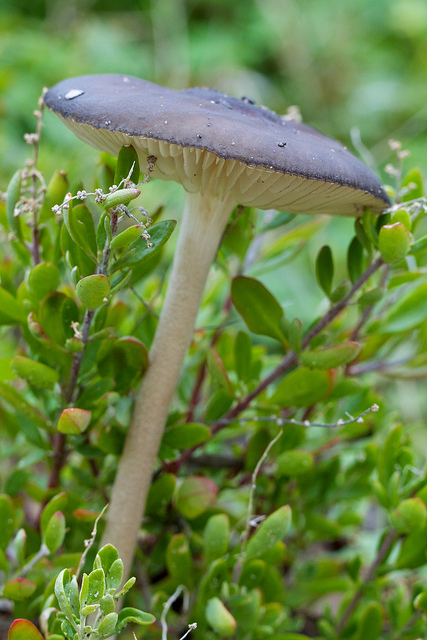
There is not a lot of information around on the fungi eaten by indigenous people in Australia before the arrival of Europeans. One of the few references on the topic is by James Drummond who arrived in the Swan River Colony in the year it was founded, 1829.

He was a botanist and a keen observer and recorder of the local flora as well as the diet of the original inhabitants. The following is a snippet from a letter he wrote to the Perth Enquirer in May 1842.

I have often wondered if it might be possible to identify the blue staining bolete that he describes as Woorda. There are many blue staining boletes in Western Australia and I know of several that people have eaten but none of them fit the description he gives. I had long suspected that it might be a Gyroporus since members of that genus are eaten elsewhere on the globe and with one exception they appear to all be edible.
A paper published in 2019 gives us some some useful information about Gyroporus in Australia. It is titled “Three New Species of Gyroporus (Boletales, Basidiomycota) from Australia”. In it is a description of Gyroporus occidentalis with an explanation that it is the only rapidly blue staining member of the genus from WA.
I was fortunate enough to spot one of these on a friend’s property this year and it is shown in the following video and photographs. It is recorded as growing from sandy soil (well, that’s most of the coastal plain!) and it’s range includes Perth. I think that there is a some chance that this is Woorda but see below for further possibilities.


Some of the features of this mushroom match the description in the paper closely. The cap is described as “dry, floccose to matted woolly to heavily appressed tomentose, yellow-white to yellow buff to dirty yellow, cyanescent, with slightly extended margin”. This close-up of the cap surface seems to match that description. I couldn’t see that the cap margin was extended though.

The pores are yellow and cyanescent and approximately 0.3mm in diameter with a typically pentagonal outline.

Anther interesting aspect of this is the name Woorda. Of course transcriptions of language are subject to errors and interpretations and so forth but the records of Daisy Bates provide for some interesting reading. These are available in digital form here. The many words recorded as meaning mushroom are provided on the site as a map. shown below. It triggers the question of whether the diversity of names matches the diversity of species that were part of the diet.
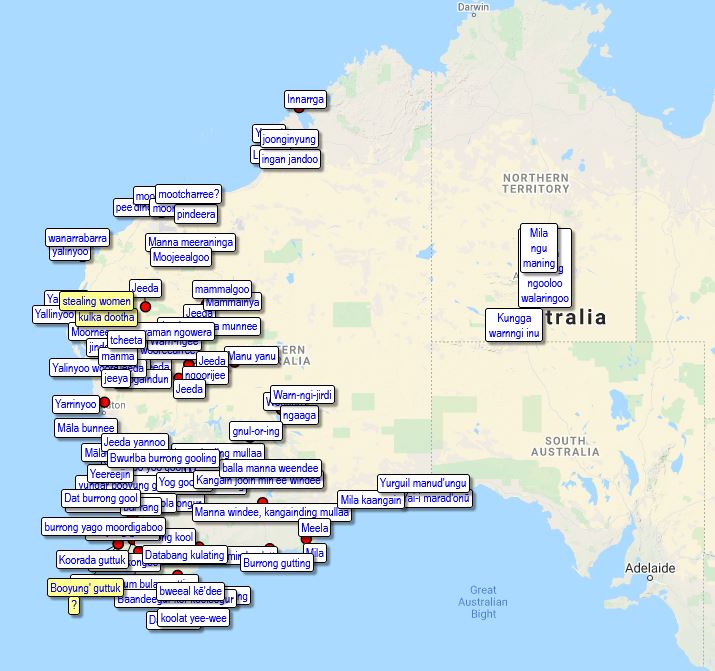
The term Woorda appears in a dictionary of Balardong Noongar language as meaning fungus. It is difficult to know if this is a generic word or refers to the specific fungus that Drummond mentions. He does seem to infer that it is specific. It is notable that, at the time he wrote to the Enquirer, he had been farming at Toodjay (Duidgee) which is in Balardong country. That would imply that the range of the fungus includes Balardong country. I am not sure if Gyroporus occidentalis extends out this far but it will be interesting to find out.

The situation is complicated by the fact that there are other, rather similar looking blue staining boletes within Balardong country. One of these is documented by Doug Sawkins in his excellent record of the fungi of Foxes Lair at Narrogin. His very large blue staining bolete is similar in some ways to Gyroporus occidentalis but it lacks the chambered stem and has red tones where it has been attacked but insects. It matches one of Daisy Bates’ records of Woorda meaning ‘large mushroom’.
It is interesting to note that there is another record of the consumption of blue-staining boletes, in this case from Gippsland in Victoria It was made by the Silesian naturalist Lothar Becker who visited Australia in two trips in the period 1849-1865. This record is reported in a paper by May and Darragh in Historical Records of Australian Science, 2019, 30, 130-137, titled “The significance of mycological contributions by Lother Becker”.. A snippet from this is reproduced below.

Note Feb 2025. The existence of ChatGPT makes the reading and translation of Becker’s text, which can be downloaded in it’s original form, much simpler. Here is the translation of this provided by the AI.
“The natives are said to consume a large quantity of mushrooms, especially those that do not require cooking and are consumed in their raw state. From this group, however, I have encountered only Agaricus bullugur and Boletus aboriginum in Gippsland. The latter turns blue when pressed, as is common when its inner part comes into contact with air.
He then goes on to say:
The natives of Pantelleria, Lampedusa, and Linosa are not familiar with the prejudice that exists in most regions of Germany, where all blue-spotted mushrooms are considered poisonous. It is, however, known that in Germany, especially among the Slavic population, more or less strongly blue-tinged mushrooms are consumed, such as B. rufus, luridus, lupinus, radicans, subtomentosus, variegatus, and badius. Boletus luridus is sold at the Prague and Vienna markets, B. radicans was once seen at the Breslau market, and B. variegatus and subtomentosus, like B. badius, possess the mentioned characteristic to a lesser degree, and sometimes not at all, yet still appear in large quantities at the Breslau market. According to a colonist, on whose testimony I place little value, a certain mushroom in Van Diemen’s Land is considered poisonous.”
Once again there is no information to identify this mushroom and there are many boletes that share this blue-staining property. I am not sure if there are any species that are common to Gippsland and Western Australia. We can rule out Phlebopus from Drummond’s comments and in any case they don’t always display blue staining. From time to time people report eating blue-staining mushrooms from various locations in Australia but sadly there is scant information regarding the actual identity of them. In some cases they have been eaten by people of European origin who have perhaps mistaken them for species from their home region. In one case in Western Australia consumption is recorded in a YouTube video and it was on the basis that boletes are generally non-toxic. This assumption has some statistical support but it remains the case that one of the few cases of fatal mushroom poisoning in Australia was from consumption of a bolete.
His comment about the report of a poisonous mushroom in Tasmania is interesting.
30 Jan 2025
Some progress!! Yay!!
Today I was going through a list of edible Australian fungi published by D. McAlpine in 1895. One of the species mentioned by him is Boletus alliciens. I had never heard of this so I did some investigation and found a description of a specimen that Drummond sent to Miles Berkeley. The description was published in the London Journal of Botany, V4, 1845, p50. It reads as follows:
Boletus alliciens, Berk.; pileo glabro luteo viscoso; carne fracta caerulea; stipite subtiliter tomentoso deorsum incrassato; non reticulato; tubulis flavis irregularibus adnexis. — Drumm. n. 156.
On the ground, called by the natives Woorda.
Pileus 2½ inches across, convex, fleshy, smooth, slimy, yellow. — Stem 1¾ inch high, ½-1 inch thick, minutely tomentose, not in the least reticulated. Pores yellow, irregular, adnexed, so that the cavity of those nearest to the stem is exposed. Spores pale, oblong. Distinguished at once by its slimy surface and changeable flesh. — It is much esteemed by the natives as an article of food.
The epithet ‘alliciens’ apparently means something like ‘attractive’, most likely alluding to its use as food.
This name is still current, so we actually have the name and a working description of the mushroom. My problem now is trying to match this with something that I have seen in the field and get a picture of it.
There are images from Queensland that purport to be Boletus alliciens but they have dark red caps and even red staining in one case and there is no mention of them being sticky. The identification seems to have come from a description by Watling rather than the original. I am trying to track that down. It also seems somewhat unlikely that this species would occur in Queensland, given the description of the occurrence in WA.
The late Roger Hilton did a survey of the Drummond Collection at Kew and he makes the following note in Nuytsia, V4, No3.
“Boletus alliciens Berk., Lond. J. Bot. 4:50 (1845); Decade 4/34.
Current name: As above.
Notes: Drummond states that this was one of the species eaten by aborigines and went (with other species?) under the name “woorda”. There is neither specimen nor catalogue number at Kew. The description is inadequate to equate it with any of the many boletes collected since.”
He tentatively questions whether that name might be applied to other edible species but there is no evidence for that from what Drummond writes – he is quite specific. Other fungi listed in lexicons have specific descriptions too. Some contemporary images by indigenous publications purport to show Woorda, but my enquiries have come to nothing and my experience is that this is probably incorrect nomenclature.
It is notable that Hilton does not attempt to match the species with anything collected since. Given his extensive experience with WA fungi, this is not encouraging. It is also somewhat surprising that something that was apparently common enough to be noted by Drummond does not seem to match any of the common species seen today. The only species that I commonly see that has a yellow slimy cap is Tylopilus phaseolisporus, but that species does not feature a blue staining reaction.
Somewhere in the back of my memory is a report, possibly by Lothar Becker of the Aboriginal women in Victoria collecting a mushroom that closely resembled Boletus luteus (=Suillus luteus). If my memory served me well they would skewer them with a stick as a means of collecting them. It is tempting to conclude that this mushroom may have had the slimy cap referred to by Drummond.
Found the reference from Lothar Becker:
“A Boletus, which scarcely differs from our B. luteus, is consumed raw by the women; Agaricus campestris L., the champignon, which occurs here as a variety, has already established itself at many places where horse breeding takes place, but it is not used by the Aborigines, who are still unacquainted with its properties. “
That note was in reference to the Wide Bay region of Queensland. Cooke also mentions edible boletes from Queensland, one of which he calls Boletus badius and says that the flesh turns blue near the tubes.
Note 17 August 2025
I have seen the word ‘Woort’ used as the name of a mushroom in various lexicons. I had wondered if this might be a variation of ‘Woorda’. This seems likely, given the following comment by Wilf Douglas in his 1996 book ‘ Illustrated dictionary of the South-West Aboriginal language’
“In the South-west language there are no words which change their meaning if spelt with a D instead of a b. Likewise, no words change meaning if t is used instead of d.”
I will mention also here that there is a green mushroom mentioned in a couple of places. I have often wondered what this might be. One thought was Amanita (austro)viridis, but given the description of this by Miller as having a stale, unpleasant taste and being localised to Two Peoples Bay nature reserve, this seems unlikely.

![IMG_0717[1]](https://i0.wp.com/morrie2.com/wp-content/uploads/2016/05/img_07171.jpg?resize=459%2C614&ssl=1)