The Hedgehog Mushroom – Hydnum ‘repandum’

One very common mushroom throughout the SW of WA is a species commonly known as Hydnum repandum. It differs from normal mushrooms in that it has spines instead of gills or pores.

It can be found in open marri/jarrah forest in hills around Perth, but down here I find it most frequently in association with tea-tree (Taxandria) scrub on my property. Like the Chantarelle, it grows in rings.

It is a relatively long lasting mushroom, not prone to insect attack or rot. Though small, it is not hard to pick enough for a meal or two in half an hour if you are in the right area.

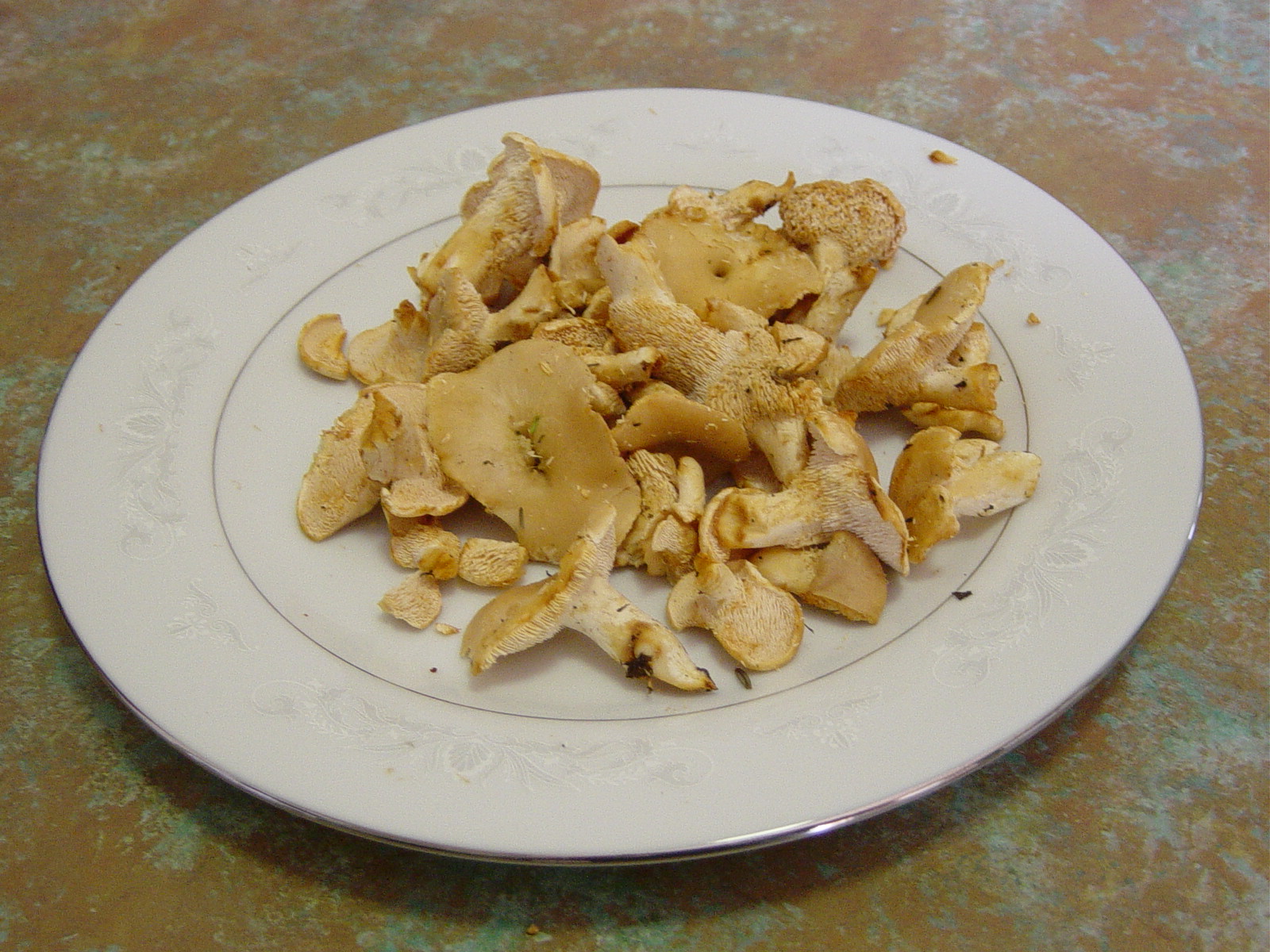
Here is a plateful that I picked one day.
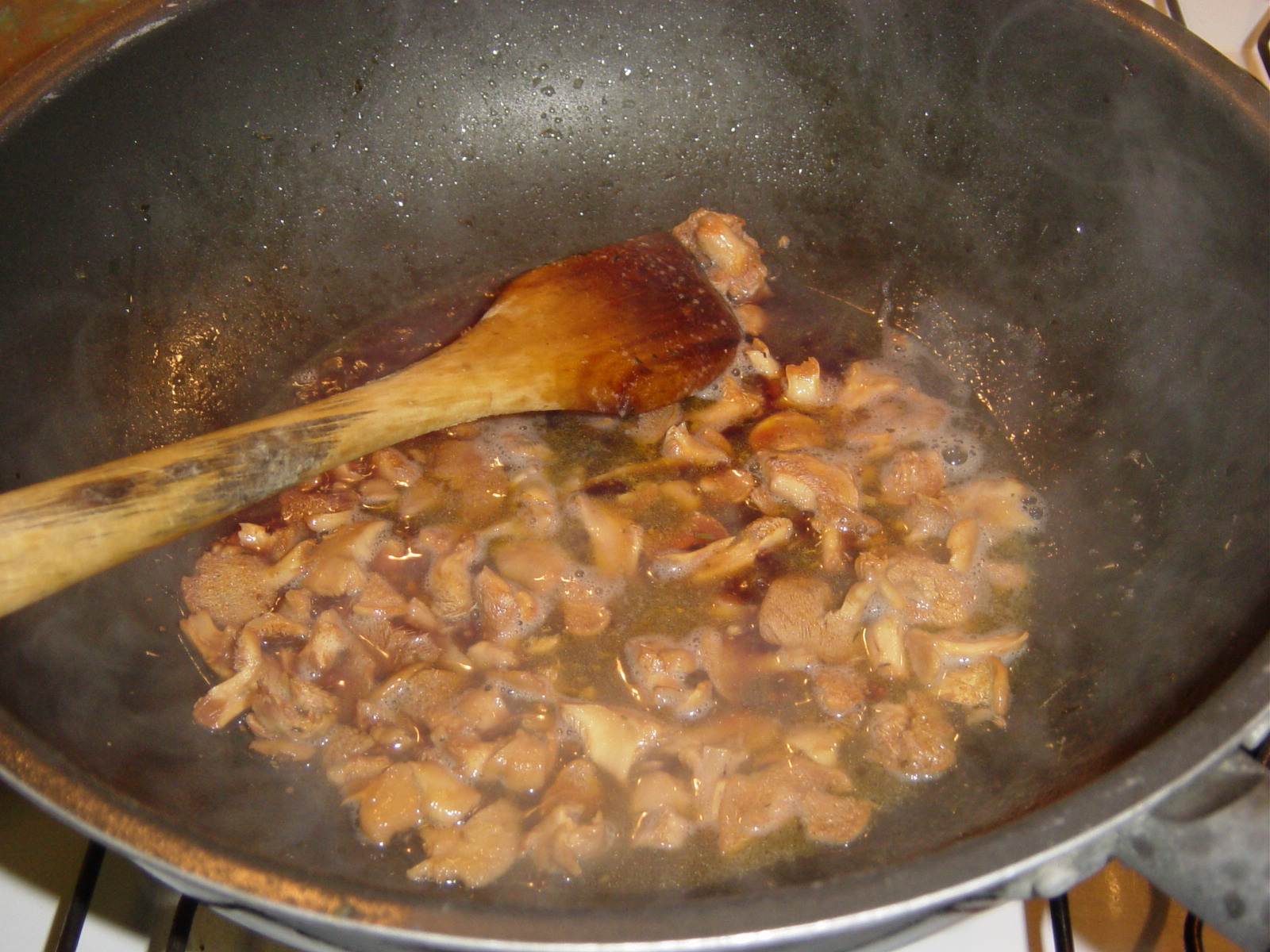
A favourite dish I make with these involves putting them into a pan with some chicken stock and red wine and reducing the volume to about half. Then chicken can be added, along with vegetables and some cream to finish.

A close-up of the mushroom is shown below, but the colour leaves something to be desired.   I will try to get a better one this season.
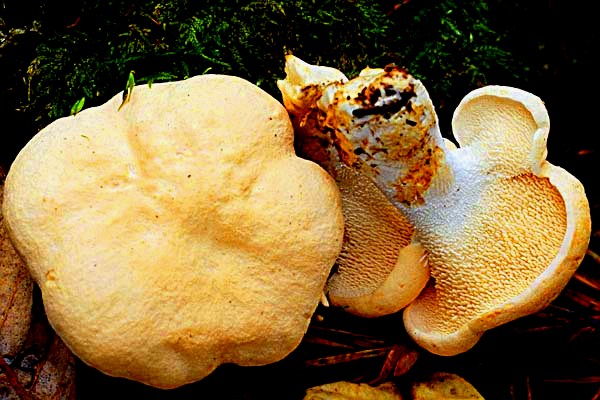
These also occur on the east coast where they are reported to grow in Messmate forest in Victoria.

There is another very similar species or perhaps variety that grow in close proximity to these ones.  They have been described as Hydnum ‘chestnut’ or Hydnum aff. repandum.  These ones have a longer stem and a chestnut brown cap.  I have also eaten these and they taste similar though they are not as robust in form as the orange toned species.  This one also grows in Victoria and Tasmania.

hydnum chestnut

Hydnum ‘chestnut'(crocidens), on my place

Both of these forms can exhibit a deep pore at the centre of the cap.  I did wonder if this was Hydnum umbilicatum, but Roger Hilton advised me otherwise and since this feature appears to be randomly distributed in specimens of both types, it is most likely a morphological variation rather than a separate variety or species.

Note: August 2016

Some recent DNA information from suggests that the chestnut variety is Hydnum crocidens.  It is interesting then to see the similarities between these mushrooms and those on Clive Shirley’s NZ site that are named as varieties of Hydnum crocidens.

It is even more interesting to read a recent  phylogenetic analysis of Hydnum based on DNA analysis and published in May 2016.  This puts paid to any concept that this mushroom is Hydnum repandum.  Specimens in the WA Herbarium are of un-named species (17 and 19) and others are unequivocally Hydnum crocidens.  The 3 species from New Zealand are all found in Australia. 

The name ‘crocidens‘ derives from mycologist Mordacai Cooke, who described them in 1890.  Below is a brief excerpt from his 1892 book ‘Handbook of Australian Fungi’, together with his illustration.

Cooke’s illustration of Hydnum crocidens

Species fungorum (Oct 2022) says that the current name for H. crocidens is H. ambustrum, described by Cooke and Masse slightly earlier in 1887.

Spines of Hydnum crocidens

Under the microscope, the spines appear glistening white with some of them displaying an orange-coloured point. There is some suggestion from this image that the spines are hollow.

The spores of this species are very small and almost spherical. My sizing is slightly larger than that reported by Cooke.

Spores of Hydnum crocidens

The spores are borne on basidia that are normal to the surface of the spines. From what I can make out there appear to be 5 spores on each basidium.

Basidia of Hydnum crocidens

It is noticeable that these mushrooms are resistant to decay. They can last for many weeks in the wild without developing the fungal infections like Hypomyces that cause the rapid demise of other species. This suggests that they have some inherent antimicrobial activity.

A remarkable example of this resistance is shown in the images below. These specimens were collected on 7 August and this photograph was taken on 24 October, which is a period of 78 days. They have been kept in an ordinary refrigerator in a plastic zip-lock bag. There is not the slightest visual hint of decay nor any odour. I would expect most mushrooms to be significantly degraded over this period.

Hydnum after 78 days in plastic bag in refrigerator
Hydnum after 78 days in a plastic bag at 5 degrees C

Medicinal use of Hydnum.

Recent (2021) research has shown that extracts from Hydnum have antibiofilm activity. This is important because many chronic bacterial infections, such as the childhood ear infection Otitis media rely on the formation of a biofilm for their persistence and their resistance to antibiotics. While this research is behind a paywall, the abstract suggests that extracts of the mushroom used in conjunction with antibiotics can resolve biofilm infections. This journal has a Q3 ranking, so it will be interesting to see if this surfaces in one of the higher ranking journals over time.

Other research reveals that the extracts of the mushroom have ‘remarkable antioxidant properties‘.

Note 29/10/24
There is a focus on the importance of biofilms to antimicrobial resistance reported in Nature at this link.
Chemistry

Some components of the mushroom include the two very closely related flavinoids myricetin and apigenin. The structures of these are shown below.

These two compounds are the subject of a lot of publications. As an example, myricetin has recently been reported to have potential as an anti-viral and anti-inflammatory agent with potential to be useful in the treatment of Covid-19.

Polar extracts of the mushroom are reported to contain substantial amounts of quinic acid. This would tend to make the mushroom taste bitter. I haven’t really noticed that, but I have not tasted it raw.

There are anecdotal reports that consumption of Hydnum as an uplifting effect on mood. I have not observed this effect personally.

Comments (8) »

Pleurotus australis – the native oyster mushroom

Pleurotus australis is not the most common of mushrooms and unfortunately it’s habitat overlaps that of the poisonous  Omphalotus nidiformis, or ghost mushroom. Thats the one that glows in the dark. I have only ever seen P. australis growing on peppermint trees. That is Agonis flexuosa. The first one I ever saw was in the Perth area. I enlisted the help of a venerable mycologist (Roger Hilton)  to identify it. There were a few fruiting bodies on the tree in question and they were huge. The texture of these was like leather and there is no way that they could be eaten. Note the wavy cap margin.

In the region down where I live now, however, the oyster mushrooms are smaller and would be edible if there were enough of them to be bothered with. They also get fly-blown very quickly.

For some further information on locally picked oyster mushrooms, see WhereFishSing.

Here is a picture of some growing at Yeagarup.

They are quite simple to cultivate. The same procedures can be used as one would apply to any other oyster mushroom. Pasteurised straw is a the simplest medium. The rather odd thing about P. australis under cultivation is that it bears little resemblance to the wild fungus. The pinheads are a dark black/purple colour.

When grown on a little further, they are a rather soft mushroom, with a distinctive purple tinge to the upper surface.   I have some pictures of these somewhere and when I find them I will add them to this post.  Ah, here we go.  This is an example of a cultivated one.

12 Years on and here is another picture of a cultivated specimen.  In this case I took the culture from a dried specimen.  It took a while to take off but grew quite well after that.  I fruited this one in my greenhouse whereas the first one was fruited in a rather dark corner of my kitchen.   In any case the result was quite different.

One thing that must be said about this mushroom.  Be very careful not to confuse it with Omphalotus nidiformis.  They are very similar in the wild.  O. nidiformis, however, will glow if you break off a small piece and put it in a jar by your bed.  The oyster mushroom can also be recognised by the fine network of criss-crossed gills that run right down the stem to the point where it emerges from the tree. This is a picture of Omphalotus nidiformis.   It is somewhat variable, but this is typical.

In other places, Omphalotus nidiformis can take on a much more funnel-shaped appearance.  Here is a picture of some from the rainforest at Dorrigo, NSW.

omphalotus dorrigo

Omphalotus nidiformis from Dorrigo

23 June 2013

This year I visited the site of the mushroom shown in the first illustration.   There was a new crop growing and they were in the juvenile stage.   As with the local ones from down here, they had a dark purple cap with a slightly scaly texture.   They were more robust, but otherwise matched the local specimens.  So it is clear that they change as they age.   I am now more comfortable with the identification of both as P. australis.   I again tried to bring this into culture, but without success this time.   I do have some pieces of infected wood though, so I will try to culture those.   A friend in Perth got a culture of the Perth specimen going last year, but he found that it would not grow on straw like his normal king oyster mushrooms.

9 May 2021

It is a long time since I updated this post. I have now moved to Busselton. These mushrooms are everywhere around the town and in the adjacent forest particularly this year. If you go out in the evening with a torch you can see them releasing spores. You have to see this in person to appreciate the vast amount of spores that are released by these mushrooms. They must travel a long distance which makes it surprising that they aren’t more common on Peppermint trees in more inland locations. A friend did send me a picture of some on one of his apple trees in Manjimup and they have been spotted on a grape vine in Margaret River however so it seems that they are capable of occurring on other hosts. Actually, now that I think of it, I have seen these on a Warren River Cedar (Taxandria juniperina) while taking a tour along the Donnelly River and Taxandria parviceps(?) near Capel.

The spores are elongated, rather like grains of rice, about 10.5 x 5.6 microns. This is a microscope image showing the spores along with some sizing statistics. These differ from the spores of Omphalotus nidiformis which are close to spherical.

In the wild, this mushroom is often found to be riddled with larvae. These belong to the fungus fly Tapeigaster cinctipes. The males of this species patrol the tops of the mushrooms, waiting to mate with any females that happen along. The females lay their eggs in the gills and the larvae make their way into the mushroom from there. It is common to see these mushrooms pecked to pieces by birds that are no doubt feeding on the larvae. The images below show a male on the top of a mushroom and a view of one of the larvae under the microscope.

Tapeigaster cinctipes

Tapeigaster cinctipes larva

Comments (13) »

Agaricus aff. sylvaticus – the forest mushroom

When the rains come in Autumn, the karri forest comes alive with a huge variety of fungi.

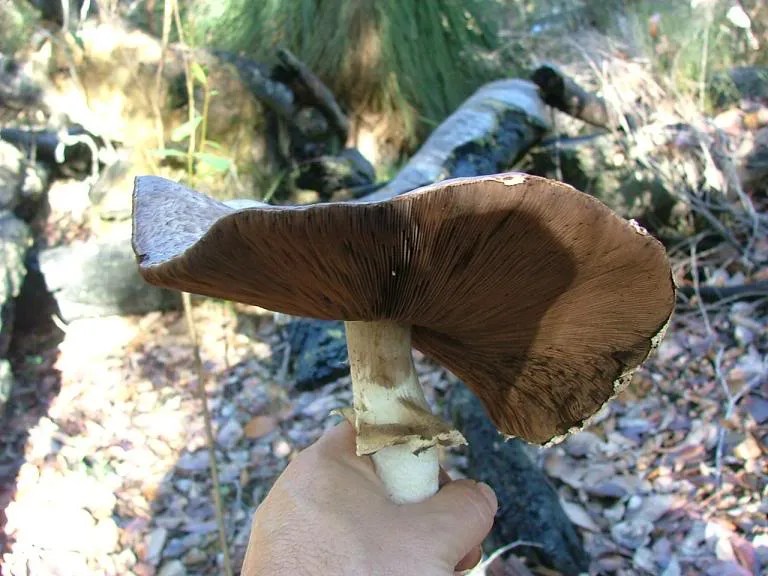
One of the mose sought after ones is Agaricus aff. sylvaticus, the forest mushroom. It grows to a diameter of approximately 150 mm and is often found in large outcrops.

I have childhood memories of walking through the forest picking these mushrooms when we would come down and stay here on school holidays. Those memories are an strong driver for my living here now.

The forest mushroom is quite a distinctive fungus and once one has seen a few, it is easy to recognise them. There is, however one caution that I would apply to picking and eating them and it is the same caution that I apply to all Agaricus species – if it smells of phenol, leave it alone. Another description of that smell is ‘like India Ink’.

I have picked and eaten these mushrooms for many years without ever finding any that smelled of phenol, but one year, when they were in great abundance, I picked a bag of them and the phenol smell was clearly evident. Perhaps it was the fact that there were so many of them, I don’t know. But I didn’t risk eating them. Mushrooms containing phenol are likely to cause distressing stomach upsets.

Sometimes this mushroom can reach enormous size.   This specimen was found when I was collecting firewood in the mixed jarrah/marri forest.


Comments (4) »

Armillaria luteobubalina (et al) – the honey fungi

There are quite a few edible fungi in Australia, but very little accumulated experience as to their edibility and almost no expertise in identification.

This makes consumption of wild mushrooms in Australia a pastime only for the few who are willing to take the time to gather the necessary experience in identification and cautionary procedures.

There is little history of mushroom poisoning in Australia. This is primarily because the population share a common fear of mushrooms that are not bought in a shop. That is a good thing. It is not a field for fools or those that would conclude that the lack of poisoning indicates a lack of deadly species. There is no simple test for edibility. None. You really need to know what you are doing in this field, or risk a very nasty death.

With that forwarning, let me describe a few of the mushrooms that I eat.

The first of these is my personal favourite. Armillaria luteobubalina. It is a native mushroom and is very widespread. It tends to attack weak plants in the forest situation, but will run rampant in gardens or in logged areas. It is slowly killing many of the trees in the iconic Kings Park, in Perth.

Armillaria luteobubalina

If you take but the slightest morsel of this mushroom in the raw state, you will find that it had the most bitter taste imaginable. You will be spitting it out for half an hour. But the slightest blanching in hot water removes the taste completely. Cooking in any form also removes the taste. Once that is accomplished, this mushroom has a wonderful texture (young specimens in particular) and flavour enhancing properties. I love to cook it with a little butter and some ham. Delicious! Some of the distinctive features of this mushroom that aid identification are: The cap colour varies from yellow to a dark greenish hue and has a rough texture like sandpaper. It also features an umbo in the centre. The stipe has an annulus and small scales.

I have been eating this mushroom for a decade or so without ever finding any others that enjoyed its delights.  Not until I discovered, by chance, that a little old Italian lady, who lives in the old peoples home in my town, has been eating it for years.  Her English is not very good, even though she has lived here for perhaps 40 or 50 years.  I find it hard to communicate with her.  One day I must visit her with a native Italian speaker and record her story.  There is almost no history of European consumption of native fungi in Australia.

————————————————————————–

Edit May 2016 

As time goes by I learn more about this.  I find that Italian people not just locally but across the country have been eating these since the 1950s at least.  They pickle them and they are known as Chiodini, or ‘little nails’.  Google tells me that several species are so described.  Anyway, I fully intend to try this process out this year.

————————————————————————-

It should be possible to cultivate this mushroom and it has in fact been grown in vitro in a small way.   It is certainly not difficult to get it growing on agar by sterile cloning.  The resultant growth develops rhizomorphs, the same structures that are responsible for the spread of the fungus in the wild.   I think that the culture looks a bit like an alien.  🙂

Armillaria luteobubalina in culture

Update: 25 June 2012

Armillaria luteobubalina is not the only species of honey fungus in Australia.   We also have A. hinnulea.  Kathy of Northern NSW has these growing and has tentatively tried them.  She found that it lacked the bitter taste of A. luteobubalina and when cooked it had a mild, slightly sweet taste.  Images of her mushrooms, together with some discussion, can be found here.

Mention should also be made of Armillaria novae-zelandiae and Armillaria limonea both of which are reported as having been eaten without ill effect by Hall et al in the book “Edible and Poisonous Mushrooms An Introduction”  ISBN 0-478-10806-0.  Interestingly, in the same book, they report Armillaria luteobubalina as being ‘bitter and inedible’.  I had some for lunch today and they were certainly neither of those things!

Armillea luteobubalina featured in the Australian Fungi stamp set issued in 1981.  The notes that went with the issue take care to explain that the edibility of Australian species has not been fully investigated and until further investigation is conducted they should be regarded as inedible as a protection.  🙂

Update 1 September 2012

In parts of Italy, they eat Armillaria mellea, which has an annular ring, but they don’t collect another variety that looks similar but doesn’t have a ring.  The text on this photo translates as:

“Here from our parts, theres also this variety without ring, however, is not collected, as well as with much sought after ring of armillaria mellea.Have a great weekend!!

Update 4 October 2015

Armillaria luteobubalina was first described from a collection made in eastern Victoria in 1978.

In a paper by G.A. Kile of the CSIRO and R Watling of the Royal Botanical Gardens in Scotland, published in the Transactions of the British Mycological Society in 1981, under the title ‘An expanded concept of Armillaria luteobubalina they describe the occurrence of this mushroom in south eastern Australia but comment that it is unknown in WA.  That rather surprised me given the significance it has in the karri forest. A subsequent paper by Kile et al in 1983 first details the occurrence in WA.

In a paper addressing Armillaria in the karri forest, published in 2003 by  Robinson, Williams and Smith and  of the Department of Conservation and Land Management, the issue of spread of the fungus by spore dispersal is discussed included is the following quote:

“In mixed-species eucalypt forests in Victoria, Kile (1983) reported 36 genotypes of luteobubalina from a total forest area of 24 ha, and estimated that new disease centres, arising from basidiospore infection, had occurred at the rate of less than one per year. Thus disease spread by airborne spore dispersal does not need to be considered when formulating management options in eucalypt forests infested with A. luteobubalina.”

The main means of spread of the fungus is by root contact and that transport of specimens is unlikely to be a problem in terms of spreading disease. This contrasts with some other species of Armillaria elsewhere.

Another interesting thing about Armillaria is that in most cases the mycelium and the mushroom are composed of diploid cells (with a single fused nucleus).  This contrasts with other mushrooms that have dikaryotic cells (with two unfused nuclei).

In terms of eating, I have found that frying it in a mixture of oil and butter at a high heat until it just begins to brown produces an excellent flavour.

10 June 2023

I collected a spore print of Armillaria luteobubalina and put it under the microscope today. The spore size was 8 x 6.3 microns. They appeared to show a large nucleus and a sharp point of detachment. There was also some appearance of spikes on the surface but my technique requires some improvement to verify this. I used Quink ink as a stain. This image was taken with oil immersion.

Armillaria luteobubalina spores

6 June 2024

One mushroom that could potentially be confused with Armillaria luteobubalina is Pholiota malicola. It grows in clusters and has a yellow cap with an umbo. The cap however is smoother than that of Armillaria and it does not have the annulus that is present in Armillaria. The stem is also different, lacking the scales seen in Armillaria. It is not edible. This image which was taken in the Wollongong area is reproduced with the permission of Rhys Hart.

Pholiota malicola

Comments (8) »

The chanterelle- a special mushroom

One of the great things about this block is the vast variety of fungi that grow here. When I first looked around I found this native chanterelle. It was the first time I had ever seen this particular fungus and it was quite a thrill. In my mind, I have christened the property ‘Chanterelle’.

chanterelle
Pink Cantharellus from Western Australia

Since that first find, I have logged 90 different species of mushroom on the block. A few of them, like the chantarelle are edible, most are of unknown edibility and a few are deadly poisonous.

Personally, I find that the chantarelle is quite tasteless, although some report and apricot taste.  It does have some decorative value in cooking.

These mushrooms grow in rings in the forest.  Sometimes they occur in large numbers, but usually there will be no more than about 20 or 30 in a ring.   They are a much smaller and more delicate mushroom than their European counterparts.  The colour is distinctive.   This helps amateurs from confusing them with the poisonous Austropaxillus infundibuliformis that is extremely common around these parts.

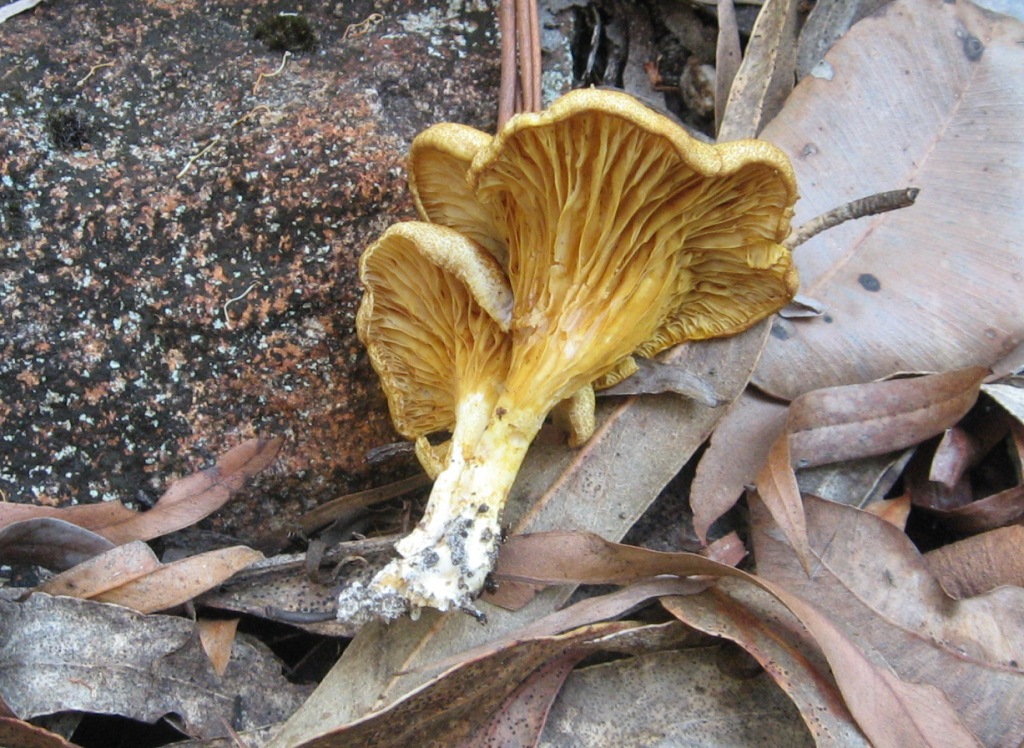
Austropaxillus infundibuliformis (funnel-shaped) is shown below.   It  bears a strong resemblence to the European chantarelle, but it should be treated with great caution, as its close cousin, Paxillus involutus is poisonous.   The nature of the poison in this fungus is quite different from other common types.   It causes a reaction within the body whereby the immune system collapses.  This doesn’t always happen, for some reason.  There seems to be a sensitising process.  But a very nasty way to die.  Note that the Austropaxillus shown below comes in a variety of colours centred on yellow, and it bruises black after time.

Austropaxillus infundibuliformis, mimicing Cantharellus.

The chanterelle mushroom cannot be cultivated without planting an innoculated host tree.  Nobody would bother doing that as the fungus is too small to be commercially viable.

There are more species of this mushroom growing on the east coast.  See for example these two posts from my fellow blogger.

There are other chanterelles that grow in the Kimberley area and in fact right across the tropical north and into F N Queensland.  There are several varieties and I am not sure that they have all been named.  Some of those ones are much more substantial and actually have some taste.  Access to those is not easy however.

June 25

The images below show the spore-bearing basidium and associated structures (dark field, phase contrast, 20x objective) and the spores (lactophenol blue, 20x objective, 7.4 x 4.6 microns).

Cantharellus (WA) basidium and associated structure.

Spores of Cantharellus sp. from Western Australia.

Comments (6) »