

During another walk this evening I encountered another mushroom that had a similar appearance to an edible field mushroom. I picked it and brought it back to the house to document why it is not an edible field mushroom. Here is a picture of the cap.
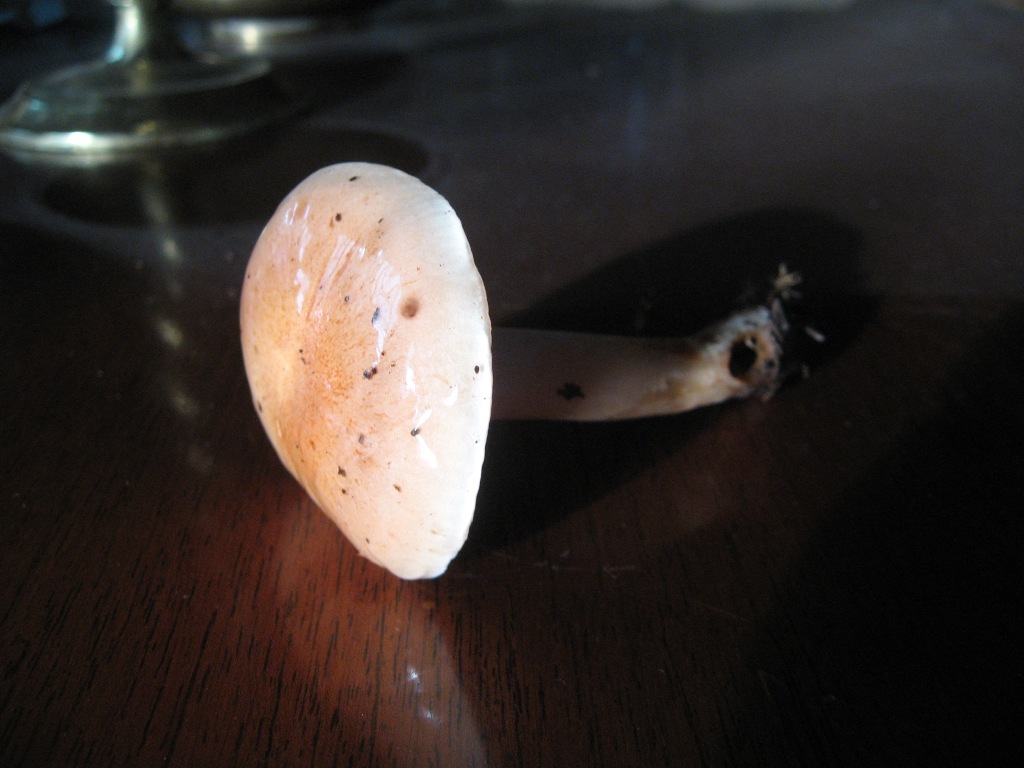
Hebeloma westraliense, showing glutinous cap
The cap is not outside of the colour range that one might expect for an edible field mushroom, but notice that it is shiny? In fact it is quite slimy to the touch. This alone is enough to declare it to not be an edible Agaricus. However, let us continue…

Hebeloma westraliense, showing gills and top of stipe.
When we flip the mushroom over, we can see that the gills are in the right kind of colour range and that the stem has the right sort of thickness in relation to the cap. In fact, the gills even darken from pinkish to brown over time. However, the thing that is glaringly absent is an annulus or ring on the stem. Not a hint of one! We know for sure now that this is not an edible Agaricus, but lets go further…
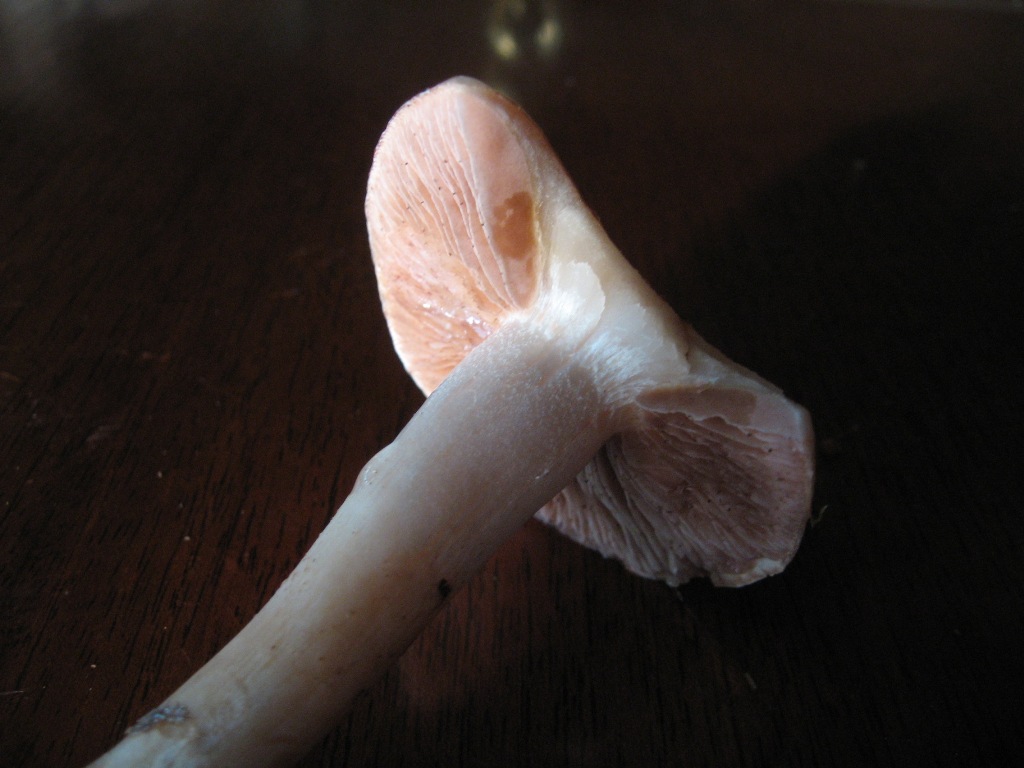
Hebeloma westraliense, torn
If we attempt to snap the stem away from the cap, the result is unsuccessful. The whole cap tears apart rather than breaking at the junction of the stem and the cap. There is no change in the tissue type between the stem and the cap. This thing has now failed three tests. Quite a pretty mushroom never the less 🙂
If you are wondering about the tabletop, it is Australian red cedar, Toona ciliata. The mushroom is Hebeloma westraliense, edibility unknown (Bougher and Syme). Hebelomas are very useful for promoting the growth of Eucalypts and are cultivated for that purpose worldwide.
December 2023
In pine forests, and associated with introduced trees there is another species called Hebeloma crustuliniforme, also known as Poison Pie that is known to be poisonous.

Hebeloma crustluniforme with $10 note for size comparison.

Hebeloma crustuliniforme, torn in half.
I often hear people offer the advice “if you can peel a mushroom it is edible”. Of course such generalisations are nonsense, since you can peel a death cap. But I suspect that the origin of this advice is that this is a means of distinguishing between Agaricus and Hebeloma.