This mushroom was growing on wood waste in a Eucalypt forest in Pemberton. That contrasts to it’s reported preference for Pinus in North America.
It is a pretty mushroom, with dark edges outlining the gills.
Gills of Pluteus atromarginatus
The gills are free, though some other examples online show more separation from the stem than in this case. According to Michael Kuo, this is unusual for a Pluteus species. The cap is dark purple and the gills are white with a very slight pink tinge
The surface of the cap is covered with fibrous scales.
Cap texture of Pluteus atromarginatus.
The overall texture of the mushroom can be described as ‘watery’. It is reported to be edible, but to be honest the texture doesn’t make it very appealing. Tasted raw, it was reminiscent of other Pluteus species but it left an aftertaste that was slightly hot, and I can see how it is reported as being like radish. I fried a couple up in a pan and they became very sloppy, as expected. The taste became more mushroom-like, not unpleasant, and the after taste seemed to have been removed, although I think some still lingered from tasting it raw.
The spores of one specimen as shown below. They are almost spherical, smooth, with an average size of 6.6 x 6 microns.
Spores of Pluteus atromarginatus.
The spore print is supposed to be pink but I would describe this as rusty brown.
The genus Lacrymaria contains species with dark brown gills that are very similar in colour to Agaricus. Today I spotted the mushrooms below on the side of the road in the middle of Karri forest near Pemberton in SW WA.
Lacrymaria velutina
The gills were a dark chocolate brown.
Gills of Lacrymaria velutina
From the above shot a couple of things stand out. Firstly, the gills are attached to the stipe. This differs from Agaricus where the gills are always free. Secondly, the stipe has split into a number of strips. This does not happen with Agaricus.
A close-up of the gills also shows that they are blotchy in appearance, which we do not seen in Agaricus.
Close-up of Lacrymaria velutina gills
Under UV light the entire mushroom glows a lovely purple colour. Unfortunately I was unable to capture this colour on my iPhone.
Note: I have named this specimen from online images. It may be a native species that is not described.
Lacrymaria are not considered to be edible mainly because of taste rather than toxicity. It has a very thin flesh in any case so would not make much or a meal.
One of the most commonly asked questions on mushroom forums is “What is this yellow mushroom in my flowerpot”. The mushroom they are referring to is Leucocoprinus birnbaumii. This is one of a number of closely related species that are associated with potting mixes.
It is a fleeting mushroom, appearing as a small yellow lump then growing into a small parasol shape before sinking back into the substrate. Part of this process is caught in the video below, reproduced with kind permission of Thomas Phoon Kong Wai of Singapore.
This mushroom was first described by British mycologist James Bolton in his book ‘A History of Fungusses growing about Halifax‘ published in 1788. He gave it both a common name, ‘Yellow Cottony Agaric’ and a botanical name, Agaricus luteus, seen on the left.
Unfortunately, the name he gave it, Agaricus luteus was already in use so his nomenclature did not fit with the rules and it fell to Czech mycologist Augustus Corda who found it growing in a greenhouse in Prague to name it after a garden inspector called Birnbaum.
I was rather intrigued by the note that Bolton made regarding it being found in a pine-stove. I had no idea what a pine stove was but further investigation reveals that the growing of pineapples was all the rage in England and Scotland at the time and wealthy people constructed hothouses with elaborate heating systems in which to cultivate them in the cold climate. One elaborate monument to this fad is this construction by John Murray, the 4th Earl of Dunmore which you can visit in Scotland.
Chemistry
The intense yellow colour of these mushrooms is due to two alkaloids known as birnbaums.
The structure of these compounds was determined by Bartsch et al. in 2005. This work is in some places referenced with the comment that these compounds are toxic but if one reads the paper there is no such mention of toxicity. A review by Rani and Granchi in 2015 also notes that there is no biological assessment of these compounds.
There have also been some octadecanonoic acids identified in the methylene chloride extracts of this fungus. They were shown to have some antibiotic activity.
This mushroom is widely described as toxic but the reality is that there is no data available anywhere to support this claim. Considering that this is such a common mushroom, one might expect some records of toxic effects to be recorded but there is nothing. Given that these are often found in indoor settings, they are the sort of things that pets might occasionally nibble on and in fact I noticed one such case on the Emergency Identification for Plants and Fungi page on Facebook. In this case a dog in Australia had eaten one. Inquiries with the vet revealed however that there was no indication of the dog suffering from toxic effects.
I think that this is one of those cases of the propagation of mushroom myths like the old chestnut about Coprinus comatus being poisonous if consumed with alcohol. It probably has its origins in the fact that this mushroom was at one stage grouped with the Lepiotas which do contain species that are deadly poisonous. I think that consumption of a small mushroom like this would be pointless and I would not recommend it but I have read a report from one person who claims to have eaten them.
Effect on pot plants.
One of the most common questions asked is if this mushroom has any effect on the potted plants. People often leap in and declare that it is beneficial because it is breaking down organic material and feeding the plants. Others infer some sort of direct influence on plant growth, either beneficial or not. In reality, it is not really desirable for potting mix to be breaking down as it’s primary function of to support the plant and provide a reservoir of water. And degradation of cellulose does little to provide nutrients to the plant. One possible effect is that the mycelium, which is hydrophobic, can cause the entire potting mix to become hydrophobic and this will prevent the potting mix acting as a water reservoir.
These mushrooms produce sclerotia, small round bodies that resemble seeds in some ways. They are yellow and less than a millimetre in diameter. New colonies of fungus can grow from these sclerotia. These can be observed in the surface layer of potting mixes. It can take several years for mushrooms to appear in pots, a factor which can make it difficult to link cause and effect. Because of the presence of the sclerotia, it is difficult to get rid of the fungus. It has been observed however that replacing the top layer of potting mix will delay the formation of mushrooms for a year or so.
The spores of this species are white and dextrinoid which means they give a reddish colour with Melzer’s reagent.
Dextrinoid reaction of spores with Melzer’s reagent.
There is not a lot of information around on the fungi eaten by indigenous people in Australia before the arrival of Europeans. One of the few references on the topic is by James Drummond who arrived in the Swan River Colony in the year it was founded, 1829.
James Drummond, interpreted from historical image
He was a botanist and a keen observer and recorder of the local flora as well as the diet of the original inhabitants. The following is a snippet from a letter he wrote to the Perth Enquirer in May 1842.
I have often wondered if it might be possible to identify the blue staining bolete that he describes as Woorda. There are many blue staining boletes in Western Australia and I know of several that people have eaten but none of them fit the description he gives. I had long suspected that it might be a Gyroporus since members of that genus are eaten elsewhere on the globe and with one exception they appear to all be edible.
A paper published in 2019 gives us some some useful information about Gyroporus in Australia. It is titled “Three New Species of Gyroporus (Boletales, Basidiomycota) from Australia”. In it is a description of Gyroporus occidentalis with an explanation that it is the only rapidly blue staining member of the genus from WA.
I was fortunate enough to spot one of these on a friend’s property this year and it is shown in the following video and photographs. It is recorded as growing from sandy soil (well, that’s most of the coastal plain!) and it’s range includes Perth. I think that there is a some chance that this is Woorda but see below for further possibilities.
Gyroporus occidentalis. The rapid blueing reaction in real time
Gyroporus occidentalis In situ view showing cap surface and pores
Gyroporus occidentalis. View showing stipe and pore surface
Some of the features of this mushroom match the description in the paper closely. The cap is described as “dry, floccose to matted woolly to heavily appressed tomentose, yellow-white to yellow buff to dirty yellow, cyanescent, with slightly extended margin”. This close-up of the cap surface seems to match that description. I couldn’t see that the cap margin was extended though.
Gyroporus occidentalis. Cap surface
The pores are yellow and cyanescent and approximately 0.3mm in diameter with a typically pentagonal outline.
Gyroporus occidentalis pore surface
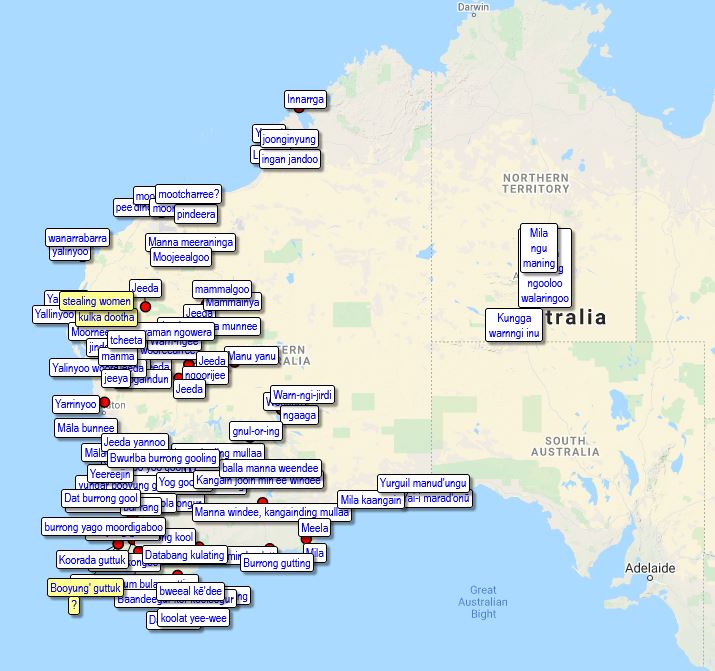
Anther interesting aspect of this is the name Woorda. Of course transcriptions of language are subject to errors and interpretations and so forth but the records of Daisy Bates provide for some interesting reading. These are available in digital form here. The many words recorded as meaning mushroom are provided on the site as a map. shown below. It triggers the question of whether the diversity of names matches the diversity of species that were part of the diet.
Map of words for mushroom from digital Daisy Bates site
The term Woorda appears in a dictionary of Balardong Noongar language as meaning fungus. It is difficult to know if this is a generic word or refers to the specific fungus that Drummond mentions. He does seem to infer that it is specific. It is notable that, at the time he wrote to the Enquirer, he had been farming at Toodjay (Duidgee) which is in Balardong country. That would imply that the range of the fungus includes Balardong country. I am not sure if Gyroporus occidentalis extends out this far but it will be interesting to find out.
Noongar groups. Attribute John D. Croft, English Wikipedia
The situation is complicated by the fact that there are other, rather similar looking blue staining boletes within Balardong country. One of these is documented by Doug Sawkins in his excellent record of the fungi of Foxes Lair at Narrogin. His very large blue staining bolete is similar in some ways to Gyroporus occidentalis but it lacks the chambered stem and has red tones where it has been attacked but insects. It matches one of Daisy Bates’ records of Woorda meaning ‘large mushroom’.
It is interesting to note that there is another record of the consumption of blue-staining boletes, in this case from Gippsland in Victoria It was made by the Silesian naturalist Lothar Becker who visited Australia in two trips in the period 1849-1865. This record is reported in a paper by May and Darragh in Historical Records of Australian Science, 2019, 30, 130-137, titled “The significance of mycological contributions by Lother Becker”.. A snippet from this is reproduced below.
Note Feb 2025. The existence of ChatGPT makes the reading and translation of Becker’s text, which can be downloaded in it’s original form, much simpler. Here is the translation of this provided by the AI.
“The natives are said to consume a large quantity of mushrooms, especially those that do not require cooking and are consumed in their raw state. From this group, however, I have encountered only Agaricus bullugur and Boletus aboriginum in Gippsland. The latter turns blue when pressed, as is common when its inner part comes into contact with air.
He then goes on to say:
The natives of Pantelleria, Lampedusa, and Linosa are not familiar with the prejudice that exists in most regions of Germany, where all blue-spotted mushrooms are considered poisonous. It is, however, known that in Germany, especially among the Slavic population, more or less strongly blue-tinged mushrooms are consumed, such as B. rufus, luridus, lupinus, radicans, subtomentosus, variegatus, and badius. Boletus luridus is sold at the Prague and Vienna markets, B. radicans was once seen at the Breslau market, and B. variegatus and subtomentosus, like B. badius, possess the mentioned characteristic to a lesser degree, and sometimes not at all, yet still appear in large quantities at the Breslau market. According to a colonist, on whose testimony I place little value, a certain mushroom in Van Diemen’s Land is considered poisonous.”
Once again there is no information to identify this mushroom and there are many boletes that share this blue-staining property. I am not sure if there are any species that are common to Gippsland and Western Australia. We can rule out Phlebopus from Drummond’s comments and in any case they don’t always display blue staining. From time to time people report eating blue-staining mushrooms from various locations in Australia but sadly there is scant information regarding the actual identity of them. In some cases they have been eaten by people of European origin who have perhaps mistaken them for species from their home region. In one case in Western Australia consumption is recorded in a YouTube video and it was on the basis that boletes are generally non-toxic. This assumption has some statistical support but it remains the case that one of the few cases of fatal mushroom poisoning in Australia was from consumption of a bolete.
His comment about the report of a poisonous mushroom in Tasmania is interesting.
30 Jan 2025
Some progress!! Yay!!
Today I was going through a list of edible Australian fungi published by D. McAlpine in 1895. One of the species mentioned by him is Boletus alliciens. I had never heard of this so I did some investigation and found a description of a specimen that Drummond sent to Miles Berkeley. The description was published in the London Journal of Botany, V4, 1845, p50. It reads as follows:
Pileus 2½ inches across, convex, fleshy, smooth, slimy, yellow. — Stem 1¾ inch high, ½-1 inch thick, minutely tomentose, not in the least reticulated. Pores yellow, irregular, adnexed, so that the cavity of those nearest to the stem is exposed. Spores pale, oblong. Distinguished at once by its slimy surface and changeable flesh. — It is much esteemed by the natives as an article of food.
The epithet ‘alliciens’ apparently means something like ‘attractive’, most likely alluding to its use as food.
This name is still current, so we actually have the name and a working description of the mushroom. My problem now is trying to match this with something that I have seen in the field and get a picture of it.
There are images from Queensland that purport to be Boletus alliciens but they have dark red caps and even red staining in one case and there is no mention of them being sticky. The identification seems to have come from a description by Watling rather than the original. I am trying to track that down. It also seems somewhat unlikely that this species would occur in Queensland, given the description of the occurrence in WA.
The late Roger Hilton did a survey of the Drummond Collection at Kew and he makes the following note in Nuytsia, V4, No3.
“Boletus alliciens Berk., Lond. J. Bot. 4:50 (1845); Decade 4/34.
Current name: As above.
Notes: Drummond states that this was one of the species eaten by aborigines and went (with other species?) under the name “woorda”. There is neither specimen nor catalogue number at Kew. The description is inadequate to equate it with any of the many boletes collected since.”
He tentatively questions whether that name might be applied to other edible species but there is no evidence for that from what Drummond writes – he is quite specific. Other fungi listed in lexicons have specific descriptions too. Some contemporary images by indigenous publications purport to show Woorda, but my enquiries have come to nothing and my experience is that this is probably incorrect nomenclature.
It is notable that Hilton does not attempt to match the species with anything collected since. Given his extensive experience with WA fungi, this is not encouraging. It is also somewhat surprising that something that was apparently common enough to be noted by Drummond does not seem to match any of the common species seen today. The only species that I commonly see that has a yellow slimy cap is Tylopilus phaseolisporus, but that species does not feature a blue staining reaction.
Somewhere in the back of my memory is a report, possibly by Lothar Becker of the Aboriginal women in Victoria collecting a mushroom that closely resembled Boletus luteus (=Suillus luteus). If my memory served me well they would skewer them with a stick as a means of collecting them. It is tempting to conclude that this mushroom may have had the slimy cap referred to by Drummond.
Found the reference from Lothar Becker:
“A Boletus, which scarcely differs from our B. luteus, is consumed raw by the women; Agaricus campestris L., the champignon, which occurs here as a variety, has already established itself at many places where horse breeding takes place, but it is not used by the Aborigines, who are still unacquainted with its properties. “
That note was in reference to the Wide Bay region of Queensland. Cooke also mentions edible boletes from Queensland, one of which he calls Boletus badius and says that the flesh turns blue near the tubes.
Note 17 August 2025
I have seen the word ‘Woort’ used as the name of a mushroom in various lexicons. I had wondered if this might be a variation of ‘Woorda’. This seems likely, given the following comment by Wilf Douglas in his 1996 book ‘ Illustrated dictionary of the South-West Aboriginal language’ “In the South-west language there are no words which change their meaning if spelt with a D instead of a b. Likewise, no words change meaning if t is used instead of d.”
I will mention also here that there is a green mushroom mentioned in a couple of places. I have often wondered what this might be. One thought was Amanita (austro)viridis, but given the description of this by Miller as having a stale, unpleasant taste and being localised to Two Peoples Bay nature reserve, this seems unlikely.
Macrolepiota dolichaula in its typical habitat – a grassy paddock (Image credit: Pixie Miller)
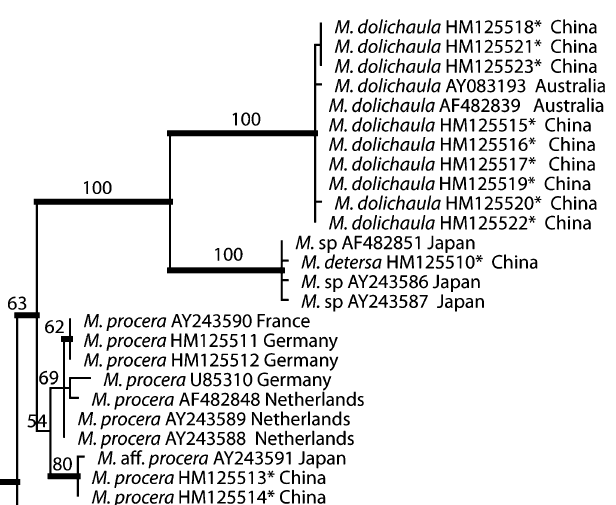
Macrolepiota dolichaula is a large mushroom that can often be seen in open paddocks from some distance away. It occurs in the warmer regions of Australia such as the North Coast of New South Wales and Queensland. It also occurs in other countries such as Vietnam, Northern Thailand and China. In all those places it is also considered an edible species. Genetically, the specimens from Australia form a monophyletic clade with the species from China. DNA Barcoding shows a 100% match between specimens from Australia and China. This is shown by specimens lodged by the mycologist who specialises in this genus, Else Vellinga. Genetically, it sits close to Macroplepiota procera, with which it is often confused.
The epiphet ‘dolichaula’ comes from Greek ‘dolichos’ for long, and ‘aulos’ for tube, referring presumably to the stipe. It is conventional to pronounce ‘ch’ in Greek as ‘k’ in English. I pronounce this dolly-kola. People in Australia sometimes use the nickname ‘Dolly’ for this mushroom.
Phylogenetic relationships in Macrolepiota, from :
When it is young, the mushroom has is bell-shaped (campulinate) as shown in the image below.
Young specimen of M. dolichaula shown bell-like shape (Image credit: Pixie Miller)
The centre of the mushroom has a slightly raised area (an umbo) which often has a light tan colour. From the centre, the cap squamules radiate towards the rim, the spacing getting wider towards the outside. These are white to very faint yellow-brown. The whole cap at maturity is between 60 and 210 mm in diameter.
Cap of M. dolichaula showing radiating squamules.(Image credit Drew Raison)
The gills are white to begin with, but darken to a straw colour over time. They are crowded and are not attached to the stem (free) and the length alternates between long (lamellae) and short (lamellulae).
Gills of M. dolichaula are white at first but become cream coloured over time. (Image credit: Drew Raison)
M. dolichaula, showing alternating long (lamellae) and short (lamellulae) gills (Credit: Jye Zap)
As the cap expands, a partial veil extending from the edge of the cap to the stem breaks away. This membrane has a similar texture to the cap surface. At the edges of the cap, ragged remnants of this partial veil remain.
Expanded cap of M. dolichaula showing partial veil breaking away. (Image credit: Simone Small)
If it is not torn away completely, as in the above image, on the stem, the remains of the partial veil form a ring or annulus. This hangs downwards.
Annulus on M. dolichaula (Image credit: Pixie Miller)
The stem (stipe) of the mushroom is often lightly covered with squamules rather like the cap. It tapers slightly from the base to the top and it is hollow. At the bottom of the stem, when cut or bruised will develop an orange/brown colour. It does not produce a bright red colour and does not form a colour at the top of the stem. The stipe also splits into vertical pieces. This can be seen starting to happen on the last picture at the bottom of this post.
People sometimes refer to these mushrooms as Parasols, or White Parasols but i prefer to avoid terms like this as they can lead to much confusion.
This mushroom needs to be distinguished from Chlorophyllum molybdites. With practice this is easy to do but for the beginner, the simplest test is to wait until a specimen matures and the gills of C. molybdites will be seen to develop a dark grey/green colour.
It also needs to be distinguished from Chlorophyllum hortense, a mushroom with smaller stature but similar appearance. This distinction can be made by the fact that Chlorophyllum hortense stains bright red immediately right through the whole length of the stem. Another feature that is less clear is that C. hortense has a striate margin, that is to say closely spaced lines at the edge of the cap.
In a book recently published by the CSIRO this species is listed as poisonous because of unspecified reports of bad reactions. Given that this mushroom is so easily confused with Chlorophyllum molybdites, I am confident that this mis-identification is the origin of such reports.
Within the Australian mushrooming community (not to mention China and Asia) this is regarded as one of the most popular and tasty of wild mushrooms. I am not aware of a single report of ill effects but I am aware of dozens of glowing reports regarding the edibility and taste.
M. dolichaula, picked and ready for the kitchen. (Image credit: Jye Zap)
Within the genus Agaricus, the Section Xathodermatei contains a number of species that are commonly known as yellow stainers and they are known to contain phenol which causes quite nasty gastric upsets if consumed. I have been meaning to put together a post about these but it was only this morning that I found a substantial patch of them on a street verge to do some images and experiments. A few members of the patch are shown in the picture below.
Yellow stainers on street verge
The yellow staining reaction is seen both on the cap and on the stem of the mushrooms and manifests itself as a bright chrome yellow stain that quickly fades. Once picked, the yellow stain on the cap may not continue to show itself. The picture below shows the sort of stain that occurs when you first pick one of these mushrooms. This was completely gone within 2 minutes.
Yellow stain on edge of cap when first picked
The partial veil on these mushrooms has a fluffy appearance that I believe can be called flocculose. The appearance of the partial veil at various stages is shown in the following set of images. The centre image shows both the partial veil and the remains of the universal veil. Together, these form the ‘double annulus’ that is a characteristic of this Section.
Partial veil at various stages of growth
The yellow stain on the cut stem can also been seen in these images as can the white core in the centre of the stem, a feature that is also seen in supermarket mushrooms.
Another feature that tends to be a characteristic of mushrooms in this Section is the ‘boxy’ cap shape. That shape can be seen in the first image above. This is where the analysis gets interesting. As I have mentioned elsewhere, the yellow stain can be made permanent on these mushrooms by applying an alkali. The yellow colour is due to 4,4-dihydroxyazobenzene. While looking closely at these mushrooms I noticed that they have a very distinct internal structure featuring a very dense section in the cap above the stem. This is revealed in a sectioned piece developed with Napisan solution which provided the necessary alkalinity and perhaps some oxidizing power that might have had an effect. An example of a sectioned mushroom developed in this way is shown in the pictures below, compared with a supermarket version.
Yellow stainer (top) compared with normal supermarket mushroom (bottom), both developed with Napisan solution
In this view it is immediately apparent that there is a significant difference in the internal structure of the two mushrooms. The hard core in the centre of the cap of the yellow stainer shows up clearly. I strongly suspect that this structure is responsible for the boxy shape of these mushrooms. Beyond that however, the flesh of the cap of the yellow stainer remains refractory to the effects of the Napisan while the flesh of the supermarket mushroom saturates and slightly darkens. The hard core also influences the way the cap separates from the stem. In the case of the supermarket mushroom the separation is very clean but in the case of the yellow stainer the stem breaks away with a rather ragged edge, as shown in the picture below with two yellow stainers on the right and two supermarket varieties on the left.
Cap separation on supermarket mushrooms (left) versus yellow stainers (right).
I have in mind a few more experiments on these interesting mushrooms but I will finish this post off for now.
A quick postscript. After about an hour the difference between the two mushrooms became even more stark.
The Saffron milk cap is a mushroom that occurs widely on the east coast in pine forests. Foragers are actively encouraged to pick this mushroom in NSW in places like Oberon. It also occurs in Victoria, South Australia and Tasmania. Reports from Queensland are rare but it is occasionally found there. Sadly, it is not something we see in the pine forests of WA, though there have apparently been unsubstantiated reports of it from the Kewdale area, according to Bougher and Syme (1998). There is another mention of someone trying to establish this in WA in an earlier paper. I have certainly never seen it in WA.
To view one of these beauties I had to travel to Adelaide on a heads up from some friends there. These were cropping up in early February of 2017 after some rain, to the general surprise of enthusiasts there. There were not a lot of them at this time, but I did manage to find this single specimen, to my great joy. Thanks to Kate et. al. for the heads up!
This is what it looks like from the top. Notice the pine needles.
Lactarius deliciosus cap
When cut, the inner surface reveals an orange colour at the margins, as shown below.
Lactarius deliciosus showing red cut surface
Some texts say that these mushrooms are not particularly good eating and that the name is in fact a misnomer. To test this out, I took my specimen down to a the barbecue at a local park in suburban Adelaide and fried it up with a little olive oil. Adelaide is so well endowed with such parks and barbecues and I am sure that they are a popular gathering place. On this particular day however there was nobody else around though, and perhaps that is because it was 42 degrees. All this reinforces the oddity of finding mushrooms at this time of year.
Anyway, back to the taste test. I found that the smell and the taste were intimately entwined and that it was a pleasant and unusual taste. It is hard to describe a smell or taste but I kept thinking of vegetables like carrots. This may well have been influenced by the orange colour. The other very distinctive and great thing was the firmness. This is easily the most firm mushroom that I have ever cooked and eaten.
I look forward to eating more of these. Who knows, perhaps they might crop up in WA? Time will tell.
It has come to my attention that there is an Australian native mushroom that bears some resemblance to Lactarius deliciousus. This is Multifurca stenophylla. It has similar zonation and a general similarity to saffron milk caps but it has a latex that is initially white and is unpleasantly bitter. The fruiting bodies are also smaller. And of course it does not grow in pine plantations.
While driving around in April, I noticed for the first time this year some rather large puffballs growing around the place in the Donnybrook area. Here is what they looked like.
Calvatia fragilis
When cut open, these revealed a firm white flesh with a pleasant mushroom smell. They lacked a ‘sterile base’ which is the bit at the bottom close to the attachment point to the ground. The lizard skin pattern was also distinctive. If left undisturbed they develop a purple spore mass and break open.
Calvatia fragilis spore mass
All of these factors together led me to identify them as Calvatia fragilis, which was subsequently confirmed by DNA analysis (97% AJ684871).
The picture below shows the specimen torn open. There is a slight yellowing when it is bruised. It has a distinct skin.
Calvatia fragilis torn open
The next picture shows another view of the surface of the puffball.
Surface of Calvatia fragilis
I found something similar in March 2021 after some unseasonal rain and humidity. These were a little more aged than the first ones and the skin (peridium) had become a bit more faceted but I believe it is the same fungus. This specimen turned soft overnight.
Calvatia fragilis immediately prior to spore formation
Some people say that all white puffballs in Australia are edible. This is not true as many years ago I found a massive white puffball growing next to a mulga tree in Hopetoun that had an extremely unpleasant smell. When I heated some up it caused us to evacuate the kitchen!
Calvatia fragilis is edible though and I sliced this one and fried it in butter. The taste reminded me a little of eggs.
A walk in a pine plantation in WA during winter will often reveal a truffle-like fungus lying on the top of the ground or sometimes almost buried.
Rhizopogon pseudoroseolus
This is Rhizopogon, introduced with the pine trees and a very effective fungus for assisting the pines to grow. The mycelium from fungi such as these acts as an extension of the roots of the trees, drawing in nutrients that would otherwise be unavailable to the trees.
Many sources report that the species occurring here are Rhizopogon luteolus but DNA results on the specimen pictured above match R. pseudoroseolus (GQ267483). This species, an introduction from the USA is also very common in New Zealand, though the appearance does not appear to match either the image nor the key published by Jerry Cooper of the Fungal Network of New Zealand. There are many different species, lots of variability and many published revisions of this genus so it does make identification difficult.
In Japan, a member of this genus, Rhizopogon roseolus is much prized as a food where is it known as Shoro. The Kiwis, always much more proactive on these matters than we are, have done some comparisons on the species growing in New Zealand with those in Japan and have gone so far as introducing the Japanese species into NZ as a potential agricultural product.
This is not an easy fungus to identify visually and there is sparse information about edibility. My friend Jsun has eaten a species that grows in Queensland and while visiting here he pickled some that I had collected. These are shown in the picture below. He has selected specimens that were firm and had a white interior when cut in half. When pickled, the outside became quite distinctly reddish.
Pickled Rhizopogon pseudoroseolus
I have eaten small quantities of these and must say that they are rather bland. Jsun reports that he likes to add them to stews and so forth and that they soak up the flavor of the dish.
There have been many reports from the times of early European settlement, all from Tasmania, of the Aboriginal people eating a white’ punk’ growing on trees. It has been widely assumed that this is Laetiporus portentosus, formerly known as Piptoporus portentosus.
This June I chanced upon a specimen of this lying on the ground in Bridgetown. It was quite a massive thing, weighing several kilos and it was saturated with water. That is why I assume was on the ground, having fallen from its position because of its weight. Here it is sitting on my dining room table.
Fallen Laetiporus portentosus on table
Here is another shot of it, this time showing the inside after I had cut it open with great difficulty. I don’t think this would have been possible with primitive tools.
Laetiporus portentosus cut open
You can see that the inside looks sort of cottony. In fact it more closely resembles polystyrene in texture. An attempt to eat a small piece of it revealed that it was about as edible as polystyrene too. Not even in an emergency could anyone possibly eat and digest this fungus. Perhaps the story is different with very small specimens but I am doubtful.
It is quite difficult to get a picture of one of these in-situ on a tree because they tend to grow quite high up. I was lucky enough to spot one by a road cutting near Donnybrook that enabled me to scramble up and take a picture with my phone. Here it is.
Laetiporus portentosus in situ
The fact that these are relatively few and far between and so high up on the trees is further evidence against them being used as food.
It is however widely reported that they were used as tinder and to carry fire. Some experiments revealed that a dried specimen could be ignited very readily and that it would smolder for a long time. By judicious control of the fire front on a smoldering specimen it could easily be kept aglow for hours. Uncontrolled burning of half a specimen lasted about 40 minutes. I made a short video of a small piece smoldering after it had been ignited. A still from that video is shown below.