Archive for Fungi

Phlebopus marginatus

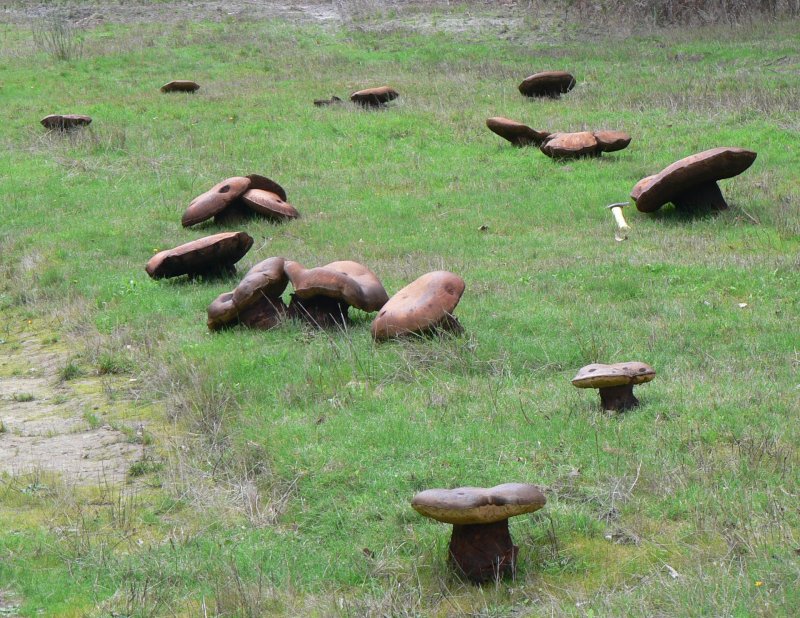
Phlebopus marginatus has the largest fruiting body of any mushroom in Australia.  It is a truly spectacular mushroom.  I am including it here as it is recorded as being edible, but the sheer joy of the whole growth event may surpass any pleasure from eating it.

In Western Australia it is known as the Salmon gum bolete, and  Roger Hilton has recorded it as being edible.  The indigenous people did not eat this mushroom however, according to a report by James Drummond in the 1850s.   The pictures below, however, are from Victoria  (thanks lizza)

It grows in rings.  These might be described as circles of giants.

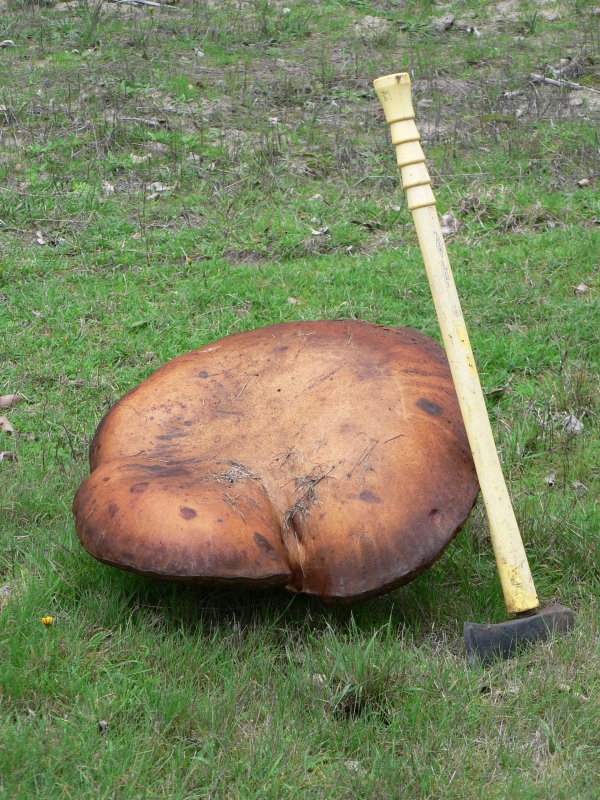
The actual size of an individual mushroom can be up to a metre in diameter.  This picture shows one in comparison with a block splitter that is 800 mm in length.

Whereas in Western Australia this species grows mainly in the wheat-belt which has a relatively low rainfall (300 -600 mm/a), similar mushrooms in the eastern states can grow in quite different locations where it is much wetter (+600 mm/a). Information on the distribution likely to be somewhat influenced by the fact that there are other large un-named boletes that could easily be mistaken for this species.

It is notable that specimens in the eastern states often display a blue colouration in the flesh whereas those from Western Australia do not display this feature. There has been no systematic study of the variation in this genus across the country, but it is notable that there are 5 species listed in the Queensland Mycological Society list of boletes. Given the significant difference in the rainfall patterns between the areas it occurs in Western Australia and on the east coast, it is quite possible that the species in WA is in fact different from those in the east. For anyone interested in pursuing this, there is some sequence data on iNaturalist presented by Damon Tighe as observation number 244645627. This was a sample from the typical range, in Corrigin in the WA wheat belt.

My friend Jsun Lau reports finding this species in northern NSW and comments on it’s edibility. The specimens he shows however differ somewhat from those shown above.

It is unclear how it got the name Salmon Gum Bolete, but it is probably because it was thought be in mycorrhizal association with that tree, Eucalyptus salmonophloia which occurs across the range where this mushroom is normally found in Western Australia. This tree does not occur naturally in the east coast however, so the terminology is really not really appropriate to the vast majority of recorded occurrences. It is a pretty tree however and I include a picture of it here just for interest.

Eucalyptus salmonophila

Because of its size, this mushroom has always been an item of curiosity. This image, from the State Library of Western Australia, George Henry Riches collection of glass negatives ; BA2751/137, shows a young Harry Ferries sitting on what can only be one of these mushrooms, probably in the Wyalkatchem area in the central wheatbelt area around 1905.

The genus Phlebopus has a wide distribution usually described as pan-tropical. In this regard the species from Western Australia is very much an outlier. It is consumed in various countries such as China, Thailand and Reunion. Given the poor reports regarding the taste of specimens found in Australia, it seems that the species found in other countries may have a more appealing taste. Studies are somewhat hampered by the fact that the mushroom is often infested with insect larvae and it is not easy to preserve specimens.

Although this mushroom was originally assumed to be mycorrhizal, the situation is much more interesting than that. It has been grown in culture without any host tree but more interesting still is that it has been found to be in a three-way relationship with tree roots and mealybugs. This is described in a fascinating paper by Fang et al in 2020. The fungus participates in the formation of a gall on the roots of the tree which provides the mealybug with protection. The galls are lined with the mycelium of the fungus. The mealybugs have mouth parts that are able to penetrate through the mycelium layer and into the roots from which they draw sustenance. The mealybugs in turn exude ‘honeydew’ which provides food for the fungus.

This is not the only mushroom that forms such an association. The Ash bolete Boletinellus merulioides also enters into such an arrangement with an aphid. There are many mealy bugs that are associated with this type of symbiosis as well. I had not been aware of the diversity of root mealybugs until they raided my tomato plants this year. Below are some images of the ones that have invaded my tomatoes. It seems that they might be associated with some kind of fungus too as there seems to be quite a lot of white material in association with their location on the plant root. I have not established the genus of these guys yet.

Root Mealybugs


Comments (23) »

Identifying a field mushroom

Disclaimer  :  These notes are provided as a guide only.  While every attempt has been made to try to assist in the identification, the risk of eating any wild mushroom rests with the individual and I do not accept  any responsibility for consequences  that may arise from the action of anyone eating wild mushrooms.  See also  inedibles and lookalikes

—————————————————————————————————————————

The fungus that we know in Australia as a field mushroom is a member of the genus Agaricus.  This is a large genus with a single ancestor (monophyletic) and within the genus is a number of sections each containing a range of species.  While it is tempting to try to assign a species name to any mushroom that you might find, this can be difficult in Australia because many of the species are undescribed or if they are described they aren’t reported in popular guide books.  In addition, it might require the use of a microscope and other detailed analysis.   For our purposes though, it isn’t important to have a name; edibility can be determined by features that can be simply observed.  Our main objectives are:

  • make sure we have an Agaricus
  • Make sure it is not in the section Xanthodermatei

Examples of some well known members of the Agaricus genus are:

Agaricus bisporus – the classic small supermarket mushroom

Agaricus bitorquis – marketed as a larger form of supermarket mushroom

Agaricus arvensis – the almond mushroom or horse mushroom.

Agaricus campestris – the classic if oft mis-identified field mushroom.

This list of features has been put together to assist the average person to identify an edible field mushroom.

1.  Cap colour and texture

The cap of the edible Agaricus species varies from white though dun and on to a slightly pinkish colour in species like A.  sylvaticus.  The cap may be slightly scaley, and may be cracked.  It is always dry and is never slimy to the touch.  Both the colour and texture of the cap are influenced by the environmental conditions as well as the genetics.

Any mushroom with any hint of green in the cap colour should be rejected as this is the colour of the deadly Amanita phalloides.

 top of small field mushroom, typical of those found in lawns (Dave Freer)

top of large field mushroom, similar to supermarket field mushroom (Dave Freer)

top of Agaricus arvenis, showing scales

A forest mushroom, showing red tones on the top

Top of Agaricus bitorquis.  A clean off-white, with undulations

A horse mushroom from the Riverina district of NSW.  Note scales.

A mushroom from a backyard in Penshurst, Victoria, showing some radiating spots.

A mushroom from Digby in Victoria, showing red/brown central region and radiating scales.

2.  Gill colour

The gill colour may vary from brown to pink or off-white in the young mushroom, but it will always darken to a dark brown in a mature specimen.  ‘Not black, but dark brown. Never eat a ‘field’ mushroom with white gills.  This eliminates the poisonous Amanita and Chlorophyllum molybdites.

Pink colour of immature specimen of  a small field mushroom.  Picture courtesy of Dave Freer.


3.  Spore print

The spore print is always dark brown.  Not pink, not rusty, not black or purple or white.  Dark brown only.

How do we take a spore print?  Easy.  Place the mushroom, or a piece of it, on a piece of waxed paper and place a glass over the top, with the edge of the jar just propped up by a matchstick or something similar to allow water vapour to escape.  Place in a position away from draughts, overnight.

A simple setup for taking spore print

A spore print of an Agaricus species

4.  The stem snaps away from the cap

The stem of an Agaricus has a texture that comprises a bundle of stringy cells running axially.  The cap has a different texture.  At the point of the junction of these two textures, there is  region where the two will break apart cleanly.  Try this for yourself with a supermarket mushroom.  Note in this mushroom the dark gill colour.  Note also that the gills are ‘free’, that is to say they are not attached to the stem.

The point of separation should be between the top of the stem and the flesh of the cap.  In some species the stem appears to break away cleanly, but close inspection will show that there is a piece of the flesh from the cap attached to the stem and the position of the separation is actually between the surface of the cap and the flesh of the cap.

This test serves to separate Agaricus from members of the family Cortinaraceae, such as Hebeloma, Inocybe, Cortinarius and Galerina, some of which are seriously poisonous.  It does not separate it from Amanita though.

5.  Smell

Field mushrooms have a distinctive smell that is either ‘mushroomy’  due to a chemical called octenal, or almond/aniseed due to the presence of benzyl alcohol and benzaldehyde.

If the mushroom has a smell of phenol, which is the smell of India ink, or phenyl disinfectant, coal tar soap, creosote or sometimes described as ‘chemical’, then it should be rejected.  Another common product that has the phenol smell is wheelie bin cleaner.  It contains cresols, which are related and smell the same.   Interestingly, and I don’t know why, at high dilutions wheelie bin cleaner smells like Clag glue. Perhaps they use phenol as a preservative.

If in doubt,  there are three approaches you can take;  1) put the mushroom in a plastic bag for 15 minutes and then sniff the contents or  2) heat a piece of the suspect mushroom in a microwave for a minute.  3) Keep one on your desk or other work surface for a few hours.  Sometimes when the smell is not apparent at first it will become apparent over time.  I don’t know what is behind this effect but it is possibly because the phenol is present as a pentose glycoside, ie it is bound to a sugar molecule and that this combination breaks down slowly once the mushroom is picked.  The bad smell will become more apparent if there is phenol present as will the almond smell. If you can’t reliably and comfortably identify the smell, preferably with confirmation from someone else, then you should reject the mushroom.

It is often reported that some people can tolerate eating mushrooms that contain phenol.  I did not believe this for a long time but a friend showed me a specimen of what was undoubtedly a yellow staining mushroom from Section Xanthodermatei that a local farming family had been consuming without ill effect.  The identity was confirmed by DNA analysis.  Like many poisons, there is a distribution of susceptibilities in any population and this seems to be an example of that.

Why is phenol a problem and benzaldehyde isn’t?   Because phenol causes acute irritation of the gastrointestinal tract.  This can cause distress and vomiting, but it will pass and will not leave any permanent damage.  Benzaldehyde is a natural product that is a component of almond essence that is used in making marzipan and is without any toxic effects at the doses involved in mushroom consumption. Similarly, benzyl alcohol has low toxicity.

Some poisonous species contain hydroquinone as well as phenol.  This too can also cause gastric upsets. In these ones, both the phenol smell and the yellow colour are not as intense.  The smell should be determined on a fresh specimen at the base of the stem.

6.  Colour of cut or bruised flesh

The colour of the cut or bruised flesh may be brown or red or yellow, or there may be no change in colour at all.  Here for example is an edible mushroom, Agaricus bitorquis, which is showing red on a cut piece.  Photo courtesy of Dave Freer.

Brown or red bruising is usually ok but not an infallible indicator.   A yellow colour may be ok or it may indicate Agaricus xanthodermis, which will cause stomach upsets.  There is much confusion about this.  The yellow colour is an indicator of  A. xanthodermus, which contains phenol, but it does not necessarily indicate an indedible mushroom.   For a diagnosis of an indedible yellow staining mushroom, one needs to have the yellow stain in combination with a phenol smell, as mentioned above. Another term for yellow staining is ‘flavescent’.

The place to determine both the colour and the smell is the base of the stem.  Both features are less prominent in other regions of the mushroom. Don’t be shy, really squash it to get the smell.

Another feature of the yellow staining inedible species is that the yellow colour changes to brown over about an hour.  The yellow colour also intensifies with cooking.  Another test is that the colour intensifies and stays permanent in response to a drop of a 10% solution of potassium hydroxide or the more easily obtained sodium hydroxide which does the same thing. Below is a picture of a mushroom that has been tested with sodium hydroxide.  For some more details on structure and staining in section Xanthodermatei, look here.
yellow stain with caustic

7. Substrate

Field mushrooms will always be found growing from some kind of soil.   They never grow directly from wood and they do not  grow in the middle of cow pats.  There are some deadly species like Galerina that grow from wood and if it is growing from a cow pat, there is a good chance that it is the notorious hallucinogenic ‘gold top’, on the Australian east coast at least.  They do not tend to grow from wood chip or bark mulch either.

Don’t pick and eat mushrooms that grow beside highways or other places where they may have accumulated things like heavy metals or other potentially toxic things.  Mushrooms can be quite good at gathering these things.

8.  Cap shape

Mushrooms of the Section Xanthodermatei, the yellow-staining, phenol containing species tend to have a flat top when juvenile, sometimes continuing to when they are fully grown.  They are often described as having a ‘boxy’ shape.

This, however is not exclusive to this section.  There are many other species that have a similar flat top, and the classic example is Agaricus augustus, known in the US in particular as The Prince, and highly prized as an edible.  So the flat top has limited value as a diagnostic tool.  Sometimes people declare mushrooms to be yellow strainers and therefore inedible based on shape alone without even testing for a yellow stain and smell.  I suggest taking a more thorough approach as outlined above.

9. Tasting

If you are eating an Agaricus that you have never eaten before, try out a small piece first. Sometimes we can be allergic to mushrooms for no apparent reason.   If it tastes horrible, don’t eat it!  This has happened to me with something I expected to taste good.   If you have not experienced any ill effects by the next day, then you can move forward to eating a larger quantity.

Whatever you do, don’t gulp down a huge meal of something that you are unfamiliar with.

10.  One final thing

If, after reading all of the above, you are still not sure, then there is an old mushroom gatherers maxim that applies:

If in doubt – chuck it out

(This picture is repeated as a Facebook catcher)

agricarus 4

Peter Donecker

Comments (57) »

Look-alike Hebelomas

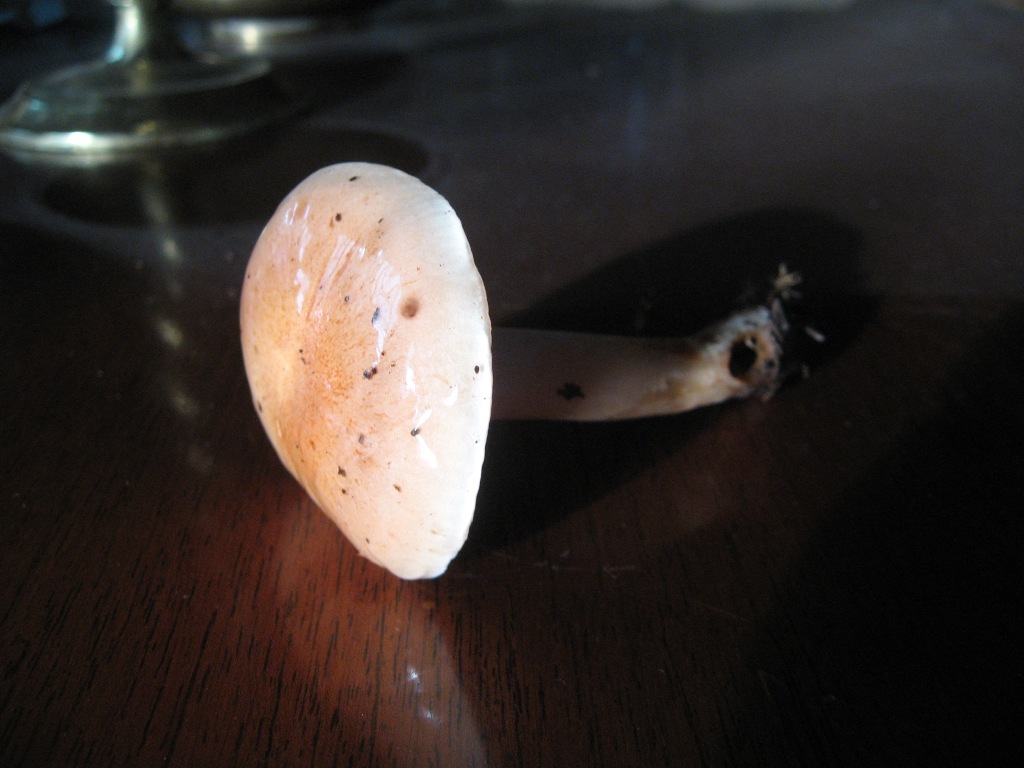
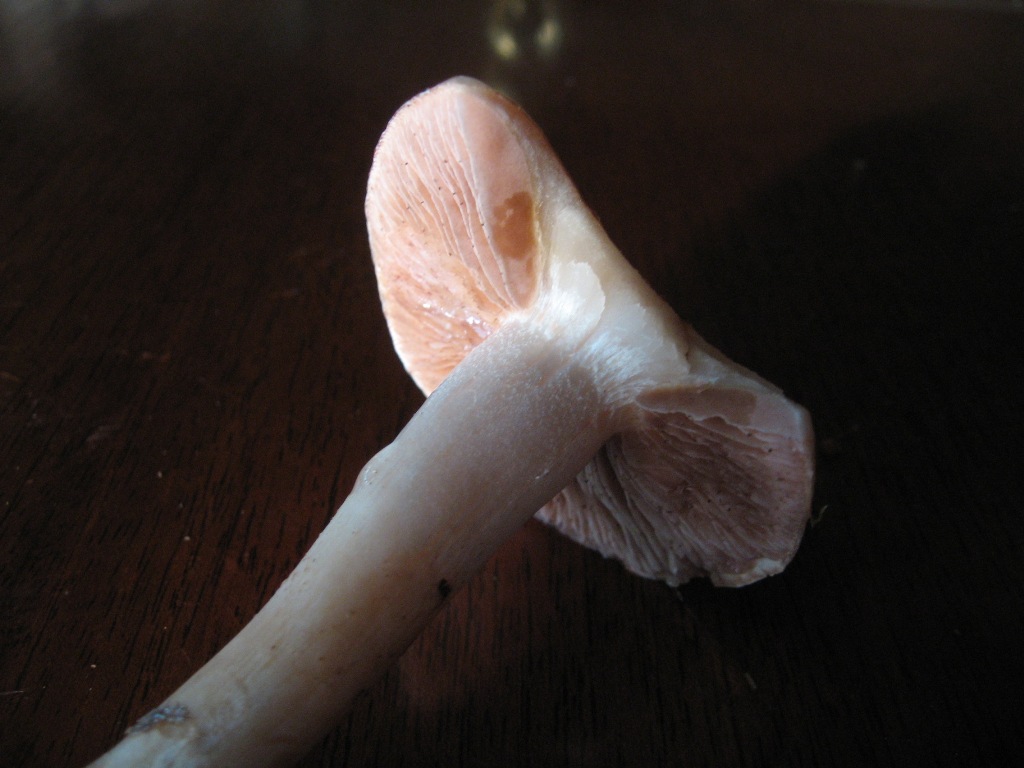
During another walk this evening I encountered another mushroom that had a similar appearance to an edible field mushroom.   I picked it and brought it back to the house to document why it is not an edible field mushroom.  Here is a picture of the cap.

Hebeloma westraliense, showing glutinous cap

The cap is not outside of the colour range that one might expect for an edible field mushroom, but notice that it is shiny?  In fact it is quite slimy to the touch.  This alone is enough to declare it to not be an edible Agaricus.  However, let us continue…

Hebeloma westraliense, showing gills and top of stipe.

When we flip the mushroom over, we can see that the gills are in the right kind of colour range and that the stem has the right sort of thickness in relation to the cap.  In fact, the gills even darken from pinkish to brown over time.   However, the thing that is glaringly absent is an annulus or ring on the stem.  Not a hint of one!  We know for sure now that this is not an edible Agaricus, but lets go further…

Hebeloma westraliense, torn

If we attempt to snap the stem away from the cap, the result is unsuccessful.  The whole cap tears apart rather than breaking at the junction of the stem and the cap.  There is no change in the tissue type between the stem and the cap.  This thing has now failed three tests.  Quite a pretty mushroom never the less 🙂

If you are wondering about the tabletop, it is Australian red cedar, Toona ciliata.  The mushroom is Hebeloma westraliense, edibility unknown (Bougher and Syme).  Hebelomas are very useful for promoting the growth of Eucalypts and are cultivated for that purpose worldwide.

December 2023

In pine forests, and associated with introduced trees there is another species called Hebeloma crustuliniforme, also known as Poison Pie that is known to be poisonous.

Hebeloma crustluniforme with $10 note for size comparison.

Hebeloma crustuliniforme, torn in half.

I often hear people offer the advice “if you can peel a mushroom it is edible”.  Of course such generalisations are nonsense, since you can peel a death cap.   But I suspect that the origin of this advice is that this is a means of distinguishing between Agaricus and Hebeloma.

Comments (12) »

Look-alike Cortinarius

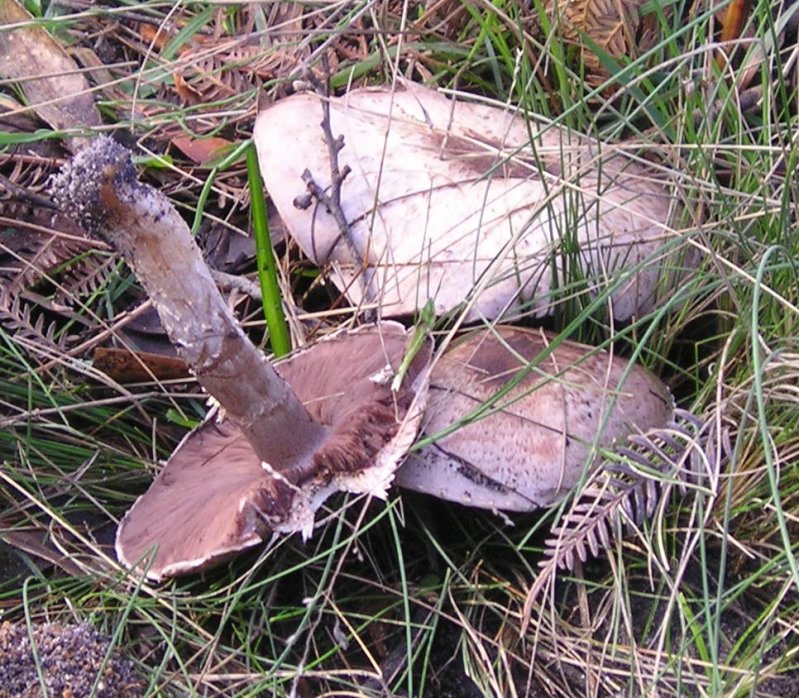
I was walking along the fire track this evening when I spotted this lovely big white mushroom cap, about 100 mm across.

Now, in colour and shape, this is not disimilar from an edible Agaricus.  It is similar for example to Agaricus bitorquis.  The location, in undisturbed eucalypt forest is a little unlikely for an Agaricus such as that however.

It can be seen that the edge of the cap has remnants of a torn veil.   This might lead one to think that it is an Amanita.  However, on flipping the mushroom over, all is revealed.

We can see from this that the mushroom has a ring on the stem, like an edible Agaricus and that the gills are within the right colour range, but on the surface of that ring is a deposit of orange spores.   This shows us immediately that what we are looking at is not an Agaricus, but is in fact a Cortinarius of some kind.  If it was an Agaricus, it would have a chocolate brown spore print.

Further differentiation from Agaricus is provided by the fact that the stem and the cap are part of the same structure.   In Agaricus, the stem will break away cleanly from the cap.

As a rule, species in the genus Cortinarius are poisonous, so this is one mushroom that we would definitely avoid!

Leave a comment »

Boletes – a lost resource

“Few orders of plants appear to contribute more to the support of animal life in Western Australia.  Many species, Particularly, the genus Boletus, are used as food by the natives and directly supply no inconsiderable portion of their support for several months a year.”

James Drummond, the pioneer botanist of WA.

This quote is from an article by eminent mycologist Roger Hilton, in a short article about edible fungi he wrote in the journal Landscope in 1988.

In Western Australia there is a large number of boletes that spring up each Autumn.  Judging from overseas experience, it is likely that a lot of these are edible species, but all of the knowledge of Aboriginal consumption of these fungi sadly has been lost.

Hilton comments there are boletes that will make you sick, but none that are known to be lethal like the Amanitas.   However, there has been one recorded case of a fatality from eating a bolete.  In this case it was from muscarine in the mushroom.

From time to time, I experiment with some of the many boletes that spring up on my property.  My standard test is to lightly fry a few small slices in some oil and do a taste test.   By this means, I have been able to eliminate a few as being too revolting to consider.   There remain others that are tantalisingly tasty.  I tried one a few hours ago.   It was a handsome specimen with firm white flesh and a black cap.   When cooked in this way, it produced a wonderful tasting type of crisp.  So far, I am feeling no ill effects from the very small pieces that I tasted.   But this is not for the faint-hearted!   Over the years, by cautious exploration, I hope to be able to find one or two boletes that are edible.  I would rather be using a gas chromatograph for the initial assessments, however.

Presently, the only boletes that are known to be edible are the Slippery Jacks and Phlebopus marginatus, the Salmon Gum mushroom which often appears in the news because of it’s giant size and the introduced Boletus edulis that occurs in South Australia and Victoria. There are also reports of a “Mulga Bolete” that was cooked in ashes before being eaten but it’s identity is unknown.

Comments (2) »

Coprinus comatus – The shaggy ink cap

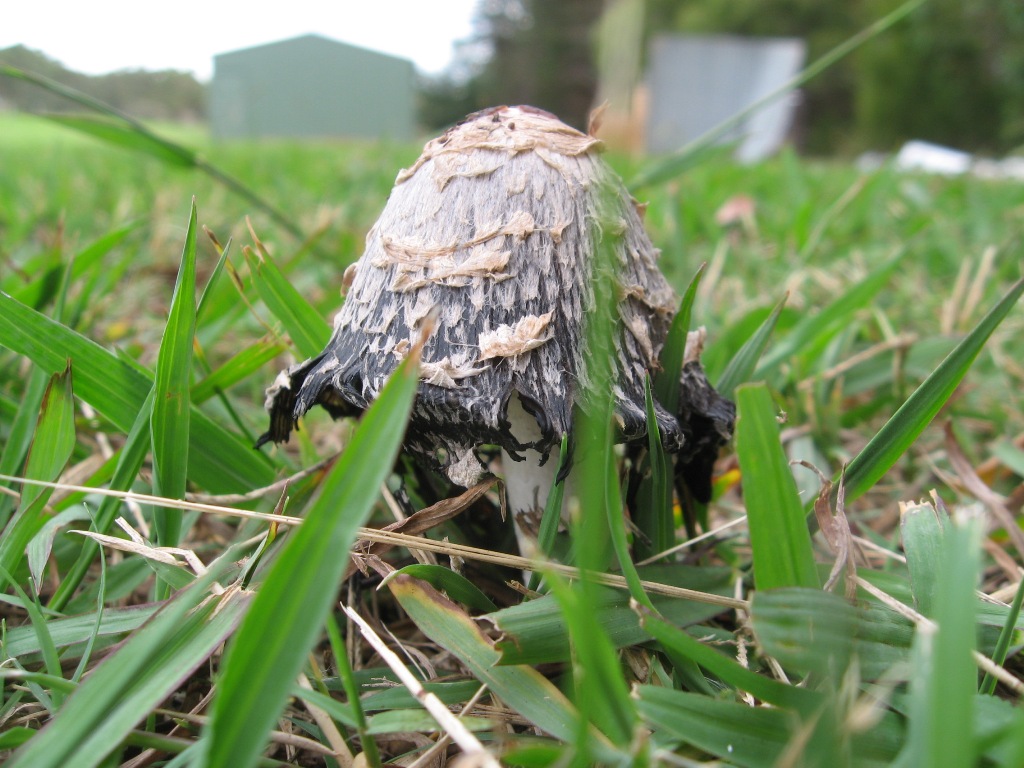
This mushroom is not a native, but it grows in Australia.  It is often found in parks and on waste ground and once established in a patch of ground, they will come up year after year.  Often, they favour grassed areas where the grass clippings are allowed to rot down in situ.  The one below is on the edge of the local football oval where it comes up each year with the onset of the first rains and continues to fruit through winter.

Coprinus comatus at the start of deliquescence.

These mushrooms, in common with all the members of the genus, self-decompose into a black inky mess.   The one above is beginning to go through that process and the one below is well into it.

Coprinus comatus, showing outward curl of rim during deliquescense

Sometimes, red droplets can be seen emerging from these mushrooms, in the same manner as some species of Agaricus. This seems to be associated with the spores.

Coprinus comatus, showing red droplets emerging from unopened cap

For culinary purposes, the mushrooms are best picked before the decomposition process has set in.  Decomposing specimens need to be kept apart from fresh ones.   They can be kept in iced water in the fridge for about half a day to avoid onset of the decomposition reaction.

The purpose of the decomposition reaction, sometimes called deliquescence, is related to spore production. Like most mushrooms, this species has a need to disperse it’s spores to the wind. This is difficult because of the cylindrical shape. To overcome this, the spores ripen from the bottom upward, as they do so the cap curls outward and dissolves into a dark inky mass. These actions are due to the influence of enzymes, including at least one chitinase that assists in the breakdown of the chitin in the cell walls. The mushroom contains a range of chitinases, as do other fungi, and they serve different purposes. Some for example assist in the extension of the hyphae and cell rearrangement. The chitinase that is primarily responsible for breaking down the cell structure in the cap does not affect the stipe which needs to maintain structural integrity during spore release.

The decomposition process does not produce anything toxic and the mushrooms can be eaten at any stage. The ‘ink’ can even be used to make a vegan version of squid ink pasta. It can also be used as writing ink, though it needs to happen quickly as it will further decompose under the influence of bacteria. Addition of some essential oil like oil of cloves is said to delay the fermentation of the ink. This use is nowhere near as common as the use of ink made from oak galls and iron salts.

For years I tried to incorporate these mushrooms into dishes without much success.  They always turned into a horrible slimy mess.  Then someone explained the trick.  You need to slice them and then toss them in a pan for a while on low heat until they have lost a good proportion of their moisture.  After that, they can be cooked as you would a normal mushroom.  The de-watering step ensures that they remain firm during the cooking process.

It is also possible to dry these mushrooms if you happen to have a dryer, or if the weather is sunny.  Drying must be done to the point of crispness.  Once dried, they can be used to impart a distinctive flavour to dishes.

Many books declare that this mushroom cannot be eaten with alcohol.  Unfortunately, this is a myth that has been propagated throughout the world.  Some of the confusion is due to the fact that the mushrooms that do cause this problem used to be grouped in the same genus, Coprinus.   With the advent of DNA profiling, things have been changed around and there are now only a few species left in the genus Coprinus.   The offending mushrooms are now in the genus Coprinopsis.  The most well known member of the genus that causes problems with alcohol is Coprinopsis atramentaria, the common ink cap.   Others in the genus contain the same chemical, with Coprinopsis picacea, the magpie fungus of Europe containing more than the common ink cap, though it is seldom consumed because it has an unpleasant smell. It is notable that Coprinopsis and Coprinus are not only different genera, but they are in different families.   Coprinus is in Agaricaceae and Coprinopsis is in Psathyrellacea.  They are not even closely related!

The compound that causes the issues with alcohol is known as Coprine.   It is an unusual amino acid.  There are other unusual amino acids in other fungi that are also responsible for toxic effects.    These are sometimes called non-protein amino acids as they do not belong to the set of amino acids that are incorporated in proteins. Since they are not tied up in proteins they are free to be extracted from the raw mushroom and in this way they enter the digestive system. The structure and breakdown reaction of coprine are shown below.

coprine mechanism

When we consume alcohol, our body processes it in a specific way.   It is first converted to acetaldehyde and then that is acted on by an enzyme called aldehyde dehydrogenase which converts the acetaldehyde to acetic acid.   The aminocyclopropanol in the reaction above blocks the action of aldehyde dehydrogenase and the result is an accumulation of acetaldehyde in the body.   This is toxic and it gives a reaction similar to Antabuse, a drug that has been used to treat alcoholism.
There is no truth in the idea that coprine itself has been used to treat alcoholism.  It has far to many other toxic side effects to be used clinically.   One of those side effects is to cause tumours in the reproductive system of male rats ( or was it mice?).

Somewhat perversely, some of the compounds produced by Coprinus comatus have been shown to reverse liver damage caused by alcohol, at least in a rodent model.

Coprinus comatus is a relatively large mushroom.  It can attain a height of 200 mm or more and is typically 20 to 30 mm in diameter.   It should not be confused with some of the similar looking small species that are sometimes seen on composts for example.  One mushroom of similar stature that occurs in my part of the world is Coprinopsis aff. stangliana.   It is shown in the image below.

Coprinopsis aff. stangliana

Coprinopsis aff. stangliana is so named because it resembles a northern hemisphere species. DNA studies suggest however that it is a native, at least in Western Australia where it can be found from Perth southward to at least Margaret River. It is common in the Tuart Forest. It rivals Coprinus comatus in size, sometimes reaching 300mm in height. A large specimen is shown in the image below.

Coprinopsis aff. stangliana showing long stipe, outward curled cap and deliquesence.

The spores of Coprinopsis aff. stangliana are shown below.

Spores of Coprinopsis aff. stangliana

Another type of ink cap that has some similarity in appearance, though it is much smaller, is Coprinellus flocculosus. It is shown in the image below, together with it’s spores.

Coprinellus flocculosus
Spores of Coprinellus flocculosus

Footnote May 2011. I found a large patch of these growing nearby a few days ago and picked several kilograms of them. In order to handle them quickly, I decided to chop them and render them down to a soup in a stainless steel pot. It was an expensive pot with a copper insert in the base and I bought it for making jam. They rendered down nicely and I left the pot on the stove overnight, then decanted it into two smaller containers in the morning. The resultant mix had a pleasant, almost sweet smell. However, upon tasting a small sample of soup made from the mix, my senses were soon overcome by an unpleasant metallic taste. Research suggests that this is 1-octene-3-one. I can still taste it after 24 hours and two intervening meals. I have never tasted anything with such a persistant after taste. So that is something to be wary of with this mushroom. I have dried a smaller sample of them, and will investigate their taste with caution.

Comments (9) »

Agrocybe (Cyclocybe) parasitica

At the top of my list of edible mushrooms that I have not tried is Agrocybe parasitica.  That is because it is a large mushroom and can occur in fairly large clusters.  It should also be possible to cultivate this mushroom.


Above picture is courtesy of Reiner

Various sources disagree with respect to the edibility of this mushroom.  None list it as poisonous, but some advise caution.  On the other hand, Watling and Taylor (1987) describe it as an excellent edible.  Their description can be found here.

9 May 2021

It is 11 years since I made that post. This year has seen a flurry of fb posts from people in northern NSW describing this as the best tasting mushroom that they have ever eaten. It seems that it occurs in quite large outcrops in that area as well as in New Zealand. It also occurs in Tasmania. I am still to taste it. Oh, and it has had a name change to Cyclocybe parasitica.

Comments (7) »

Truffles – the new crop of the region

In this corner of Western Australia, black truffles are becoming big business.   Although the soil requires quite a bit of lime to bring up the pH, they are growing exceptionally well here, with some of the biggest specimens in the world coming from a farm about 20 kilometers away from me.  I have a small plantation of innoculated oaks and hazelnuts that are years away from providing a harvest, but I live in hope.  This is an example of a truffle that I purchased locally.  It cost around $100.

truffle

Leave a comment »

Tricholomopsis rutilans – plums and (dis)custard –

Some mushrooms that are listed as edible might be better listed as non-poisonous.   I did try a little bit of one of these plums and custard mushrooms which are considered edible in Europe, but it was truly disgusting, with a taste like mud – yuk!

tricholomopsis

June 2022.

It is likely that this is not in fact Tricholomopsis rutilans but another closely related species. One that has been reported from the Perth region in 2020 is Tricholomopsis scabra.

Comments (1) »

Morchella – The morel, a worldwide favourite

This mushroom is a favourite right around the world.   Most people in Western Australia are completely unaware of it, however.  I have found it in quite a few situations, but nothing quite compared with the crops that emerged from pine bark mulch next to a limestone wall at Golden Bay, to the south of Perth over a period of 3 years.  There were thousands of them. They are always quoted as a spring mushroom, but I found these large crops in mid-winter (June/July).

I didn’t get photographs of the outcropping, unfortunately as it was before digital cameras were an everyday item.  But I did get this one picture of a single specimen. (see edit below) There is a better image of one on this site.

morchella

And, just in case you don’t believe the  numbers of morels that I picked, here is a jar full of dried ones.   BTW, if drying morels, do it as fast as possible to prevent any other organisms taking hold.

I have found a single morel growing in the karri forest right next to my place, and they are reported as being common in Spring through the jarrah forests of the SW.  They are not uncommon in suburban Perth, and friends have shown me examples cropping up in their back yards.

It is quite easy to culture these from a piece of the inside of the hollow stem, using standard techniques.   The ones I have cultures like this have been very vigorous growers.  However, moving  from culture to fruiting body is not a simple task and has defeated many highly skilled mycologists, as well as me.  Update (2022) My friend Jsun Lau has managed to grow them, however, in a planter pot.

I have eaten a lot of these, my favourite recipe being morels stuffed with crab meat cooked in a cream sauce.  The only problem I found was that it was almost impossible to wash the sand out of the crenulations.  WA is a sandy place.  To be perfectly honest, though I find them to be pleasant to eat, I can’t understand the frenzy that they induce in places like the US, in May.

When I had a lot of them, I tried to sell some to restaurants around Perth.  Most of them had never seen a morel!

Note: June 2011. The morels in the picture above have been identified as Morchella rufobrunnea, by DNA matching through the assistance of morel expert Philippe Clowez. (Genbank KM588017.1)  This appears to be the first record of this species in Australia. Previous specimens have come from Mexico, Israel, The Canary Islands. The habitat where these were found is remarkably similar to that described for the other specimens, even down to the presence of olive trees in one case. The unusual timing of the fruiting appears to be another feature in common with the overseas versions. Thank you Philippe.

Edit 1 Sept 2015:  With thanks to correspondent Oscar, I was able to collect more specimens of Morchella rufobrunnea from pinebark mulch in Joondalup a Perth suburb last weekend.  This was exactly the same sort of substrate that I found them in before.   I am very grateful to Oscar for alerting me to these as I have been on the lookout for them for 14 years since my first find.   Here is a picture of a cluster of them together with the lump of and bark and soil that they were growing from.

IMG_0157morelsmall

The lump of bark and soil appears to be stuck together with mycelium in much the same way as the stonemaker fungus, Polyporus tuberaster.  The association with pine bark mulch is interesting as this species is reported to be associated with pine forests.  Just how they come to be associated with the mulch is a mystery though.  They appear to be saprobic rather than mycorrhizal in this case.  Since the advent of Facebook mushroom interest groups it has been possible to establish that these are also widespread in SA, VIC and NSW too. They occur over a very wide time range, from June right through to October.

Here is a picture of some as they occurred on the mulch.


morchellaruffoonbark

Reports of M. rufobrunnea in WA range from Bunbury to Yanchep and they appear to be exclusively restricted to the Swan Coastal Plain which is comprised of calcareous limestone sands which are naturally alkaline in nature.  In Israel, they are reported in a silty clay loam with a pH of 7.85.  This 2021 publication describes some detailed investigations into the microbiome associated with the fruiting bodies.  They report a progression of microbes in samples from bare soil illustrated in the diagram below.  This appears to show quite a complex level of symbiosis with different types of microbes at different stages of development.  The existence of complex relationships between Morchella and bacteria has been demonstrated elsewhere in the literature (2019).  Even more remarkable perhaps is the claim the Morchella crassipes actually farms the bacterium Pseudomonas putida. In contrast to its human counterparts it has not slapped a patent on this process however.


Another type of morel that occurs in Western Australia comes up in forests after fire.   I have encountered these in burnt karri forest in large numbers though they are also reported to occur in burnt jarrah forest.  These are reported to be Morchella elata by the local mycologists. Here are a couple of images of them.

Morchella elata lantern1

Morchella3

From these two images, it can be seen that the morphology changes widely. The second one looks very much like M. importuna, a mulch-growing species from the US.

More recent work has suggested that there are two fire morels in WA, one of which is identified as Morchella septimelata and the other is yet to be named.  A recent revision by Richard et al. renames M. septimelata as the earlier described M. eximia. This is of worldwide distribution and genetically identical specimens have been reported from Wyoming.  A specimen collected in 2016 by the author has been confirmed as M. eximia by DNA analysis thanks again to M. Clowez. (Genbank KM587970.1)  Fire morels occur in August and September.

There is another morel that occurs in NSW and Victoria in forests that have not been subjected to fire.  It was recently (2014) identified as Morchella australiana.  This species has been recorded in WA from a sample collected near Narrogin.   Though it was identified by DNA sequencing, this has sadly not been shared to the world via Genbank.  This specimen is recorded in iNaturalist and an image is reproduced below under commons license.  It has also been seen near Palgarup. 

Morchella australiana

Morchella australiana, near Narrogin, WA

People have been collecting morels that are not associated with fire  from the forests in Victoria for a long time.  Perhaps these are the Morchella australiana referred to above.   Below is a picture of a basket of them kindly provided by a friend.   You can see the black edges on them which seem to be a feature of these ones.

Victorian forest morels

Victorian forest morels

In Tasmania, Karen Stott & Caroline Mohammed have investigated native morels as part of a RIRDC project, “Specialty Mushroom Production Systems: Maitake and Morels”, available online.  They have identified a number of species that are shown below in a picture from their publication. They also address the cultivation of these fungi.  It would not be surprising to find similar species in WA, or perhaps a re-classification of some of the M. elata that are currently reported here.

tasmanian morels

In South Australia, people are reporting a morel with black edges.  One report says that these can be found on remnant sand dunes with sclerophyll forest.  Here is a picture of one from South Australia with kind permission from Yannick Foubert.

yannick-morel

There are many more morels in the US than we have here.  Debbie Viess who has been kind enough to comment in this blog has a rather nice summary together with some information on some of the different species.

October 2021

I was intrigued to see some images taken by Bronek Burza in the Hobart area of Tasmania labelled Morchella tasmanica. A couple of his images are included below, with his permission.

Morchella tasmanica credit Bronek Burza

I had not heard of this species before so I did a little bit of research. It turns out that this was first described in 1920 by John Ramsbottom who worked for the British Museum. The specimen was collected by Lilian Suzette Gibbs in 1914 from The Dromedary near Hobart. A snippet from her publication is given below.

Lilian Gibbs (1870-1925) is quite an interesting character – she travelled the world documenting the ecology of mountain habitats. I will leave the interested reader to research further about her.

Lilian Suzette Gibbs

The description of the species is given in the second installment of the paper above. It is in Latin and doesn’t really help too much with the identification.

An English translation of the above is provided by an online translator with quite a few perhaps incorrect adjustments by me.

Ascomate oblong-conical, acute, c. 3 cm. long, 1.5 cm. thick, base
scarcely exceeding stipe diameter, pruinose, with primary longitudinal ribs subparallel, edges obtuse, dark-chestnut-brown, secondary transverse, folded, irregularly shaped;

Stipe subequal and at the base not thickened, slightly thicker toward the top, c. 9 cm. long, 1 cm. thick, glossy velvety, completely covered in tawny down ;

Hairs? variable, septate, distally scarcely thickened, c. 20 microns thick;

Asci cylindrical, tapering at the base, octospores, 350-400 µ x 22-24 µ;

Spores largely ellipsoid, hyaline or hyaline-ochraceous, 27-32 µ x 15-16 µ;

Paraphyses branching, septate, hyaline or hyaline-ochraceous, barely thickened at the tips, 15-17 microns thick. 

On wet ground.

To date there has only been one species of Morchella that has been considered to be native to Australia and this is Morchella australiana. Some collections from Tasmania have been identified as M. australiana and there is some speculation that Gibbs’ specimen is in fact the same as M. australiana. In that case it would seem that the name Morchella tasmanica should take precedence. It should be noted though that the Tasmanian specimens do not seem to turn black like the specimens of M. australiana from Victoria and NSW.

This led me to wonder if the Gibbs’ specimen was still in existence and if it might be possible to do a DNA analysis on it. It seems that I have been beaten to the punch here and that just last month a voucher was lodged in Genbank by a group of Australian mycologists. It appears with the Genbank reference OK159934.1. Perhaps because this is a very old specimen, the analysis has been done on the LSU (large subunit ribosomal RNA gene). If one runs a BLAST on this, it does not show up M. australiana as a close relative but perhaps this is because the different approach taken in the DNA analysis. I don’t have sufficient expertise to work my way through this. In due course I imagine that there might be some publication explaining whether M. tasmanica and M. australiana are the same species.

We can compare Rambottom’s description with that of the more recently described M. australiana. One glaring difference is the size of the asci; only 140-165 microns for M. australiana. The paraphyses in M. australiana are described as 5-10 microns thick, which is much less than Ramsbottom describes.

Comments (27) »