Archive for Poisonous fungi

Australian Mushroom Poisonings 1

The death of Phillip Brouard, May 1885.

This is the first post in a series on historical mushroom poisonings in Australia.

One of the earliest recorded cases of mushroom poisoning in Australia, the death of schoolboy Phillip Brouard in 1885 remains an intriguing and tragic event. Occurring at a time when knowledge of fungi in Australia was extremely limited, this case raises questions about the circumstances of his poisoning, the rapid progression of his illness, and brings to light the broader historical context of his family

The Setting: The Town and the School

Kanyapella State School was situated approximately nine miles east of Echuca in Victoria.  Echuca is 190km directly north of Melbourne, at the junction of the Murray and Campaspe Rivers, on the northern boundary of Victoria.

Map of Victoria showing location of Echuca

The school opened in 1880 with an enrolment of 36 students. The weatherboard school building sat on land once owned by a Mr. Penny, leading to its early nickname, “Penny’s School.” Head teacher at the time of Phillip’s death was Silas G. Frost.

The Brouard family lived in a redgum slab cottage, a common form of dwelling at the time. These structures were built using split redgum timber, often with minimal insulation, reflecting the rural lifestyle of many settlers. Mr Brouard is reported to have had a vineyard on his property.

The Incident:

The Teacher’s Account

This account is transcribed from the hand-written Coroner’s Inquest of 7 May 1885.

Silas George Frost, sworn, states: I am the head teacher of the Kanyapella North State School No. 2285. I have viewed the body of the deceased, Philip Brouard.

Between half past 10 o’clock and a quarter to 11 o’clock yesterday, the deceased came to the school. I asked him why he was late, and he stated that he had been at home doing nothing.

He was frequently late, so I was forced to give him two taps on the hand (the punishment was very slight). He went to his seat. Some time after, about half an hour later, he complained that he was not well. I told him that he might go outside, not knowing that anything serious was the matter. He did not go outside but staggered away.

He fell on the floor and returned to his seat. I went to him and asked if he wanted to have a drink. He took a taste of water, and I placed a wet handkerchief on his head. He appeared to be in a fit or spasm. Stringy liquid issued from his nose and mouth. I then called my wife and carried him into my residence and placed him down on the couch. He lay very still. As he appeared to be sinking, I sent for his father. Mr. Brouard arrived, and I sent him for the doctor & Sergeant of Police thinking the boy was dead.

He gradually sank from the time he took ill & did not rally at all. The doctor arrived with the sergeant. The doctor pronounced the boy to be dead – His illness lasted about 3/4 of an hour.

Silas G. Frost

Taken signed and sworn at
Echuca in the Kialla Bailiwick
of the Colony of Victoria this 9th
day of May 1885 Before me.

Henry Cresson J.P.

Phillip Brouard on couch with Mr. and Mrs Frost (chatGPT)

Medical Testimony of George Reginald Edkins, M.D.

George Reginald Edkins, duly sworn, saith:

I am a duly qualified Medical Practitioner and reside at Echuca. I have this day performed a post-mortem examination on the body of the deceased boy, Phillip Brouard, who appeared to be about fifteen years of age.

There were no external marks of violence. The brain and other organs were found to be healthy. In the stomach, I discovered a quantity of fungoid mushrooms which were not partly digested and appeared to have been eaten uncooked. The stomach was very much distended. The small intestines were twisted in several places, indicating that there must have been violent peristaltic action.

I attribute the cause of death to the ingestion of poisonous mushrooms. I have heard the evidence of the last witness, and the symptoms described by him are consistent with those caused by eating poisonous mushrooms. I am aware that fungoid mushrooms can be highly poisonous.

George Reginald Edkins, M.D.

Truancy and Social Context

Schooling became mandatory in Victoria with the passage of the Education Act 1872, which made Victoria the first Australian colony to offer free, secular, and compulsory education to children aged 6-15, unless they had a reasonable excuse. 

Truancy was not uncommon at the time, and later that same year, Felix Brouard was fined for his children’s non-attendance at school, alongside many other parents. This context adds to the picture of Phillip’s life, suggesting that he may not have had a highly structured education or routine.

The Autopsy Report and Medical AnalysisLikely due to muscarine

From the description of the symptoms, we can speculate as to the poison that was responsible. The most likely candidate appears to be muscarine. This occurs in a number of mushroom genera, including Inocybe, Clitocybe, Rubroboletus and Amanita. It has also been isolated from Entoloma, Mycena, Boletus, Hygrocybe, Lactarius and Russula.

Symptoms Matching Muscarine Poisoning:

  • The description of “stringy liquid issuing from the nose and mouth” is highly indicative of excessive salivation and secretion, consistent with muscarine poisoning. This aligns with the excessive parasympathetic nervous system activation caused by muscarine.
  • The violent peristaltic action (as observed in the twisted intestines) and rapid progression of symptoms could also be attributed to muscarine’s effect on the gastrointestinal tract.

    There is a case report of a 7 year old girl who suffered such violent convulsions that she was administered curare. Her symptoms were intense salivation, vomiting and convulsions without diarrhoea.
  • The fact that the mushrooms were observable in his stomach at post mortem indicates that he would have eaten them within the preceding 2 to 5 hours. Since it was 10 o’clock when he arrived at school, and sunrise is at 7.05am in Echuca at that time of year we can probably narrow it down to the preceding 2 to 3 hours. He may well have picked them on his way to school which would fit with the narrative since the teacher did not notice anything when he first showed up. Muscarine can start to take effect in as little as 20 minutes. The fact that none of his family was poisoned indicates that they were not served up as part of his breakfast at home.

Age Discrepancy

One puzzling aspect of the case is the inconsistency in Phillip’s recorded age. His death certificate lists him as 11 years old, while the autopsy estimated he was 15. Such a significant discrepancy should have been apparent, yet it remains unexplained.

In any case, it might be expected that a child would suffer more severe effects than an adult.

Cultural background

Mycophagy as a tradition

Phillip was the son of Felix Brouard, a French immigrant. As is the case for many migrants from countries where harvesting wild mushrooms is a long standing tradition, it is likely that Felix may have picked and eaten some of the wild mushrooms he found in Australia. Philip may have thus been raised without the mycophobia that was, and still is, common for people of English descent.

Even today, many migrants do not appreciate that the mushrooms that they find in Australia are not necessarily the same as those they are used to in their home countries. This has led to a number of well documented cases of lethal mushroom poisoning in Australia.

The Brouard Family

The unfortunate demise of Philip leads to the wider story of the Brouard family which in turn shines light on an interesting period in Australian history.

I will add to this post in due course with some details of this fascinating tale.

Leave a comment »

A missing Western Australian ‘Death Cap’ Amanita?

I was interested to read about some people in Rwanda who eat large quantities of a mushroom from the genus Amanita that grow in the Eucalyptus plantations there. This mushroom is called Amanita bweyeyensis. There is a YouTube video on the subject, from which this image is clipped.

Peeling Amanita bweyeyensis before consumption


https://www.youtube.com/watch?v=PtjRvTmg3GY

This mushroom sits within the Phalloideae section of Amanita, where the deadly species containing amatoxins reside. Despite this, it does not contain amatoxins nor phallotoxins. It is the amatoxins that are the cause of many fatalities when people eat other mushrooms in this section such as Amanita phalloides. Phallotoxins are not orally active so pose less of a threat.

DNA analysis shows that this mushroom sits within a small cluster that includes the white “death cap” mushrooms from Western Australia. These are: A. djarilmari, A. eucalypti, A. gardneri and A. marmorata. The partial phylogenetic tree is from this paper: https://mycokeys.pensoft.net/article/34560/zoom/fig/11/

The specimen labelled HKAS77322 was found under Casuarina in Tasmania and is 100% match for A. millsii by a BLAST analysis

Analysis of the Western Australian species has shown that these do not contain amatoxins either. This is reported in a paper that is behind a paywall but the precis is shown at this link. It is available on Deepdyve to which I have a subscription. I have also tested two of them myself using a RAT style test kit as well as thin layer chromatography and have not been able to detect amatoxins.

This is a picture of the Amanita bweyeyensis from the paper mentioned above.

The images below show two of the white species from WA as well as Amanita millsii collected from Tasmania.

Amanita djalimari

Amanita gardneri
Amanita millsii

These species are quite close in morphology and genetically. It requires multi-locus analysis to separate them on DNA analysis. There are some small differences in spore shape, with Amanita millsii having almost spherical spores. The undescribed species in the herbarium collection are similarly close genetically.

Since the African species sit so close to the WA species in terms of genetics and they grow in Eucalyptus plantations, it is tempting to think that they might have their origins in WA. If this is the case, they do not seem to have been recorded here. It is hard to know where the Eucalyptus trees planted in Rwanda came from originally; they are not WA natives but it is not beyond the realms of possibility that they came from Western Australia, given that this is the closest state to Africa.

This brings to mind the green Russulas that grow in the Eucalypt plantations in Madagascar which are eaten by the people there. They also peel those mushrooms before consumption. These Russulas are unknown in Australia though it would seem likely that is their origin.

How are amatoxins produced?

The production of amatoxins has been investigated in some detail by Heather Hallen and others in terms of genes. It has been shown that the amatoxins originate from proproteins synthesised on the ribosome. The function of the ribosome is shown in this rather cute image which is by SITNBoston and is taken from the Harvard University Site.

The codon carried on the mRNA (we all know what this is these days!) is decoded in the ribosome and amino acids carried by tRNA are converted into an amino acid chain which is known as a proprotein. This is similar to the process by which the covid spike proteins are produced by the mRNA vaccines.

These proproteins have a size in the range of 34 to 35 amino acids whereas the toxins have a size of 8 amino acids. In order for the amatoxins to be produced, these long chains need to be reduced in size and the fragments cyclised. This process has been studied in the amatoxin-producing genus Galerina by a group of researchers and the process is shown in this image from that publication.


The proproteins are acted on by the prolyl oligopeptidase enzyme which cuts the chain at the Proline amino acid and then stitches together the piece that is clipped out to form the bicyclic polypeptides (2 rings of amino acids) that we know as amatoxins.

The amatoxins are bicyclic (=two rings) octapeptides (=contain 8 peptides) with C-to-N (head-to-tail) condensation of the peptide backbone and a cross-bridge between Tryptamine(Trp) and Cisteine (Cys). Three of the amino acids (Trp, Pro, and Ile) are hydroxylated. Phallotoxins are similar in structure but their macrocycles comprise only seven amino acids. The relationship between the different amino acids is shown more clearly in this labelled diagram.

The image below shows a 3D view of an amatoxinA molecule in a similar orientation to the image above. The yellow sulfur atom can be seen within the structure and the 5-membered nitrogen-containing hetercyclic ring of (hyroxylated) Proline (P) seen on the left hand side with the (hydroxylated) Isoeucine (I) skeleton above it and Asparagine(N) below it. There is also a bridge with the (hyroxylated) Tryptamine sitting in the middle of the structure which is facing out into the page.

Amatoxin A molecule

This type of structure is very stable and survives heating and the action of digestive enzymes. That is one of the reasons that this type of toxin is so dangerous.

Just why this group of mushrooms does not always produce these toxins doesn’t seem to be well understood. I believe that specimens of Amanita marmorata taken from the same region in Hawaii have tested positive in one case and negative in another. The Hawaiian species however differ quite widely in appearance and show some genetic divergence from the Australian specimens. An interesting comment reported on a University of Hawaii site has the following quote from Dr Don Hemmes;

“The most common Australian tree on campus is the ‘paperbark’ or ‘bottle brush’ tree, so this mushroom is common on the campus under these trees in the fall,” explained Hemmes. Although not deadly, ingesting Amanita marmorata causes uncomfortable gastrointestinal issues such as vomiting and diarrhea.”

I assume that the tree he is referring to is a Melaleuca quinquenervia which has been introduced to Hawaii as a windbreak tree. I have not been aware of this association. This trees has become something of a weed in Florida so if this association is true then Amanita marmorata might be expected to show up in Florida too. His comment suggests that someone must have consumed these at some stage – I wonder if there is some record of that?

Amanita reidii from South Africa is reported to contain amatoxins and it has been suggested that it is in fact Amanita marmorata but genetic differences put this in doubt.

The origin of this clade is put at around 60 million years ago. There is some suggestion that Amanita millsii might have been separated from the Western Australian species by the dry interior of the country at around 15 million years ago but this whole area of research requires more work and samples.

I have a specimen that looks very close to Amanita millsii, collected by a friend. One of these days I might see if I can get it sequenced.

February 2025

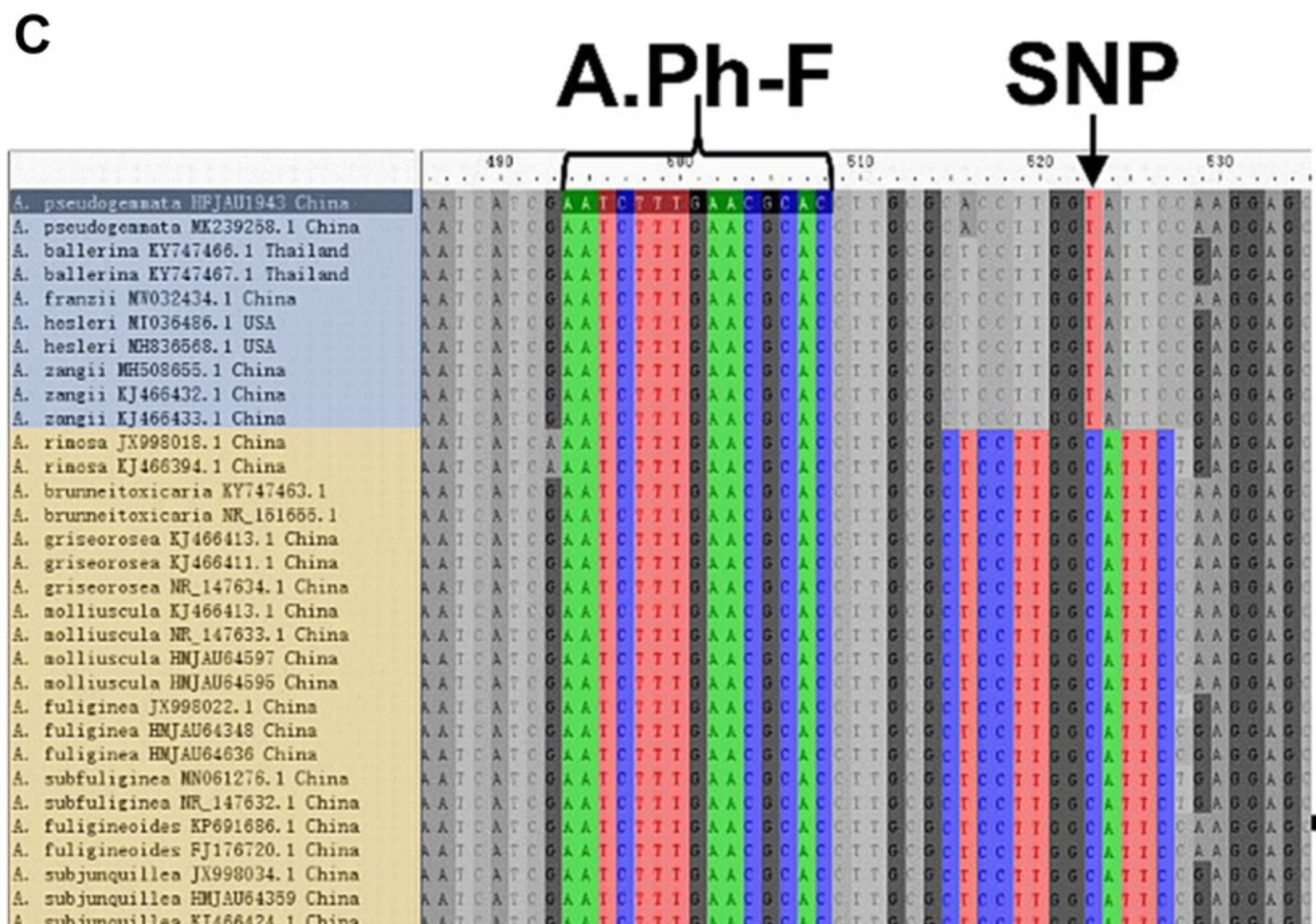
A paper from China published in 2024 suggests that the non-toxic Amanitas in section Phalloideae have a single nucleotide polymorphism (SNP) in the 5.8s region that distinguishes them from the toxic species. A clip from the paper is shown below.

This alteration in a single nucleotide would imply that this trait has been passed on from some common ancestor.

Out of interest, I used Genbank to find a short section surrounding the SNP in a selection of species mentioned above. I found that A.millsii, A. gardneri and A. djalimari all had this SNP. However, somewhat intriguingly, A. bweyeyensis did not. Neither did A. reidii, A. marmorata and A. eucalypti. I am not sure where this leaves us.

Leave a comment »