Posts tagged Australian mushrooms

Pluteus atromarginatus – just another Pluteus

Two dark purple mushrooms growing on decaying wood in a forest, showing gills and fibrous caps.
Pluteus atromarginatus on Eucalyptus wood waste

This mushroom was growing on wood waste in a Eucalypt forest in Pemberton. That contrasts to it’s reported preference for Pinus in North America.

It is a pretty mushroom, with dark edges outlining the gills.

Close-up view of the gills of a mushroom, showcasing their texture and layered appearance against a wooden background.
Gills of Pluteus atromarginatus

The gills are free, though some other examples online show more separation from the stem than in this case. According to Michael Kuo, this is unusual for a Pluteus species. The cap is dark purple and the gills are white with a very slight pink tinge

Three mushroom sections displayed on a wooden surface: a top view of the cap with gills, a side view showing the stem, and a cross-section revealing the internal structure.

The surface of the cap is covered with fibrous scales.

Close-up view of the textured surface of a mushroom, featuring dark fibrous scales on wood waste.
Cap texture of Pluteus atromarginatus.

The overall texture of the mushroom can be described as ‘watery’. It is reported to be edible, but to be honest the texture doesn’t make it very appealing. Tasted raw, it was reminiscent of other Pluteus species but it left an aftertaste that was slightly hot, and I can see how it is reported as being like radish. I fried a couple up in a pan and they became very sloppy, as expected. The taste became more mushroom-like, not unpleasant, and the after taste seemed to have been removed, although I think some still lingered from tasting it raw.

The spores of one specimen as shown below. They are almost spherical, smooth, with an average size of 6.6 x 6 microns.

Microscopic image showing spores of a fungus, with various measurements indicated in red on a dark background.
Spores of Pluteus atromarginatus.

The spore print is supposed to be pink but I would describe this as rusty brown.

Close-up image of mushroom gills and cap, showcasing a rusty brown spore print.
Spore print of Pluteus atromarginatus.

Leave a comment »

Lacrymaria velutina – an Agaricus lookalike

The genus Lacrymaria contains species with dark brown gills that are very similar in colour to Agaricus. Today I spotted the mushrooms below on the side of the road in the middle of Karri forest near Pemberton in SW WA.

Lacrymaria velutina

The gills were a dark chocolate brown.

Gills of Lacrymaria velutina

From the above shot a couple of things stand out. Firstly, the gills are attached to the stipe. This differs from Agaricus where the gills are always free. Secondly, the stipe has split into a number of strips. This does not happen with Agaricus.

A close-up of the gills also shows that they are blotchy in appearance, which we do not seen in Agaricus.

Close-up of Lacrymaria velutina gills

Under UV light the entire mushroom glows a lovely purple colour. Unfortunately I was unable to capture this colour on my iPhone.

Note: I have named this specimen from online images. It may be a native species that is not described.

Lacrymaria are not considered to be edible mainly because of taste rather than toxicity. It has a very thin flesh in any case so would not make much or a meal.

Leave a comment »

Macrolepiota dolichaula – one of the best of the edibles

Macrolepiota dolichaula in its typical habitat – a grassy paddock (Image credit: Pixie Miller)

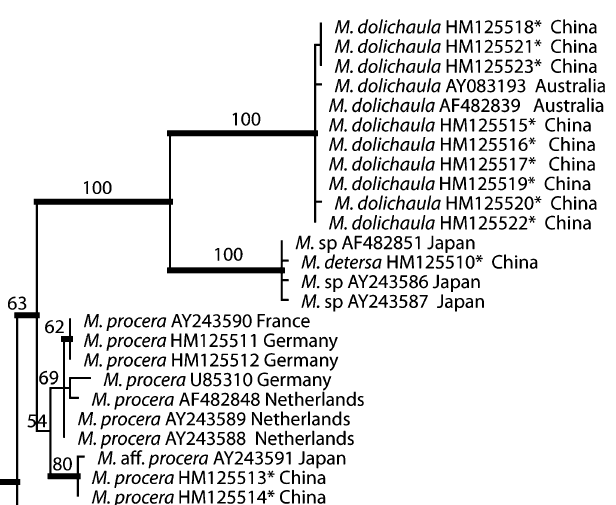
Macrolepiota dolichaula is a large mushroom that can often be seen in open paddocks from some distance away. It occurs in the warmer regions of Australia such as the North Coast of New South Wales and Queensland. It also occurs in other countries such as Vietnam, Northern Thailand and China. In all those places it is also considered an edible species. Genetically, the specimens from Australia form a monophyletic clade with the species from China. DNA Barcoding shows a 100% match between specimens from Australia and China. This is shown by specimens lodged by the mycologist who specialises in this genus, Else Vellinga. Genetically, it sits close to Macroplepiota procera, with which it is often confused.

The epiphet ‘dolichaula’ comes from Greek ‘dolichos’ for long, and ‘aulos’ for tube, referring presumably to the stipe. It is conventional to pronounce ‘ch’ in Greek as ‘k’ in English. I pronounce this dolly-kola. People in Australia sometimes use the nickname ‘Dolly’ for this mushroom.

Phylogenetic relationships in Macrolepiota, from :

When it is young, the mushroom has is bell-shaped (campulinate) as shown in the image below.

Young specimen of M. dolichaula shown bell-like shape (Image credit: Pixie Miller)

The centre of the mushroom has a slightly raised area (an umbo) which often has a light tan colour. From the centre, the cap squamules radiate towards the rim, the spacing getting wider towards the outside. These are white to very faint yellow-brown. The whole cap at maturity is between 60 and 210 mm in diameter.

Cap of M. dolichaula showing radiating squamules.(Image credit Drew Raison)

The gills are white to begin with, but darken to a straw colour over time. They are crowded and are not attached to the stem (free) and the length alternates between long (lamellae) and short (lamellulae).

Gills of M. dolichaula are white at first but become cream coloured over time. (Image credit: Drew Raison)
M. dolichaula, showing alternating long (lamellae) and short (lamellulae) gills (Credit: Jye Zap)

As the cap expands, a partial veil extending from the edge of the cap to the stem breaks away. This membrane has a similar texture to the cap surface. At the edges of the cap, ragged remnants of this partial veil remain.

Expanded cap of M. dolichaula showing partial veil breaking away. (Image credit: Simone Small)

If it is not torn away completely, as in the above image, on the stem, the remains of the partial veil form a ring or annulus. This hangs downwards.

Annulus on M. dolichaula (Image credit: Pixie Miller)

The stem (stipe) of the mushroom is often lightly covered with squamules rather like the cap. It tapers slightly from the base to the top and it is hollow. At the bottom of the stem, when cut or bruised will develop an orange/brown colour. It does not produce a bright red colour and does not form a colour at the top of the stem. The stipe also splits into vertical pieces. This can be seen starting to happen on the last picture at the bottom of this post.

People sometimes refer to these mushrooms as Parasols, or White Parasols but i prefer to avoid terms like this as they can lead to much confusion.

This mushroom needs to be distinguished from Chlorophyllum molybdites. With practice this is easy to do but for the beginner, the simplest test is to wait until a specimen matures and the gills of C. molybdites will be seen to develop a dark grey/green colour.

It also needs to be distinguished from Chlorophyllum hortense, a mushroom with smaller stature but similar appearance. This distinction can be made by the fact that Chlorophyllum hortense stains bright red immediately right through the whole length of the stem. Another feature that is less clear is that C. hortense has a striate margin, that is to say closely spaced lines at the edge of the cap.

In a book recently published by the CSIRO this species is listed as poisonous because of unspecified reports of bad reactions. Given that this mushroom is so easily confused with Chlorophyllum molybdites, I am confident that this mis-identification is the origin of such reports.

Within the Australian mushrooming community (not to mention China and Asia) this is regarded as one of the most popular and tasty of wild mushrooms. I am not aware of a single report of ill effects but I am aware of dozens of glowing reports regarding the edibility and taste.

M. dolichaula, picked and ready for the kitchen. (Image credit: Jye Zap)

Comments (1) »

Anatomy of a Yellow Stainer

Within the genus Agaricus, the Section Xathodermatei contains a number of species that are commonly known as yellow stainers and they are known to contain phenol which causes quite nasty gastric upsets if consumed. I have been meaning to put together a post about these but it was only this morning that I found a substantial patch of them on a street  verge to do some images and experiments.  A few members of the patch are shown in the picture below.

Yellow stainers on street verge

The yellow staining reaction is seen both on the cap and on the stem of the mushrooms and manifests itself as a bright chrome yellow stain that quickly fades. Once picked, the yellow stain on the cap may not continue to show itself. The picture below shows the sort of stain that occurs when you first pick one of these mushrooms. This was completely gone within 2 minutes.

yellow stain on cap

Yellow stain on edge of cap when first picked

The partial veil on these mushrooms has a fluffy appearance that I believe can be called flocculose.   The appearance of the partial veil at various stages is shown in the following set of images. The centre image shows both the partial veil and the remains of the universal veil. Together, these form the ‘double annulus’ that is a characteristic of this Section.

Partial veil at various stages of growth

The yellow stain on the cut stem can also been seen in these images as can the white core in the centre of the stem, a feature that is also seen in supermarket mushrooms.

Another feature that tends to be a characteristic of mushrooms in this Section is the ‘boxy’ cap shape.   That shape can be seen in the first image above.  This is where the analysis gets interesting.  As I have mentioned elsewhere, the yellow stain can be made permanent on these mushrooms by applying an alkali.  The yellow colour is due to 4,4-dihydroxyazobenzene.    While looking closely at these mushrooms I noticed that they have a very distinct internal structure featuring a very dense section in the cap above the stem.   This is revealed in a sectioned piece developed with Napisan solution which provided the necessary alkalinity and perhaps some oxidizing power that might have had an effect.   An example of a sectioned mushroom developed in this way is shown in the pictures below, compared with a supermarket version.

Yellow stainer (top)  compared with normal supermarket mushroom (bottom), both developed with Napisan solution

In this view it is immediately apparent that there is a significant difference in the internal structure of the two mushrooms.  The hard core in the centre of the cap of the yellow stainer shows up clearly.   I strongly suspect that this structure is responsible for the boxy shape of these mushrooms.   Beyond that however, the flesh of the cap of the yellow stainer remains refractory to the effects of the Napisan while the flesh of the supermarket mushroom saturates and slightly darkens.   The hard core also influences the way the cap separates from the stem.   In the case of the supermarket mushroom the separation is very clean but in the case of the yellow stainer the stem breaks away with a rather ragged edge, as shown in the picture below with two yellow stainers on the right and two supermarket varieties on the left.

Cap separation on supermarket mushrooms (left) versus yellow stainers (right).

I have in mind a few more experiments on these interesting mushrooms but I will finish this post off for now.

A quick postscript.  After about an hour the difference between the two mushrooms became even more stark.

Comments (3) »

Laetiporus portentosus -White punk, poor tucker indeed

There have been many reports from the times of early European settlement, all from Tasmania, of the Aboriginal people eating a white’ punk’ growing on trees.  It has been widely assumed that this is Laetiporus portentosus, formerly known as Piptoporus portentosus.

This June I chanced upon a specimen of this lying on the ground in Bridgetown.  It was quite a massive thing, weighing several kilos and it was saturated with water.  That is why I assume was on the ground, having fallen from its position because of its weight.  Here it is sitting on my dining room table.

Laetiporus portentosus desk

Fallen Laetiporus portentosus on table


Here is another shot of it, this time showing the inside after I had cut it open with great difficulty.  I don’t think this would have been possible with primitive tools.

Laetiporus portentosus cut

Laetiporus portentosus cut open

You can see that the inside looks sort of cottony.  In fact it more closely resembles polystyrene in texture.  An attempt to eat a small piece of it revealed that it was about as edible as polystyrene too.  Not even in an emergency could anyone possibly eat and digest this fungus.  Perhaps the story is different with very small specimens but I am doubtful.

It is quite difficult to get a picture of one of these in-situ on a tree because they tend to grow quite high up.  I was lucky enough to spot one by a road cutting near Donnybrook that enabled me to scramble up and take a picture with my phone.  Here it is.

laetiporus donnybrook

Laetiporus portentosus in situ

The fact that these are relatively few and far between and so high up on the trees is further evidence against them being used as food.

It is however widely reported that they were used as tinder and to carry fire.  Some experiments revealed that a dried specimen could be ignited very readily and that it would smolder for a long time.  By judicious control of the fire front on a smoldering specimen it could easily be kept aglow for hours.  Uncontrolled burning of half a specimen lasted about 40 minutes.  I made a short video of a small piece smoldering after it had been ignited. A still from that video is shown below.

laetipurus glowing

A piece of Laetiporus portentosus smoldering


Leave a comment »

Identifying a field mushroom

Disclaimer  :  These notes are provided as a guide only.  While every attempt has been made to try to assist in the identification, the risk of eating any wild mushroom rests with the individual and I do not accept  any responsibility for consequences  that may arise from the action of anyone eating wild mushrooms.  See also  inedibles and lookalikes

—————————————————————————————————————————

The fungus that we know in Australia as a field mushroom is a member of the genus Agaricus.  This is a large genus with a single ancestor (monophyletic) and within the genus is a number of sections each containing a range of species.  While it is tempting to try to assign a species name to any mushroom that you might find, this can be difficult in Australia because many of the species are undescribed or if they are described they aren’t reported in popular guide books.  In addition, it might require the use of a microscope and other detailed analysis.   For our purposes though, it isn’t important to have a name; edibility can be determined by features that can be simply observed.  Our main objectives are:

  • make sure we have an Agaricus
  • Make sure it is not in the section Xanthodermatei

Examples of some well known members of the Agaricus genus are:

Agaricus bisporus – the classic small supermarket mushroom

Agaricus bitorquis – marketed as a larger form of supermarket mushroom

Agaricus arvensis – the almond mushroom or horse mushroom.

Agaricus campestris – the classic if oft mis-identified field mushroom.

This list of features has been put together to assist the average person to identify an edible field mushroom.

1.  Cap colour and texture

The cap of the edible Agaricus species varies from white though dun and on to a slightly pinkish colour in species like A.  sylvaticus.  The cap may be slightly scaley, and may be cracked.  It is always dry and is never slimy to the touch.  Both the colour and texture of the cap are influenced by the environmental conditions as well as the genetics.

Any mushroom with any hint of green in the cap colour should be rejected as this is the colour of the deadly Amanita phalloides.

 top of small field mushroom, typical of those found in lawns (Dave Freer)

top of large field mushroom, similar to supermarket field mushroom (Dave Freer)

top of Agaricus arvenis, showing scales

A forest mushroom, showing red tones on the top

Top of Agaricus bitorquis.  A clean off-white, with undulations

A horse mushroom from the Riverina district of NSW.  Note scales.

A mushroom from a backyard in Penshurst, Victoria, showing some radiating spots.

A mushroom from Digby in Victoria, showing red/brown central region and radiating scales.

2.  Gill colour

The gill colour may vary from brown to pink or off-white in the young mushroom, but it will always darken to a dark brown in a mature specimen.  ‘Not black, but dark brown. Never eat a ‘field’ mushroom with white gills.  This eliminates the poisonous Amanita and Chlorophyllum molybdites.

Pink colour of immature specimen of  a small field mushroom.  Picture courtesy of Dave Freer.


3.  Spore print

The spore print is always dark brown.  Not pink, not rusty, not black or purple or white.  Dark brown only.

How do we take a spore print?  Easy.  Place the mushroom, or a piece of it, on a piece of waxed paper and place a glass over the top, with the edge of the jar just propped up by a matchstick or something similar to allow water vapour to escape.  Place in a position away from draughts, overnight.

A simple setup for taking spore print

A spore print of an Agaricus species

4.  The stem snaps away from the cap

The stem of an Agaricus has a texture that comprises a bundle of stringy cells running axially.  The cap has a different texture.  At the point of the junction of these two textures, there is  region where the two will break apart cleanly.  Try this for yourself with a supermarket mushroom.  Note in this mushroom the dark gill colour.  Note also that the gills are ‘free’, that is to say they are not attached to the stem.

The point of separation should be between the top of the stem and the flesh of the cap.  In some species the stem appears to break away cleanly, but close inspection will show that there is a piece of the flesh from the cap attached to the stem and the position of the separation is actually between the surface of the cap and the flesh of the cap.

This test serves to separate Agaricus from members of the family Cortinaraceae, such as Hebeloma, Inocybe, Cortinarius and Galerina, some of which are seriously poisonous.  It does not separate it from Amanita though.

5.  Smell

Field mushrooms have a distinctive smell that is either ‘mushroomy’  due to a chemical called octenal, or almond/aniseed due to the presence of benzyl alcohol and benzaldehyde.

If the mushroom has a smell of phenol, which is the smell of India ink, or phenyl disinfectant, coal tar soap, creosote or sometimes described as ‘chemical’, then it should be rejected.  Another common product that has the phenol smell is wheelie bin cleaner.  It contains cresols, which are related and smell the same.   Interestingly, and I don’t know why, at high dilutions wheelie bin cleaner smells like Clag glue. Perhaps they use phenol as a preservative.

If in doubt,  there are three approaches you can take;  1) put the mushroom in a plastic bag for 15 minutes and then sniff the contents or  2) heat a piece of the suspect mushroom in a microwave for a minute.  3) Keep one on your desk or other work surface for a few hours.  Sometimes when the smell is not apparent at first it will become apparent over time.  I don’t know what is behind this effect but it is possibly because the phenol is present as a pentose glycoside, ie it is bound to a sugar molecule and that this combination breaks down slowly once the mushroom is picked.  The bad smell will become more apparent if there is phenol present as will the almond smell. If you can’t reliably and comfortably identify the smell, preferably with confirmation from someone else, then you should reject the mushroom.

It is often reported that some people can tolerate eating mushrooms that contain phenol.  I did not believe this for a long time but a friend showed me a specimen of what was undoubtedly a yellow staining mushroom from Section Xanthodermatei that a local farming family had been consuming without ill effect.  The identity was confirmed by DNA analysis.  Like many poisons, there is a distribution of susceptibilities in any population and this seems to be an example of that.

Why is phenol a problem and benzaldehyde isn’t?   Because phenol causes acute irritation of the gastrointestinal tract.  This can cause distress and vomiting, but it will pass and will not leave any permanent damage.  Benzaldehyde is a natural product that is a component of almond essence that is used in making marzipan and is without any toxic effects at the doses involved in mushroom consumption. Similarly, benzyl alcohol has low toxicity.

Some poisonous species contain hydroquinone as well as phenol.  This too can also cause gastric upsets. In these ones, both the phenol smell and the yellow colour are not as intense.  The smell should be determined on a fresh specimen at the base of the stem.

6.  Colour of cut or bruised flesh

The colour of the cut or bruised flesh may be brown or red or yellow, or there may be no change in colour at all.  Here for example is an edible mushroom, Agaricus bitorquis, which is showing red on a cut piece.  Photo courtesy of Dave Freer.

Brown or red bruising is usually ok but not an infallible indicator.   A yellow colour may be ok or it may indicate Agaricus xanthodermis, which will cause stomach upsets.  There is much confusion about this.  The yellow colour is an indicator of  A. xanthodermus, which contains phenol, but it does not necessarily indicate an indedible mushroom.   For a diagnosis of an indedible yellow staining mushroom, one needs to have the yellow stain in combination with a phenol smell, as mentioned above. Another term for yellow staining is ‘flavescent’.

The place to determine both the colour and the smell is the base of the stem.  Both features are less prominent in other regions of the mushroom. Don’t be shy, really squash it to get the smell.

Another feature of the yellow staining inedible species is that the yellow colour changes to brown over about an hour.  The yellow colour also intensifies with cooking.  Another test is that the colour intensifies and stays permanent in response to a drop of a 10% solution of potassium hydroxide or the more easily obtained sodium hydroxide which does the same thing. Below is a picture of a mushroom that has been tested with sodium hydroxide.  For some more details on structure and staining in section Xanthodermatei, look here.
yellow stain with caustic

7. Substrate

Field mushrooms will always be found growing from some kind of soil.   They never grow directly from wood and they do not  grow in the middle of cow pats.  There are some deadly species like Galerina that grow from wood and if it is growing from a cow pat, there is a good chance that it is the notorious hallucinogenic ‘gold top’, on the Australian east coast at least.  They do not tend to grow from wood chip or bark mulch either.

Don’t pick and eat mushrooms that grow beside highways or other places where they may have accumulated things like heavy metals or other potentially toxic things.  Mushrooms can be quite good at gathering these things.

8.  Cap shape

Mushrooms of the Section Xanthodermatei, the yellow-staining, phenol containing species tend to have a flat top when juvenile, sometimes continuing to when they are fully grown.  They are often described as having a ‘boxy’ shape.

This, however is not exclusive to this section.  There are many other species that have a similar flat top, and the classic example is Agaricus augustus, known in the US in particular as The Prince, and highly prized as an edible.  So the flat top has limited value as a diagnostic tool.  Sometimes people declare mushrooms to be yellow strainers and therefore inedible based on shape alone without even testing for a yellow stain and smell.  I suggest taking a more thorough approach as outlined above.

9. Tasting

If you are eating an Agaricus that you have never eaten before, try out a small piece first. Sometimes we can be allergic to mushrooms for no apparent reason.   If it tastes horrible, don’t eat it!  This has happened to me with something I expected to taste good.   If you have not experienced any ill effects by the next day, then you can move forward to eating a larger quantity.

Whatever you do, don’t gulp down a huge meal of something that you are unfamiliar with.

10.  One final thing

If, after reading all of the above, you are still not sure, then there is an old mushroom gatherers maxim that applies:

If in doubt – chuck it out

(This picture is repeated as a Facebook catcher)

agricarus 4

Peter Donecker

Comments (57) »