Fistulina hepatica is a cosmopolitan fungus that is known in Europe as growing on oak trees. In Western Australia the local equivalent is Fistulina spiculifera and it favours Jarrah (Eucalyptus marginata), though I have one next to my house that grows on a Blackbutt (Eucalyptus patens or Yarri). The same species grows in the other southern states on different substates. The name Fistulina tasmanicaappears to be an equivalent. Another undescribed species has been reported from the tropical north. Though it could not be classed as common, it is widespread. I have seen it growing in Kings Park in Perth. It probably grows right throughout the range of the Jarrah tree. As a young fungus, it is quite soft and dense, but as it ages it can become quite tough, like many other bracket fungi. Here is a small specimen that is around 120 mm across.
Fistulina spiculifera
Here is a much older image from the days before digital cameras. I spotted this large cluster on a roadside tree in Kings Park.
Fistulina spiculifera cluster
Note the ribbed upper surface. The underside is yellow pores and it has a yellow spore print when viewed as a dense mass.
Fistulina spiculifera spore print
There really isn’t anything else that you could confuse this with unless you really tried. Though the specimens I have seen do show signs of insect attack, they do seem to be quite resistant to that attack and the fungus makes it through to old age without being reduced to a mush, if I may use that term
When cut into slices, it displays quite a pleasant pattern:
Fistulina slices
With some exposure to the air, the cut surfaces can take on a liver red colour, which is where the ‘hepatica’ part of the name comes from. This colour may be due to the phenolic compounds that are reported to occur in it. It is also reported to contain vitamin C, which is unusual for a fungus in my experience.
The name ‘Beefsteak fungus’ is perhaps unfortunate as it tends to make one think that it should be treated like a piece of meat. The taste, however is nothing like meat, or any of the mushrooms that you might normally serve with meat. Raw, it is rather bland, but with a light frying it takes on a slightly acidic taste that most closely resembles some sort of fruit. So much so that I think it might reasonably be incorporated into a sweet dish. I have given a sample to a friend who is a cooking guru to see what she comes up with. In the meantime, I have left some in the fridge while I wait for a response.
This fungus has been brought into culture and I will see if I can persuade any of my friends with expertise in that field to attempt the same.
I will add to this post when I have investigated further.
19 June 2013
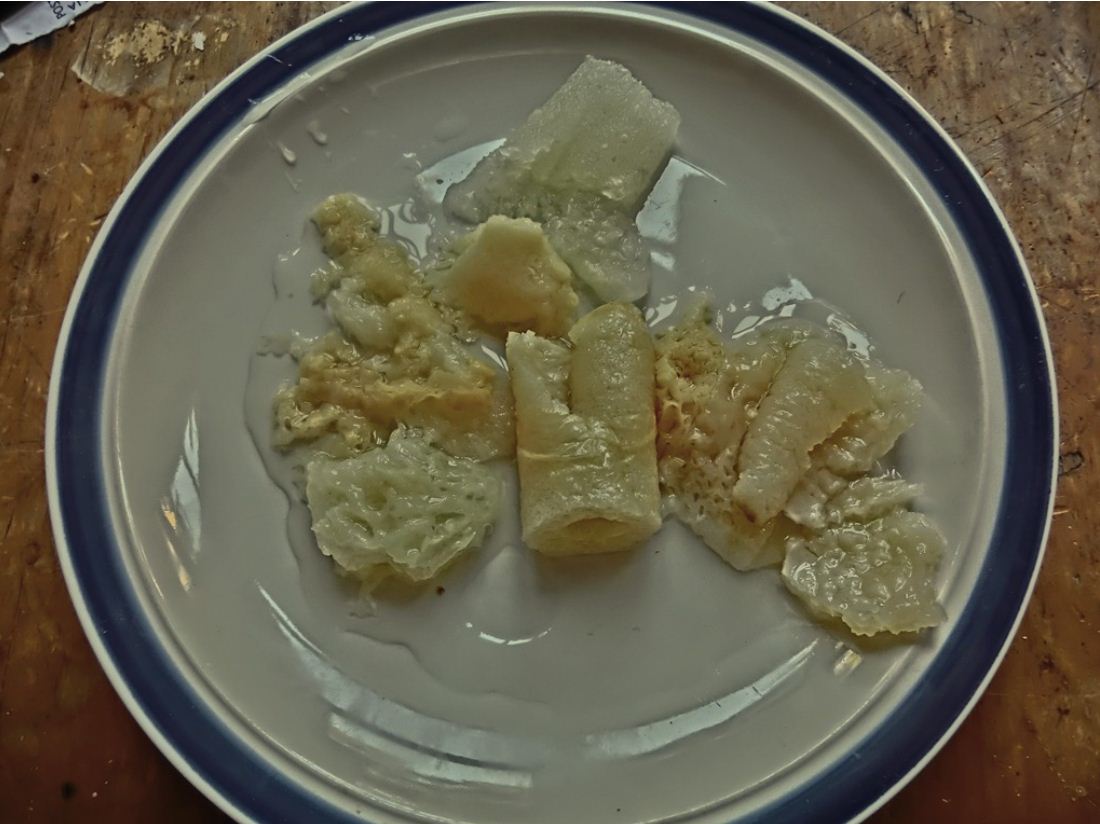
I cut the mushroom into thin slices and poached them in a sugar solution. The resultant pieces were similar to apple which has undergone the same treatment. With enough of these, one could perhaps make a sweet mushroom pie.
23 June 2013
Thus fungus is responsible for an effect known as black fleck in jarrah timber. I have been told by a local tree faller that timber with black fleck does not bend and warp in the same way that normal timber does.
8 July 2021
There are several mentions of this fungus in old records and I will try to list some of these here. The first is a mention by James Drummond in a letter to the Perth Enquirer in May 1842. An extract is shown below.
A decade earlier than this, May 1832, Alexander Collie went on an exploration to the land north of Menang country with a man named Manyat. He wrote;
I did not require Manyat’s services as an interpreter, for I did not meet with any Aboriginal people during the whole of my march of ten days, to the distance of 65 miles from King George’s Sound.[Collie doesn’t mention the direction he went in, but I expect it was to the west of the Stirling Ranges to somewhere in the region of Tambellup
Manyat performed the service of fire starter and carrier. This he did with the barren spikes of the banksia serrata (or mungat), the seeded cones of the banksia grandis, or the bark of the jarrah tree. The first and last require no preparation, but the second is placed in the fire till the outer surface is little burnt, then buried in a hole scraped in the earth with the pointed handle of the knife (taap), or of the axe (koit). The excursion seemed to make him very happy; it certainly supplied him with abundance of food, as he had the same rations as the other people travelling with us and whatever he could obtain through hunting.
The animal kingdom chiefly supplied him with kangaroo rats (wo-ail), bandicoots, possums and crows. One of the bandicoot species found is possibly a new species and has no tail. The vegetable kingdom occasionally furnished light and highly relished morsels in two sorts of fungus totally different from our mushroom or the French truffle. They are species of boletus; the one growing out of trees, of a beautiful crimson colour above. Its Aboriginal name is numar. The other grows out of the ground, of a greyish colour, and globular form: it is named mord. They are both eaten raw, are very juicy, and have a slight flavour of the chestnut.
There are other mentions of Numar in various dictionaries. An example is shown below.
It is interesting to note the spelling in this last case as I was fortunate enough today to speak with George Walley, a Noongar man from Mandurah who not only runs a business showing people about traditional culture (Mandjoogoordap Dreaming) but who was introduced to this mushroom by his grandparents. He advised me that the correct pronunciation is with the ‘u’ pronounced as in the word ‘book’. He also said that as a child he had eaten it cooked on a fire. That is different from what Collie described and shows that it was prepared in different ways.
The image below shows the spores of this species. In this case I used Quink ink as a simple substitute for lactophenol cotton blue as the stain. Seems to have worked ok. I haven’t got a scale for this at this stage. These spores are in-situ within the tissue.
Fistulina spiculifera spores
The spores seem to match the description given by Reid given below. I found the colour of the spore print to be quite bright yellow however.
The pore surface is composed of a series of tubes of circular cross-section. As the fungus ages, the tubes break apart from each other.
Fistulina spiculifera tube surface
July 2024
It has been a very late start to the wet season this year and the mix of fungi has been unusual. One species that seems to have been particularly abundant this year is Fistulina spiculifera. I took this opportunity to take a close-up image of the cap surface of one. It shows the small projections on that are responsible for Reid giving it it’s name. I would like to see a similar image of Fistulina hepatica – from what I can see online it appears to have a similar surface, like the image in this blog for example.
Spicules on surface of Fistulina spiculifera.
June 2025
Looking at images from the the internet, I noticed one posted on Instagram by well known mycological personality Alan Rockefeller. It shows Fistulina americana, newly described in 2022. The image below is clipped from that. It seems to me that the surface has something that might be similar to the ‘spicules’ on the Australian species. These are not mentioned in the paper that describes them. Nor does that paper contain any DNA information on Fistulina spiculifera.
Fistulina ameriana showing possible spicules (image credit Alan Rockefeller)
Fistulina endoxantha from South America appears to have similar protrusions on the pileus as shown in this picture from this publication.
The spores of the Southern hemisphere species all appear to have elliptical spores that are similar to the image above, whereas Fistulina hepatica has ellipsoidal spores with a definite point on the circumference, as shown in the sketch on this page. That site also mentions the species being eaten ‘since early times’ either raw or fried.
A very common sight in lawns in autumn in WA is Lyocoperdon pratense, a small white puffball that grows no more than about 50 mm across. (note: The synonym Vascellum pratense was in vogue when I first wrote this post) If you pick one of these when it is new, the interior is white and is has a mushroom smell. Later on the inside becomes a mass of brown spores that emerge through a hole in the top. The sheer quantity of spores released by these mushrooms is so vast that one can only imagine the success rate of germination and formation of a new colony is extremely small. Investigations of other puffballs support this conclusion.
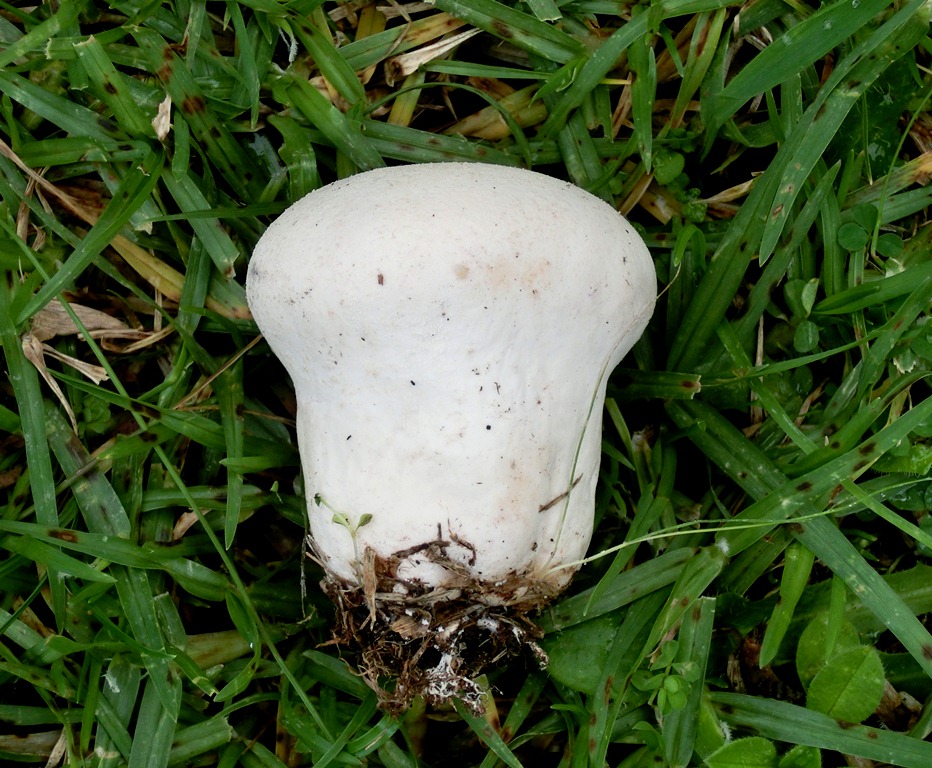
As it is rather difficult to photograph this mushroom in situ, I have taken a few pictures of one that I have picked. Here it is as it has been freshly picked from a lawn:
Lycoperdon pratense as picked
When cut in half, the mushroom shows two distinct zones:
Sectioned specimen of Lycoperdon pratense showing two zones
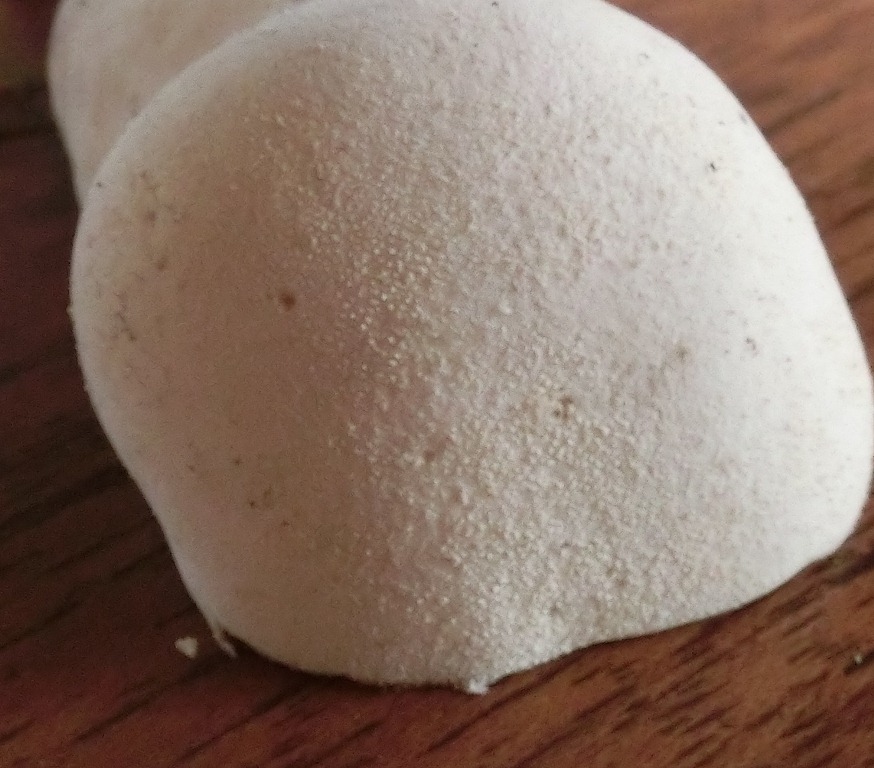
The upper surface has a fine warty texture:
Texture of upper surface of Lycoperdon pratense
Examining a specimen day after picking, the outer surface takes on a slightly gold colour if it is rubbed hard with a finger. The inside flesh also shows a very faint yellow when bruised.
To eat these, it is recommended that they be picked before the top zone begins to turn into a spore mass. In other words, while the flesh is all white. They are not considered to be a particularly desirable edible. I fried some up in oil, where they browned very quickly, and then incorporated them in an omelette. The taste was not unpleasant. There did appear to be an after taste that suggested a flavour enhancing effect.
Comment, May 2016
I think it is important to cook them while they are very fresh. I left some overnight and they softened slightly and the taste took on a slightly bitter edge.
These are quite a distinctive species. The main thing to be careful of is not to confuse them with the genus Scleroderma. There is one suggestion that the skin should be removed prior to cooking. I didn’t do this however.
These can be a problem for greenkeepers when they colonise bowling greens or golf greens. Here is an example of such an invasion on the bowling green at Nannup in May 2016.
Fairy rings of Lycoperdon pratense on the bowling green at Nannup, Western Australia
There are quite a few mushrooms that are classified as stinkhorns. Many of these are said to be edible in the egg stage. Dictyophora indusiata is however edible as the mature mushroom and it is cultivated in significant quantities in China. It is an attractive looking mushroom as shown below.
Dictyophora indusiata, Cairns, Queensland, by Steve Fitzgerald
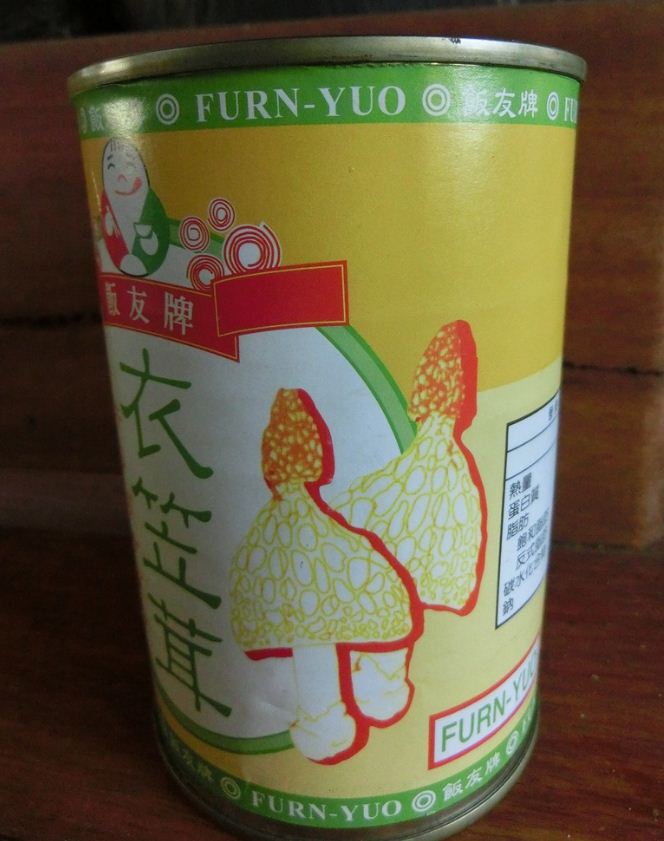
The name refers to the net-like skirt or indusium which is a transient feature, soon falling away to reveal the stem. The mushroom is also known as Phallus indusiatus, for obvious reasons but for the purposes of this post I have retained the earlier name. This is a mushroom of tropical areas. I have not encountered it in the wild personally, though I have seen the very similar Dictyophora multicolor in Cairns. I have however encountered it in canned form in an Asian food shop in Perth.
When opened up, the contents of the can were almost pure white, odourless and contained the entire mushroom, including the cap, cut into pieces, in brine.
Like other stinkhorns, when encountered in the wild, it has a disgusting smell. Rather remarkably, this repulsive smell has been claimed to cause spontaneous female orgasms in the case of a Hawaian species! This bit of nonsense started out as a joke that got out of hand but in any case the canned product does not have any hint of this smell. From what I have been able to determine, the fungus is washed to remove the spore material that contains the odour components.
I cooked up some of the pieces, which contained quite a lot of water, in a frying pan with a little olive oil and then added them to an omelette. I found that the taste was best in the pieces that had been slightly browned. This may be due to the considerable amount of glucose contained in the structure of the cell walls.
I should note that one Chinese site (that is a translation) indicates that species that have a yellow veil (indusium) are toxic. That would include Dictyophora multicolor.
I report this mushroom because it does occur in Australia and it is edible. However, it might be an adventurous person who attempts to eat it. I would be interested if anyone finds this or any of the other stinkhorns, and can let me know if the smell can be removed by washing. Meanwhile, it is readily available in canned form. And if you want a genuine Chinese recipe, you might like to try this one from the site above:
“Casserole in disposable full of water and put it into the old hen, add ginger fluff block a, a teaspoon of cooking wine first and bring to a boil over high heat, low heat slowly stew. 炖鸡时,为了防止汤水溢出,可以在砂锅上架两根竹筷,再盖上锅盖。 Stewed chicken, in order to prevent the soup overflow in the casserole shelves two bamboo chopsticks, then cover the pot. 大约三小时后,鸡汤已经呈现金黄色。 After about three hours, the chicken soup has a golden yellow. 这时可以将已经用水发过的竹荪切段,投入鸡汤中,再炖,等竹荪充分浸润了鸡汤的味道后,根据个人口味加盐,关火,撒一点点葱花增香,就可上桌了。 Then you can the segment of the water has hair Dictyophora cut, put into chicken soup, then boiled, etc. Dictyophora fully infiltrating the taste of chicken soup, according to personal taste with salt, and turn off the heat, sprinkle a little chopped green onion flavoring, can be serve.
【要点】给鸡焯水时不要弄破鸡皮;水发竹荪要多浸泡一会儿,才会去除那股怪味儿,竹荪不要放多,否则会夺鸡汤的鲜味;如果老母鸡肚子里油很多,要挖出来扔掉一点,尤其是在夏天对于喜欢清淡的人来讲。 [Points to the chicken boiled water not to break the chicken skin; The the water hair Dictyophora to soak for a while, before removal of the sense of smell children Dictyophora Do not put too much, otherwise it will seize the flavor of the chicken soup; old hen stomach where oil is a lot to be dug up and threw it away a bit, especially in the summer for people like light.].
–
(I think that was written by the person who did the instructions for my portable router table 🙂
Note 12/10/24
This mushroom is cultivated in China on sugarcane bagasse. One study reports that the mycelium of the fungus interacts with the roots of sugarcane to create what they term ‘white root’ which has a distinctive morphology. They furthermore claim that this assists in retaining nitrogen in the soil and improves crop yield. The fungus is also reported to produce indoleacetic acid, a plant growth stimulant.
Apparently, it is more difficult to cultivate them in Japan, but they are being marketed as a delicacy,
I saw this mushroom for the first time on April 30, 2024 growing in the wild in Kuranda, in North Queensland, so it would seem feasible to set up cultivation there and perhaps similar latitudes. I must say though that the specimens from China seem considerably larger than the one that I saw, shown below, complete with flies. Which reminds me, I didn’t notice any flies around the cultivated ones.
Phallus indusiatus, Kuranda, Queensland, 30 April 2024
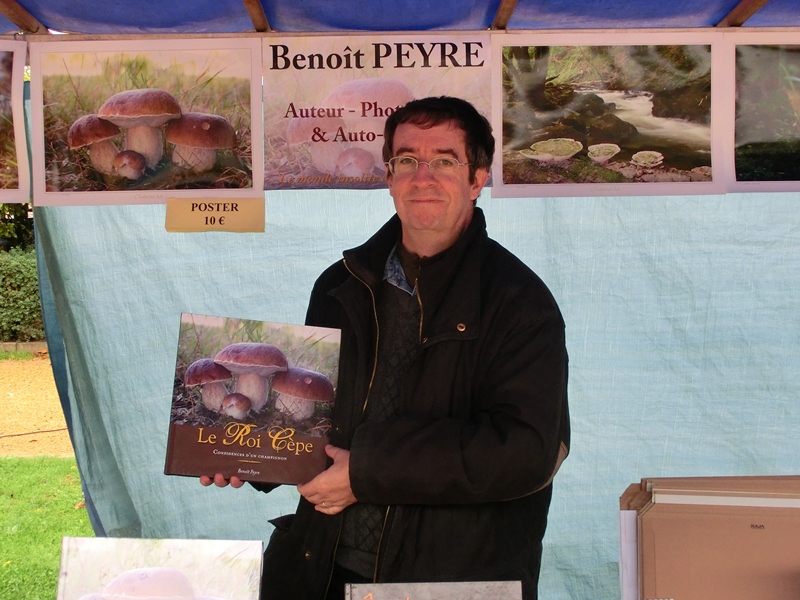
While at the annual mushroom festival at Correze in France, I met a man with a remarkable enthusiasm for mushrooms. He has produced some beautiful books featuring mushrooms, two of which I purchased. One was a book of poems illustrated with mushrooms and the other was a coffee table book describing the work of a variety of artisans who produce mushrooms from various media. He also has a range of images of various sizes featuring mushrooms. A truly remarkable man.
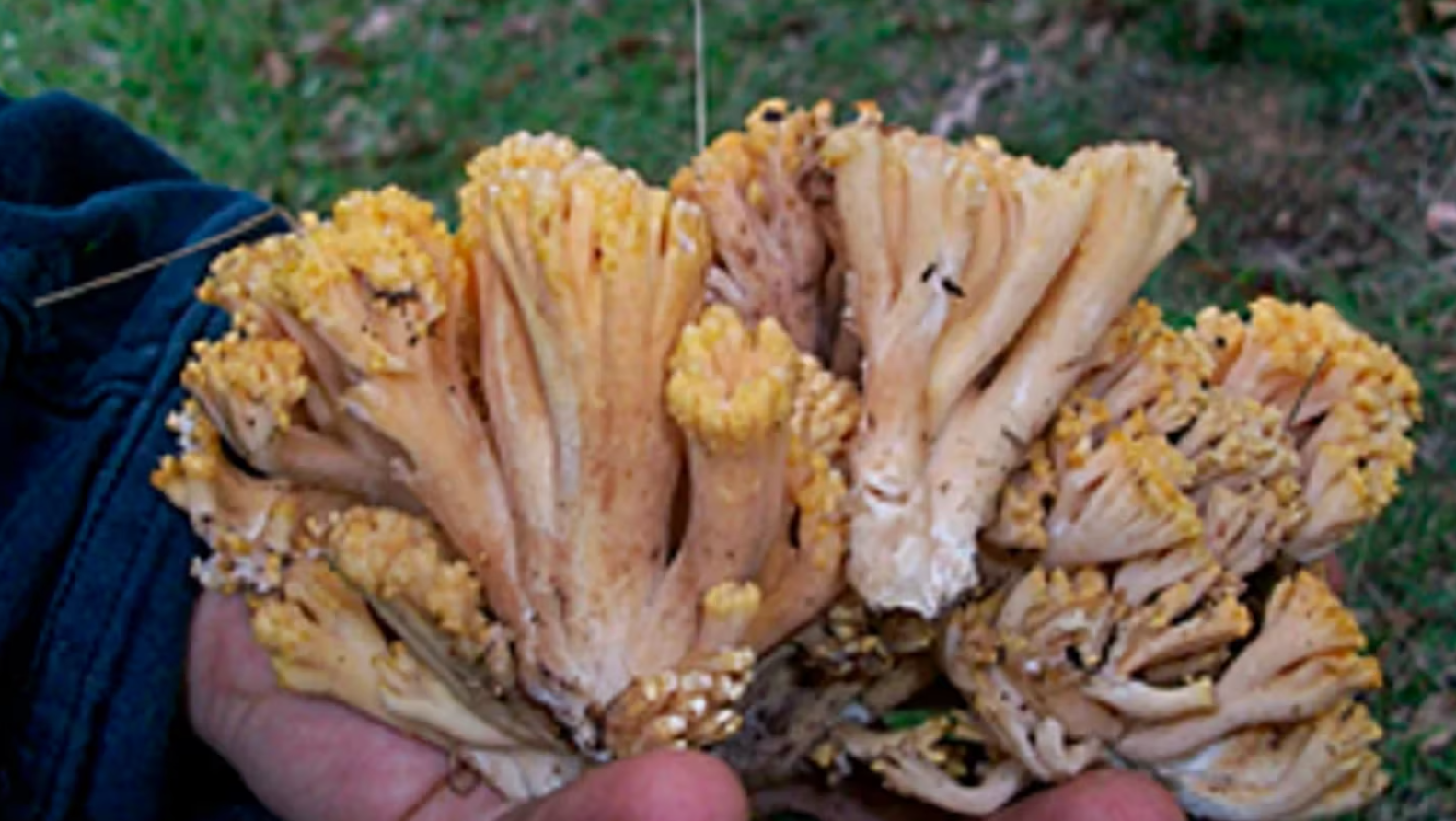
I first became interested in Ramaria ochraceosalmonicolor after the eminent Naturalist J. H. Willis mentioned that he had eaten it in his 1957 publication ‘Victorian Toadstools and Mushrooms’. Ramaria are not easy to identify and any perusal of the internet will find various illustrations with this name but looking nothing like the picture below. There is even a paper in the Australian Journal of Mycology (2007) which goes into much detail about the naming of the species.
For my purposes, however, the important thing was to establish what Willis had eaten. The paper linked above mentions that Willis as well as Bougher and Syme show illustrations of a coralloid structure for this fungus. Though the Bougher and Syme illustration is clear and matches the photograph, I was puzzled by the reference to Willis until I noticed that he had an illustration of three species of Ramaria as a fronticepiece in his book. I had previously overlooked these illustrations. Comparison with his images left me in little doubt that this is the form of Ramaria that he was referring to.
This being the case, I set some aside for a sampling. Ramaria can be risky, with a tendency to cause diahorrea according to Arora, so I decided to set them aside in the fridge and try them in the morning, rather than risk and uncomfortable night.
To be continued….
Ramaria ochraceosalmonicolor
So, I fried up the sample that I had collected and consumed about 2 tablespoons full at 10:30 in the morning. It is now 6:45 in the evening and I have had no reaction. But what an anxious time it has been. After consuming the fungus, I began googling and came up with Ramaria flavo-brunnescens. It grows exclusively under Eucalyptus in Brazil and other places in South America, and has been responsible for the death of cattle. There is a report with gruesome histological details. I am at a loss however to understand why there are not similar reports from Australia, given that there must be many cattle grazed where there are Eucalypts.
In Uruguay it grows in profusion in April, May and June where it causes a disease known as bocopa in sheep, cattle, pigs and horses. The disease has high mortality rates and is increasing in extent.
Ramaria flavo-brunnescens
There is, futhermore, a report of human poisoning and death from this fungus (the same one as in Brazil), although admittedly in combination with an Amanita, from China.
The images from the Brazilian report are disturbingly similar to my image above. Certainly enough to be within the general area, and the reference to Eucalyptus is especially unsettling. The poison is unidentified. It is reported to affect the incorporation of sulphur-containing amino acids such as cysteine. It is also most likely volatile, as toxicity is not present in dried samples.
The books in my library vary in their assessment of this fungus. Willis says he has eaten it. Kevn Griffiths says it upsets some people, Bougher and Syme declare it poisonous.
In the balance, I suggest that this fungus is far too difficult to identify to consider it edible and there is some potential for it to be lethal. Despite my experience of consuming a small portion of a cooked specimen and surviving, I suggest that it be considered an inedible species.
While there is a tantalising morsel about the toxin in google books, the key information is an orphan on an invisible page and I am loathe to spend the $137 necessary to purchase the entire book online. It simply is not worth the bother. The reward is not worth the cost. I post this report so that there is at least some documentation on the internet regarding this genera. I cannot find a single report of the progress of poisoning by this genus in humans on its own available on the internet. Neither do my books on poisonous fungi describe the progression of the syndrome.
30 April 2015
There are more Ramaria out at the moment with a wide variety of colours and forms. It prompted me to have another look for references and I found this one with some images that clearly show the ‘cauliflower’ form that is supposed to be a characteristic of this species. Note however the slight difference in nomenclature.
I haven’t seen any specimens this compact, but I have consumed one of the local species with a local man of Italian descent. I have made a video of him with it that I will process and upload when I have time.
If anyone has a link or relevant experience, I would appreciate hearing about it.
Laccaria proxima is known from both Europe and North America. In my area it is strictly associated with pine plantations. I believe that the pine species is the Maritime Pine, Pinus pinaster. The occurrence of L. proxima is variable, but it appears to be extremely common in well established plantations with trees of a diameter of around 300 mm.
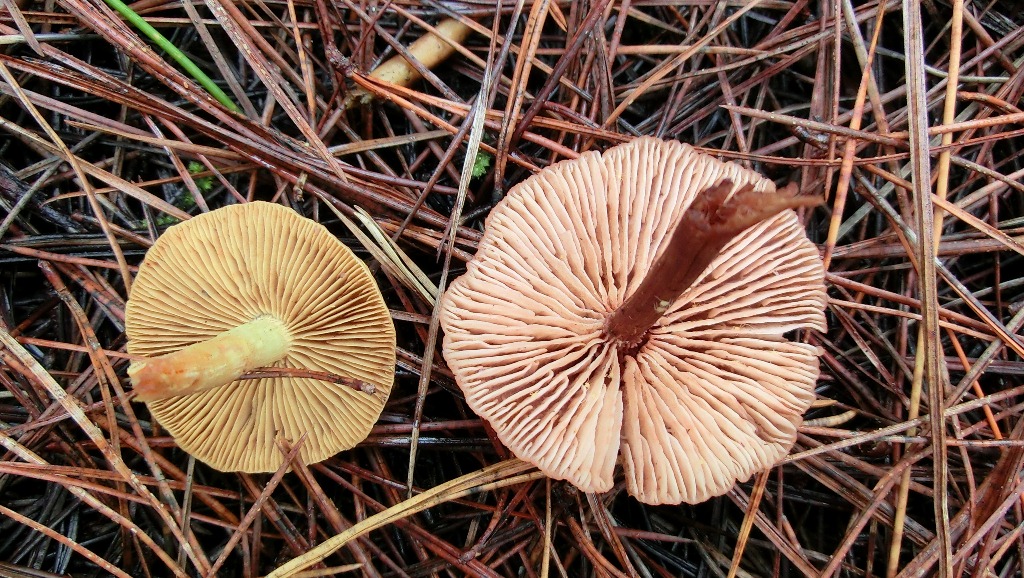
In June in these forests there is a wide variety of fungi, including several small mushrooms with brown caps. Laccaria proxima is distinctive in that it has pale salmon pink gills that are not crowded. This distinguishes it from another abundant species with yellow gills that are crowded as shown below. Laccaria proxima has a white spore print. This should be checked.
Laccaria proxima, with pink gills on the right.
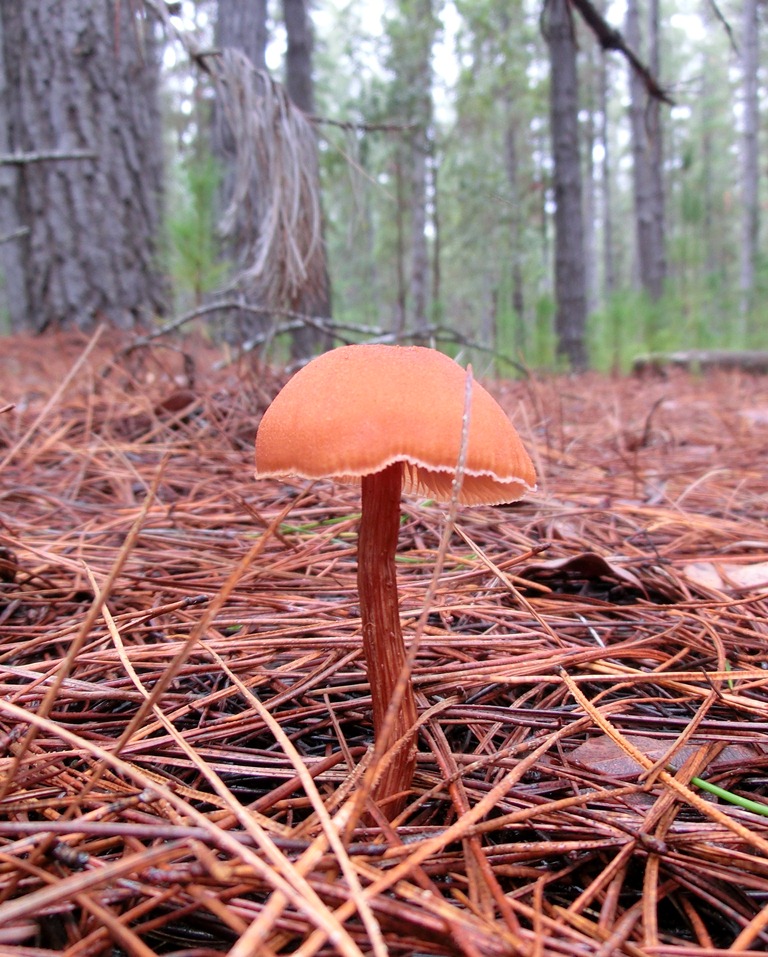
L. proxima varies in size from about 20 mm to 80mm in diameter. The stems can be up to 100mm long and they emerge from the pine needle mat. Underneath the mat, one can see the white mycelium in a layer on the top of the soil. As the mushrooms grow, they move from having slightly inrolled margins to curling up so that the gills are exposed. Below are pictures of the different stages.
A young specimen of Laccaria proxima
Mature specimens of Laccaria proxima
A distinctive feature is the striations on the stem. These stems are quite tough. A small white mite was present on the specimens that I picked in late June. They are a long lasting mushroom that does not suffer gross attack by insects or slugs. In the sandy soils of WA pine plantations, these mushrooms are sometimes contaminated by sand that splashes up as a result of falling raindrops.
I prepared some of these by washing them and then frying in a pan with oil. I had to decant some of the water during cooking as it had caught up in the gills. I added some ham to the mixture in the pan and ate them on toast. The taste resembled Volvariella slightly, though it was not as intense. I found that it left a pleasant after-taste when I had finished the meal and this lingered for some time.
There is a smaller abundant native species, Laccaria lateritia. It is very similar in general appearance, but it is smaller and the stems do not display the same striations as in L. proxima. It is probably edible as well but I have not tried it at this stage. It is interesting that various early documents refer to a red, juicy mushroom being eaten by indigenous people. Laccaria lateritia is possible candidate for this, given it’s abundance, as is some species of Hygrocybe, though they are less abundant these days. There is insufficient information to be able to identify the mushroom in question.
This is an interesting mushroom because of its abundance and well established edibility from overseas experience. Though it is not considered to be a choice edible, it is quite palatable and the pleasant after taste makes it interesting. I suspect that it has a flavour-enhancing quality to it.
11 January 2021
Recent chemical analyses have revealed the presence of a couple of unique alkaloids in this species. These are called proxamidines and the molecules contain and 8-membered ring that includes two nitrogen atoms. One of these is shown in the figure below. The two blue nitrogen atoms can be seen in the structure. The compounds were tested for biological activity but the only thing that was found was a weak herbicidal effect on a cress specimen using a standard technique. It has been suggested that these alkaloids may be responsible for the lack of insect attack that I mentioned above.
Proxamidine
There are another couple of interesting features of Laccaria. The genome of Laccaria bicolor was published in 2007 at which time it was the largest fungal genome yet published at 65 megabases. In an article in Nature, some features of this rather large genome are discussed. One feature that is noted is the coding of multiple genes that give it the ability to utilise nitrogen sources, particularly ammonia. I have read this somewhere else where it was compared with Hebeloma aminophilum in this regard. I have actually tried to test this out by spreading some urea on a patch of pine duff but the only thing that was apparent was a greater than normal amount of Amanita muscaria in that patch.
Yet another feature of Laccaria is that it has been found to be stimulated by electrical impulses so as to produce a greater number of fruiting bodies. This has been found both in field tests and in nursery pots. Many other mushrooms respond to the same treatment, notably Shiitake.
The spores of this species show spikes on the surface and are approximately 8.7 x 6.4 microns. This distinguishes them from the similar Laccaria laccata which has round spores.
Xerula australis has synonyms Xerula radicata var. australis and Oudemansiella radicata var. australis. (ref: Bougher and Syme) There are several closely related species that are difficult to distinguish even with a microscope.
While this species is reported to be edible, it does not find too many rave reviews, although one variety of Xerula radicata is being sold in kit form in China and they describe it as delicious (I suppose they would!).
It has been suggested that they might make a colourful addition to a stir fry. You would need to find a few of them though, as they are only a small mushroom with a cap 20-40 mm across and a tough inedible stem. They have quite a distinctive appearance as shown in this image kindly provided by sunphlo.
An interesting feature of Xerula radicata and most probably this variety is that it contains an anti-hypertensive agent known as oudenone. (who’d have known?) The cultivation of the fungus in liquid medium and extraction of the active ingredient is the subject of US patent 3835170. The information in that patent suggests that the active ingredient is reasonably heat stable and should survive a mild cooking process at least. Whether this is a good thing or not might depend on the individual.
I have set up a new category for fungi that I have not had any personal experience with, or reports of, other than that they are mentioned in the literature as being edible. If anyone has experience with eating these, I would like hear about it.
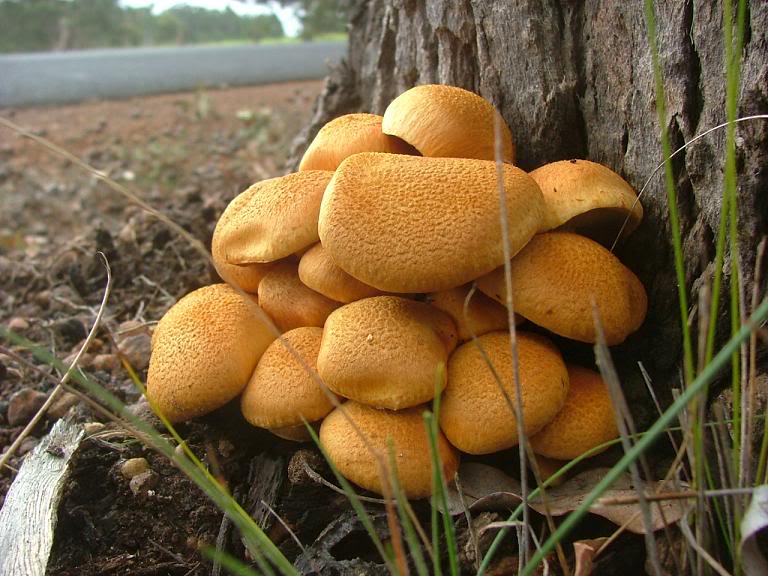
Gymnopilus junonius is also known as Gymnopilus spectabilis according to some sources (Arora p 411 for example) and I am assuming that equivalence in much of the discussion that follows. It is also known and Big Laughing Gym, since there are reports of the species being hallucinogenic. However, it is more likely that it has been confused with another species of the same genus. Either that, or the chemistry varies a lot (and in fact there are sources which suggest such regional variation in the chemistry). Bettye Rees, an Australian authority on the genus, describes it as a cosmopolitan species (6). She does not equate it with G. spectabilis though, but with G. pampeanus.
This fungus is extremely common in Autumn in my part of the world, forming huge clumps on the base of dying trees and old stumps. It occurs widely across the continent and Rees even suggests that it may be an import due to its presence on pine stumps. I have seen it both on pine stumps and at the base of marri trees. Apart from the reports of hallucinogenic activity, the species is not considered to be poisonous. The dominant feature to anyone who tastes this mushroom is its extreme bitterness. It is seriously unpleasant! Nobody with any sense of taste could possibly consume these, even if desperate for some thrill.
A little bit of experimentation however reveals that the unpleasant bitter taste can be removed by washing with vinegar and probably any other food acid. By contrast, sodium bicarbonate does not remove the bitter taste. This simple experiment reveals that the taste is acid soluble.
Given the knowledge gained from this experiment, I prepared some strips of the mushroom, leached them twice with vinegar and then rinsed with water. The result was something that retained some vinegar taste but was free of the horrible bitterness. I consumed a small portion without ill effect, or hallucinations! So, I put this mushroom forward a possible food.
As with everything, one would need to be very sure of identification before proceeding with this. And any experimentation should be undertaken with caution, but I see some possibilities.
Further notes 28 June 2012
My background in chemistry has caused me to become intrigued with this mushroom. I have done some more research and find an amazing array of conflicting statements, first hand experiences and views on chemistry.
The first thing is that this species does appear to have been responsible for various hallucinogenic experiences and reports of this range from traditional Japanese sources (1), to present day forums that discuss these things. It is said that the mushroom is consumed by people in Oguni in Yamagata prefecture, a mountainous area in Japan without ill effect when the bitter components are removed by boiling in water. (2). The fact that the mushroom is mentioned from traditional Japanese stories, as well as the comment that it is eaten today makes the history of Japanese consumption an interesting topic. It may well have been eaten for a thousand years in Japan. Kusano’s comment “Some people have described intoxication as a result of accidental ingestion of incorrectly cooked mushrooms” is an interesting comment, as it would be hard to eat them if the bitterness was not removed.
There are many sources that say this mushroom contains psilocybin, but many more that refute that. I cannot find any reports in peer-reviewed journals of isolation of that chemical from this species. It seems much more likely that the presence of that component has been inferred or simply claimed without due diligence (3) and many others.
Correction 23/02/2013: There is a report of psilocybin in this genus, including G. spectabilis, which is another name for this mushroom. The levels are low though.
Lloydia. 1978 Mar-Apr;41(2):140-4. (just beyond the online numbers). note April 2023 but now available online (12)
–
An example of a report that fails to find psilocybin is:
Stijve and Kuyper (1988) Absence of psilocybin in species of fungi previously reported to contain psilocybin and related tryptamine derivatives. Persoonia 13:463-465
as well as ref(2)
Other literature sources report and discuss the presence of bis noryangonin and compare these to the components of kava to account for the observed activity. This may be the case, but one might expect the resultant experience to be mild. Rees reports the presence of hispidin and bis-noryangonin in many but not all specimens of the genus in Australia. These are responsible for the yellow colour that has allowed the mushroom to be used to dye fabric.
Yet another explanation of the effects of the mushroom attribute it to the bitter principles, gymnopilins, that are said to have neurotoxic effects. (4). I have a copy of this last paper and the striking thing from my point of view is that the components that they examine are ones that are in the acidic fraction, which is the one we would expect to extract with a solution of sodium bicarbonate. We would not expect these to be extracted by vinegar. It brings me to wonder if they have actually proven that they are examining the bitter principle. There is no mention of taste tests. Their initial extraction with methanol may leave a mushroom devoid of bitterness (it does), but they do not report on the bitterness of subsequent fractions. (see below, however comments on bitter principle 3 April 2023)
So, I caution the reader. The chemistry is not well-defined. The source of any psychotropic effects has three explanations, none of which may be correct. For the moment, I can only report my experience which is that the bitter taste can be removed with vinegar and small portions of the resulting mushroom are edible and non-toxic.
Further tests involving boiling and (acid leaching followed by alkaline leaching) are indicated. This may take years. It is a very interesting exploration though.
References to follow.
Further note 24 July 2012
I found a large specimen and cut off a quarter of the cap and boiled it in about a litre of water for 5 minutes. I then removed the piece and rinsed it with cold water. Tasting revealed that the boiling process had indeed removed the bitter taste from the mushroom. Further tasting revealed that the bitter principle had been transferred to the water broth, which had taken on a rusty orange colour.
Perusal of a forum dedicated consumption of psychotropic mushrooms (5) indicates that people consume the bitter ‘tea’ made from the mushrooms to get intoxicated, so that is further support that the leached mushrooms should not cause any ill effects.
August 2015
This year I tried slicing one of these mushrooms thinly and boiling it extensively for an hour. I then fried the resulting pieces. The bitter taste was still there. I can’t really much hope of rendering these things into anything taste-worthy.
May 2016
Even if you can’t eat these, they may be useful in another way. According to the book ‘Mushrooms for color’ by Miriam C. Rice, they can be used with or without mordants to create dyes for fabrics. The fresh mushrooms without mordant give a bright lemon yellow. Dried ones give pale lemon yellow with all mordants except tin which gives mustard. Fresh ones with alum mordant give yellow.
April 2022
Apparently these are widely eaten in South America. I find it hard to imagine but there you go. Based on studies of the ITS region of specimens from Australia, New Zealand, Ecuador and Argentina, by Thorn et al in 2020 (7) the mushrooms are the same in all those places. If I get the chance I would love to taste what they eat in South America. Perhaps there is scope for an export market!
The paper by Thorn et al. also mentions that this mushroom does not occur in North America but that there are several other species. This resolves the issue often mentioned in North America about the species being active on one coast and not the other. They are different species and neither of them is Gymnopilus junonius.
A possible explanation of the whole dilemma is the existence of Gymnopilus orientispectabilis in Japan which may be the original ‘laughing Gym’ and does in fact contain psilocybin like some other members of the genus.
May 2022
Further revelations. Apparently these are the most widely eaten mushroom in Uruguay where they are known as the Eucalyptus mushroom or hongos de eucalypto. They are often used in a sandwich known as a Chivito. This is something of a national dish in Uruguay and there seems to be some variations on the recipe but it is something like a steak sandwich with egg. Mushrooms appear to be optional but the method of preparation is variously described as ‘boiling several times and discarding until the water is clear’ as well as ‘pickling’. So essentially it matches the experiments that I described above. The mushrooms are sold in market stalls for around 80 pesos per kg which equates to around $2.80 AUD. They are also used another dish called Choripan which is a type of hot dog made with chorizo and which is popular in Argentina.
There are pickling recipes available online. This blog has quite a detailed recipe and description of the method as well as some comments on how to select the mushrooms and a long list of comments. No doubt there are some other interesting recipes there. The writer comments that they are not the greatest of mushrooms and the vinegar can be invasive but never the less they can deserve a place at the table.
Experienced picklers will probably be familiar with the second part of this general approach. It is not something that I am familiar with and the reader can explore the details with Google translate but I summarise it below.
First part: It is suggested that the young specimens should be used as they are less bitter. They should be sliced, boiled twice in water for 20 minutes, drained and rinsed and then a third time in water containing vinegar and salt, rinsed and drained.
Second part: Blanch some carrots in boiling salt water. Slice onions and garlic. Boil equal parts of oil and vinegar, add the carrots, onion garlic and mushrooms and take off the heat.
The blog post was published in 2011, before my explorations above so it would appear that they knew about these procedures well before I discovered them independently.
There are also YouTube videos that describe the pickling process. One of them is https://www.youtube.com/watch?v=cCwS86os8qE . It is in Spanish which is a problem for me. It is notable that the mushrooms that appear at the beginning of the video do not match the ones that I am familiar with. They are not as orange and have pale stipes (and he has the clump upside down so that he seems to be washing the dirt into the gills!). The ones that appear later on seem a better match.
Hongos de eucalypti from YouTube video
Another video has useful text overlays that can be easily translated. https://www.youtube.com/watch?v=5E26T0qoess. It shows the mushrooms being harvested. Again, there seems to be some discrepancy in the appearance as the caps appear to be smooth and do not have the typical radial fibril texture that I am familiar with.
Hongos de eucalypti showing smooth cap texture
3 April 2023 – The bitter principle
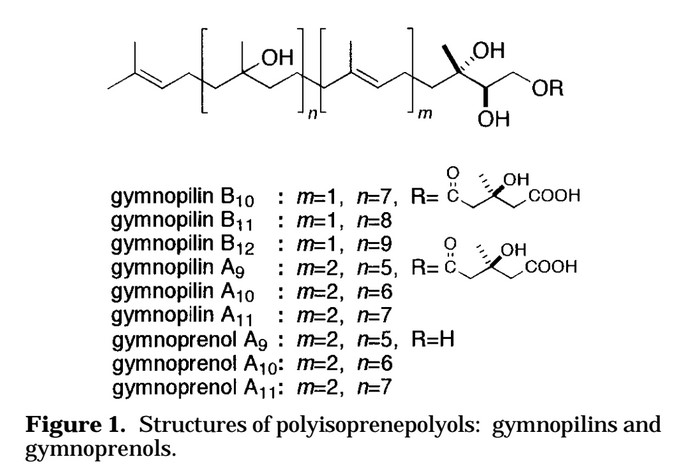
I made a bit more progress with understanding the bitter principle in these mushrooms when I read another paper (8) discussing this type of compound. It explains that gymnopilins are half esters of 3-hydroxy-3-methyl glutaric acid. If this half ester group removed, leaving a free hydroxyl group then one gets gymnoprenol which has no bitterness. The structural relationships are shown in this diagram.
To convert a gymnopilin to a gymnoprenol, the half ester group must be removed. One would expect this to be achieved by acid hydrolysis, as with any other ester. Such hydrolysis is reversible and the reaction does not go to completion.
So, rather than the acid solution removing the bitter component, it is likely that the bitterness is destroyed by hydrolysis. A similar hydrolysis would be expected to occur in the digestive system so that gymnopilins probably do no make it into the stomach in significant quantities.
So, to prepare Gymnopilus junonius without bitterness, a process of multiple acid hydrolysis steps is indicated. This should allow the hydrolysis to be driven close to completion and the bitterness to be defeated. That probably explains why my initial double acid treatment described above worked so well. So, once there are some of these around this season, I will be trying this approach.
In the meantime, I have ordered some pickled mushrooms from Uruguay which I am led to believe are Gymnopilus. I will be most interested to taste these. More to come when they arrive!
Nomenclature in Gymnopilus
The confusion in nomenclature in this genus is summarised succinctly by Lee et al (9) who explain that the species from Japan and Korea with psilocybin is Gymnopilus orientispectabilis and that the names used in earlier papers talking of toxicity and hallucinogenic effects (spectabilis and junonius) were in fact incorrect.
Toxicity of Gymnopilus junonius
Firstly, most of the papers from Japan and Korea talk of Gymnopilus spectabilis being toxic. There is a suggestion in at least one of these papers that there is an equivalence between G. junonius and G. spectabilis. The papers that talk of toxicity in Gymnopilus spectabilis appear to be referring to the hallucinogenic or ‘big laughing’ effects. There are no references in these papers to actual case studies of toxicity. It seems that they are seeking to explain the psychotropic effects in the light of no evidence of psilocybin. In fact this is exactly what one of the papers says(10):
“Although psilocybin was identified as a hallucinogenic substance in the other Gymnopilus species grown in America and Europe (5), psilocybin was not detected in the fruiting body of G. junonius grown in Japan. Therefore, other substances produced in the fruiting body of G. junonius are considered to be hallucinogenic.”
Given that these mushrooms are eaten in significant quantities in South America, and in the light of the mistakes in species identification referred to in the previous paragraph, it is likely that there is in fact no toxicity resulting from the compounds in the mushrooms, particularly if they are treated with the leaching processes described.
An interesting assessment is provided by well known and very experienced Australian mycologist Pam Catcheside. It is as follows (11): “It is toxic, with a bitter taste and, if eaten, can cause severe abdominal cramps and gastric upsets. It also has a similar effect to laughing gas, nitrous oxide so, if consumed, the person who has eaten it may be doubled up in pain but be laughing hilariously. A colleague in England was able to identify the fungus when someone phoned him complaining of stomach pains but was in fits of laughter. This explains its common name, Big Laughing Jim/Gym.“
The problem with this story is that the species containing psilocybin does not occur in England so who knows what the truth is in this account? A quote from well known American mushroom identity Alan Rockefeller, discussing the Thorn paper sheds light on this:
“One striking finding is that Gymnopilus junonius does not occur in North America, and is not psychoactive. It occurs in Europe, Australia and South America, solving the mystery of why European big laughing gyms consistently fail to cause laughter.“
or again, in reference (12)
“According to Heim (15), the European G. spectabilis is not known to be hallucinogenic although its morphologic characters resemble those of the Japanese species on all points. Recently, Gerault (16) reported that a collection of G. spectabilis from France was devoid of psilocybin.”
29 April 2023 Disappointment. The rains finally came and I got some specimens and tried slicing then boiling 3 times in vinegar of varying strength. The bitterness was reduced but it was still there. Worse though was that the taste lingered. I woke up in the middle of the night and could still taste it. I am still waiting for the jars of Uruguay pickle from Argentina.
While I was at it, I made a slide of the spores which I show below.
Gymnopilus junonius spores.
19 May 2023
After a long delay, the pickled mushrooms from Uruguay are on their way. Well actually they are being shipped from Argentina. I was anticipating their delivery earlier this week but now I am informed that they have been held up in Customs for ‘regulatory review’. This shouldn’t really be an issue as they are pickled so they pose no biological threat. I can only imagine that the poor people in Customs will be struggling to comprehend what they are looking at. I feel so helpless as I wait.
25 May 2023
Disappointment. The long awaited jars of pickles have arrived but it turns out that they are Lactarius deliciosus. A nice treat but not what I was hoping for. Back to the drawing board.
8. Sawabe, A., Morita, M., Kiso, T., Kishine, H., Ohtsubo, Y., Ouchi, S., & Okamoto, T. (1999). Structural Analyses of a Precursory Substance of Bitterness: New Polyisoprenepolyols Isolated from an Edible Mushroom (Hypsizigus m armoreus) by Fast Atom Bombardment Mass Spectrometry. Journal of Agricultural and Food Chemistry,47(2), 588-593.
9. Lee, S., Kim, C., Yu, J., Kang, H., Yoo, M., Youn, U., Ryoo, R., Bae, H., & Kim, K. (2021). Ergopyrone, a Styrylpyrone-Fused Steroid with a Hexacyclic 6/5/6/6/6/5 Skeleton from a Mushroom Gymnopilus orientispectabilis. Organic Letters,23(9), 3315-3319.
10. Shunsuke Miyazaki et al. Biomedical Research 33 (2) 111-118, 2012
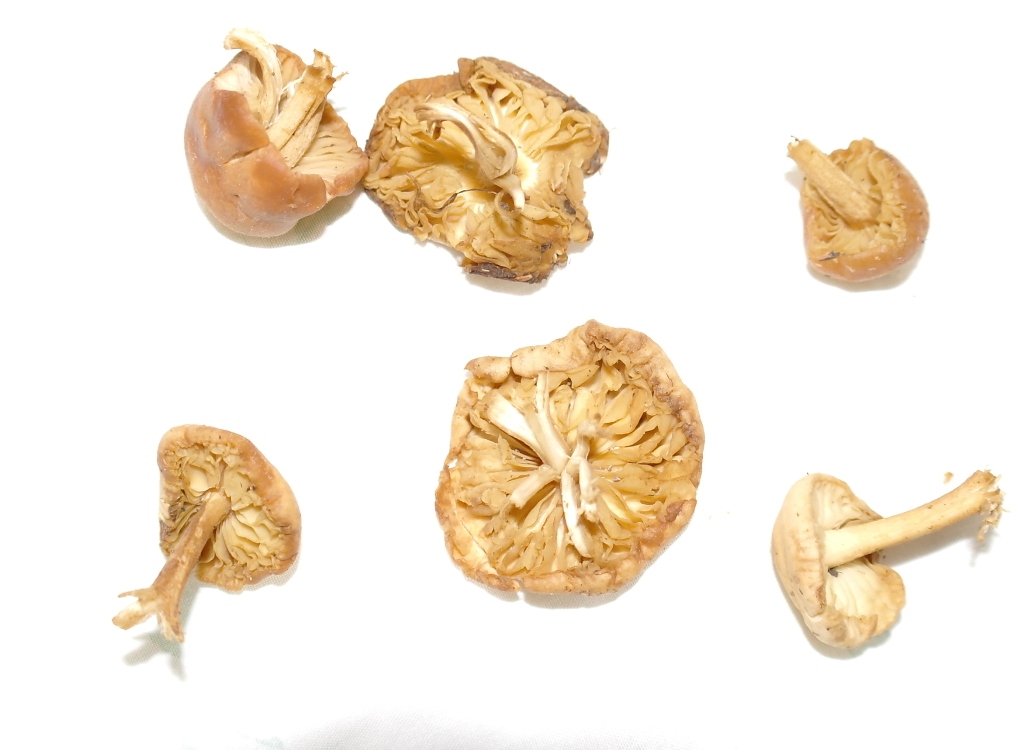
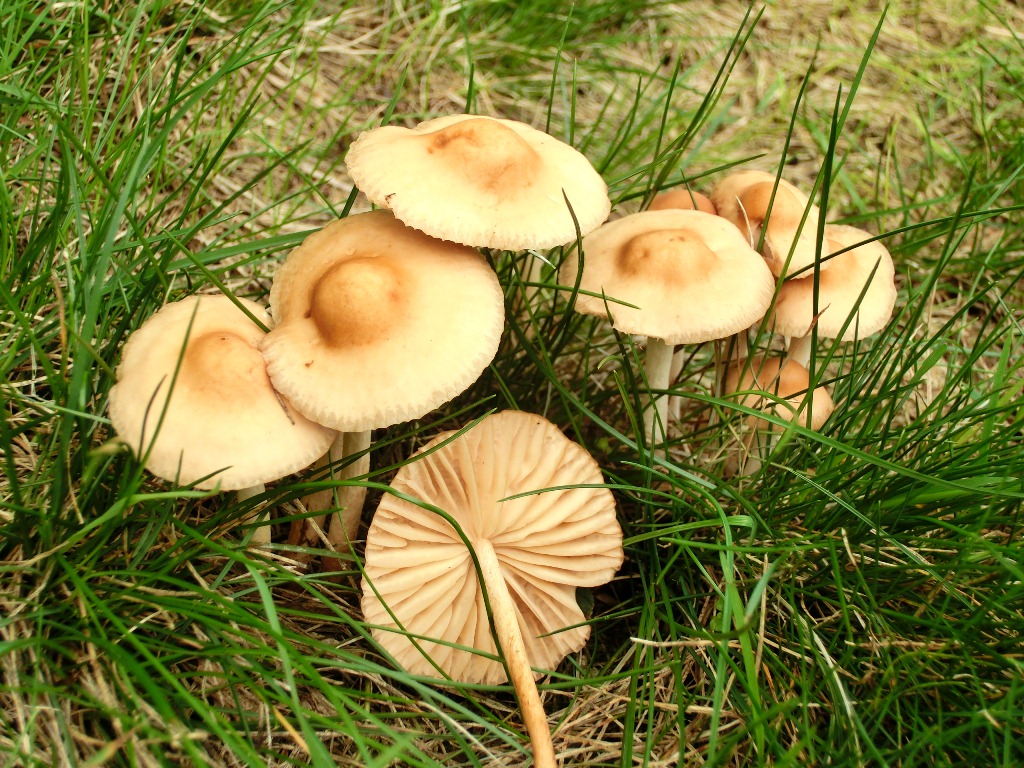
Marasmius oreades is known the world over as the fairy ring mushroom. I have not come upon them in the wild, though they do grow in Australia, having probably been imported from Europe. I came upon them in a market in Perth, where they were being sold for $160 per kilogram, imported from France! The picture below shows what they look like by the time they have been picked, shipped and packed. In France, these are known as Mousserons. Note. October 2012. After investigating further during my trip to France, it appears that Marasmius oreades is known as the Faux Mousseron. Mousseron is applied to Marasmius oreades by English speakers, while the French refer to Calocybe gambosa or St George’s mushroom as mousseron, or mousseron vrai. This muddies the waters somewhat as it is not easy to distinguish the identity of the dried specimens above. The way the stems split and their relative thickness would seem to be contrary to what one would expect from M. oreades. I will pick some in the morning and investigate this further. I will leave the reader to investigate further the identification of these mushrooms. This investigation should be undertaken with care, as there are lots of mushrooms that come up in fairy rings, and some of them are extremely poisonous. Here is a link describing them in Victoria. (I need to find a new link it seems) Update October 2012 Here is a picture of some of these mushrooms growing in France, in the village of Correze, which I am visiting to attend the annual mushroom festival. These are in the lawn of the place where I am staying. I will take one down to the fete tomorrow to have the identification verified.
Marasmius oreades growing in France
A couple of distinctive features of this mushroom are the dark raised central region of the cap, and the toughness of the stem, which can be twisted back on itself without breaking.
Twisted fairy
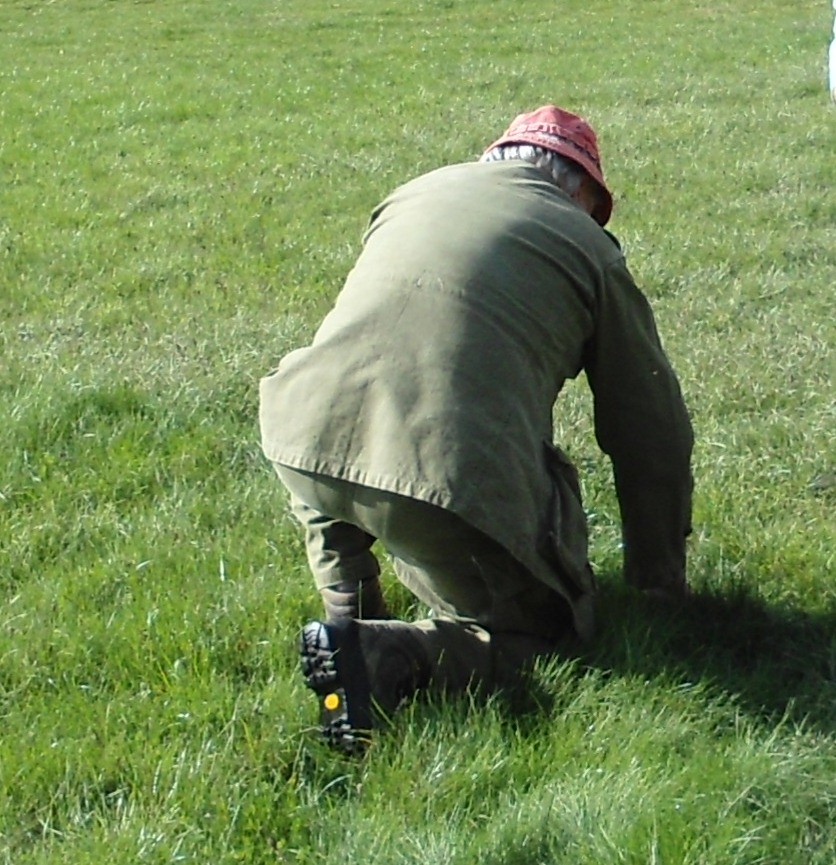
While I was in France, I was invited to visit a farm in the Alpes Maritimes, at an elevation of 1000m. Here I was shown M. oreades growing in classic fairy rings in an open paddock. The rings could be seen quite clearly by their dark green colour in comparison to the surrounding grass. The image below shows my host kneeling down to harvest some mushrooms from one of the rings.
Wood ear mushrooms, Auricularia cornea, are often seen for sale in Asian food shops. The grow quite widely on the east coast – I have seen them around the Lismore area, and they grow in the Cairns area as well as in the Hunter valley, where you can find an excellent description here.
I don’t have an image in my collection, but if someone would be kind enough to donate one, I would be happy to use it and give appropriate credit.
I have not eaten this one, and don’t know how to cook it either, but would be happy to have information on this. Cultures of these mushrooms are available in Australia, via an enthusiast, on the east coast at least.
Update 29 June 2012
I have had a kind offer of use of images from Kathy. Here is one reproduced below.